Syzygy, parts 1 and 2 (plus parts 7-12)
Syzygy
Parts 1 and 2
(With full or partial text or summaries for Parts 3-4 and 7-12; outlines for Parts 5-6.)
A novel and screenplay by Jeffrey R. Charles.
Served at: www.eclipsechaser.com/eclipsemovie
URL: http://www.eclipsechaser.com/eclipsemovie/syzygyd3.htm
Sponsored by
Versacorp
©
Copyright 1994, 1995, 1996, 1997, 1998, 2023, 2025 Jeffrey R. Charles.
All Rights Reserved.
Registered Copyright MCMXCVIII by Jeffrey R. Charles. ALL RIGHTS RESERVED.
This material is protected by Intellectual property laws. Any reproduction or commercial use without the express written and signed consent of Jeffrey R. Charles (and all other contributors, where applicable) is prohibited. Where permission for reproduction is granted, this notice and all credits must be preserved on each copy.
Syzygy Teaser Text: Total solar eclipses have influenced the human experience for millennia. Now, you can experience a multigenerational saga where eclipses play a role in the lives of people from 19th century North America to late 20th century South America. Syzygy is a story of contrasts: From peaceful settings, to converging fates, to the experience of totality, to danger, to people serving others, and to political turmoil. Follow an old west Sheriff and a farmer as they try to keep outlaws from destroying farms; a 20th century eclipse chaser as he travels the world, a Bolivian school director who wants the best for her students, a Bolivian politician who wants to hold others back, and more. Experience the totality of Syzygy. (TM)
Contents:
(As written, it is best to read Syzygy from beginning through Part 4, then jump to Parts 7-12.)
Introduction:
Syzygy is in large part inspired by the total solar eclipse expedition experiences of the author Jeffrey R. Charles [references 6-13], and the experiences of a few South American people he became acquainted with during his 1994 eclipse expedition. Among other things, later parts (chapters 7~12) of Syzygy explore the effects Latin American culture and politics can have on a visitor, particularly in situations where the visitor may become sympathetic to the plight of the country's poor (i.e. people with low income or limited opportunity) after seeing it first hand. Even when a visitor does not actively promote causes of the poor, simple association or identification with them can (through no fault of their own) lead to difficulty which may be imposed by some among an area's privileged, and the unsuspecting traveler or those he meets can be drawn into some degree of political intrigue and socioeconomic conflict.
The story exaggerates the actual experience, but not to an extent beyond what could potentially occur in some areas. (This paragraph was written in 1997, so it may become dated.) One need only recall political imprisonment of some in (circa 1997) Peru to see the extremes of what can actually happen to a person in Latin America. It is important to note that the paranoia and sanctioned oppression exhibited by the (circa 1997) Peruvian government (not necessarily later governments there) are not prevalent in modern day (e.g. circa 1997) Bolivia, which has policies that are far more civilized by comparison. In order to include more action in the story, local demands imposed on the fictional central character (while in Bolivia) do not degrade his health as severely as Mr. Charles' health was degraded on his 1994 expedition.
The Syzygy story begins with a brief fictional account of an eclipse in South America centuries ago, then emphasizes a different eclipse over the central United States during the 19th century. In the 19th-century portion, the way some rural Midwestern people talk is intended to be authentic to the time; thus, antiquated terms such as "Injun" (which has no deprecatory intent in the story) and nonstandard phrases such as "throwed in jail" are used. After this, the story jumps to the 1970's, then works its way up to the present time (1994-1997) and continues from there. Parts 7 through 12 are set in Bolivia.
This paragraph and the two below it added in/after 2023: While in Bolivia, the author met Wilma Alcocer, a person to whom this work has been dedicated from the beginning. In 1994, she was a director at a school for children that include those from indigenous and low income families. From his first day in Bolivia, it was obvious to the author that Wilma Alcocer was very dedicated to the students at the school, and that her work with the poor there was opposed by many wealthy people, political wannabe types, and by some who were associated with actual politicians [25] who had run in previous national elections, and one who later came to power. One of the politicians with whom the men had association later became Vice President of the country.
Over time, it became obvious that, in the grand scheme of things in the real world, Willma's inspirational life and experience was more important than that of the Author. A character based on her was always in the story, but over time, it appeared that she was a real world heroine in many ways. Therefore, her character is described as a heroine in the story, which is closer to who she was. Her character is in Parts 7 through 12; mainly 7, 8, 9, and 12. Sadly, Wilma Alcocer passed away on 22 August 2023, under tragic circumstances allegedly related to one of the same politically-connected people who was problematic for both her and the Author in 1994.
In Syzygy, the author's (Jeffrey R. Charles'; called John and "the Visitor") adventures chasing eclipses serve partly to tie together certain time periods in the story; and total solar eclipses provide a dramatic backdrop for more consequential matters, including the rights of low income and indigenous peoples and the inspirational life of Willma Silvia Alcocer Borda.
Dedications:
- To Willma Silvia Alcocer Borda, a woman of noble character whose faithful service to the to children of Cochabamba Bolivia is an unforgettable inspiration.
- To the members of Astronomia Sigma Octante, who perform sophisticated research with modest material resources.
- To the law abiding indigenous peoples of Bolivia, who show they are noble peoples as they patiently and silently endure the hardships of a class system.
- To the children of Bolivia; most of all to the students of Colegio Buenas Nuevas in Cochabamba. Sadly, a few among Bolivia's privileged presume to exploit educational resources for their own purposes, at the expense of children such as these. May these children grow up in a Bolivia that offers them equal opportunity and privilege.
- Added in 2023: In Memory of Wilma Silvia Alcocer Borda (1943-2023)
And now, the text of Syzygy.
Setting the Stage.
An unusual dusky sunlight covers the bleak, high altitude landscape of the west central part of what had only recently come to be known as South America. A few birds are in flight as they seek the refuge of their nests. It has only been a few hours since sunrise, but the birds respond to the fading light just as they have just before sunst in the past days and months. All is quiet.
In the distance, a group of people have come to notice the changing light. Many eventually seek shelter as they would during a storm or at the end of the day. They know that the present events are unusual: The sun is high overhead, yet the light all around them has dimmed. They do not know what is happening.
Some remember being told by their ancestors that some among their people used to have explanations for unusual events. Before the Spanish came and plundered their civilizations, it was said that some could predict even the times that unusual events would occur. But the Spanish had come more than a generation before, and there was no one left who could predict events in the sky, or even tell them what was happening now.
The sunlight continues to grow dimmer and dimmer. Soon, it dims so quickly that the fading light is obvious to everyone in real time. On one side of the sky, a diffuse darkness appears to descend on everyone. Many become alarmed and there is panic. The sun is going out!
A few dare to stay outside and look up toward the sun. They see a small sliver of sunlight shrink into a small arc of beads. The beads toward each end of the arc progressively dim and go out until only one bead is left, then it too goes out.
But there is still something in the sky where the sun had just been:
A dark, round area is surrounded by a ring of light. The ring of light has bright lines in it which extend out from the dark round area. It is as though a great eye is looking back at them. Some people scream or shout. Some are frozen with fear.
The sun as they knew it is gone!
The view of the ring of light fades to darkness, then:
[Title and Brief Opening Credits Are Shown Overlaid with the Following Scene:]
A star field fills the field of view. Gradually, one point of light near the center becomes brighter than the rest, and it becomes apparent that it is being approached. It soon becomes obvious that the light is blue, then it can be seen that it is a planet with a smaller dark gray sphere in front of it, slightly off center toward the right. As the planet grows larger, the relative size of the gray sphere appears to enlarge and gradually become more centered in front of the blue planet. As the gray sphere becomes centered, it completely covers the planet, then it appears to grow still larger, until it gradually moves off to the left and out of the field of view, again revealing the blue planet. The blue planet continues to appear larger until the view is filled with an area on its top half. The planet is the earth, and all but the extreme upper part of the North American continent fills the field of view. An unusual round dark area having a feathered edge has become visible on the northwestern limb of the planet. It is the shadow of the moon, and it is about to move over a largely unsuspecting population.
The viewpoint shifts to shifts to an aerial view of a man rapidly riding a horse over hilly and grassy terrain. A ground level view shows that he is a middle aged man with graying hair. From his vantage point, the ride over the rolling hills is exhilarating. An aerial viewpoint from behind him shows that the terrain in the distance ahead is relatively flat, and that he is approaching a farm.
Syzygy, Part 1: "An Unusual Day for Pioneer Benton Marfold." August 7, 1869:
The sun has risen over the plains of northeastern Kansas, just as it has for thousands of years. The sky is clear and bright on this summer morning. Many people awaken to begin their day, while others have already been awake for a while.
The date is August 7, 1869. The place is a few miles northeast of the small northeastern Kansas town of Grasshopper Falls. It is a town which later came to be known as Valley Falls. In a few hours, something extraordinary is going to happen.
A quarter million miles above the earth's surface, the moon orbits the earth as it has for millennia. Likewise, earth continues to orbit the sun, just as it also has for millennia. But on this day, an unusual linear alignment, or syzygy, of the sun, moon, and earth will occur.
The moon's orbit is inclined slightly more than 5.1 degrees with respect to the plane of the earth's orbit around the sun. This inclination causes the moon to be north of earth's orbital plane half of the time, and south of earth's orbit half of the time. But twice in each orbit, the moon's orbital plane crosses earth's orbital plane. Most of the time, these orbital plane crossings happen when the sun, earth, and moon are not aligned with each other.
About twice each year, the moon's orbital plane intersects earth's orbital plane when the sun, earth, and moon are within a degree or two of being aligned. Even more rarely, the orbital plane crossing happens when the sun, earth, and moon are aligned to considerably less than one degree. On average, such a near-linear alignment, or syzygy, occurs only about once per year.
When such an orbital plane crossing happens while the earth is between the sun and the moon, a lunar eclipse will occur, but the lunar eclipse will not be total unless the alignment is within about half a degree.
When such an orbital plane crossing happens when the moon is between the sun and the earth, a total solar eclipse (where the moon completely covers the sun) or an annular solar eclipse (where the moon is surrouded by a ring of solar photosphere) will occur somewhere on the earth's surface. The type of solar eclipse depends on the distance between the earth and moon at the time. Locations on earth from which a solar eclipse is visible are determined by the orbital position of the moon, the season, and the rotational position of the earth.
When an observer on earth is located directly line with the sun and the moon, a rare and precise syzygy occurs for that observer. When the moon is sufficiently close to the earth at such a time, a total solar eclipse will coincide with the syzygy.
In a total solar eclipse, a converging frusto-conical shadow, or umbra, extends from the moon's limb (i.e. apparent edge) down to where it intersects the earth's surface. Those within the umbra experience a total solar eclipse. At the earth's surface, the width of the umbra is larger if the moon is closer. Because there is no direct sunlight within the umbra, it darkens the sky during totality, and it usually darkens part of the sky up to a few minutes before and after totality.
The orbits of the earth and moon have been stable for millennia, and the times they are in syzygy with the sun can be predicted. Over many centuries, some civilizations have predicted when a syzygy will occur, including when one will result in total solar eclipse.
On this day in August 1869, the moon will briefly be in syzygy with the sun and Grasshopper Falls, Kansas. And the moon is close enough to the earth that a total solar eclipse will occur.
Life is hard for most people in 19th century Kansas, but for those who take time to observe the total solar eclipse, it will be a once in a lifetime experience. And during this syzygy, the lives of two people will unexpectedly become entwined under the shadow of the moon.
Act 1: Trouble at the Reichart Farm
Cy Pittenrouge, the local sheriff, is riding to the Reichart (pronounced Ritchert) farm, northeast of Nichols' station, to check out a report that a fence had been torn down, presumably by outlaws. Not just ordinary outlaws, but habitual outlaws. Richard's fence is not the only property that was recently damaged. Cy is now only a short distance from the farm.
Richard, his wife Ilene, and several other members of the Reichart family were among the first pioneers to settle in the area. Richard and his wife are now in their 50's, and do not have any children.
Richard is tall and of medium build, has dark graying hair, and a mustache. He tends to talk in a loud and enthusiastic way most of the time, and is locally known for keeping his wagon in tip top shape. He has also preseved a few older wagons in his barn. Ilene has long black hair which shows only slight graying.
As farmer Reichart is repairing the southern part of his fence, Cy can be seen approaching a farm house in the background. Cy arrives at the farm house, dismounts his horse, and Richard's wife, Ilene, comes out to meet him.
Ilene: "Cy Pittenrouge! So good to see you!"
Cy: "Much obliged to see you, Ma'am. How's things with y'all?"
Ilene: "Richard's out a mendin' the fence. Some folk teared some a it up last night."
Cy: "I heard there'd been some orneriness out this way, so I thought I'd ride out an' see if 'twas all so. Housen Lots' place looks somethin' terrible. His barn woulda got burnt clean up if he hadn't seed some feller a settin' the fire an' run 'im off."
Richard walks up and says: "Howdy, sheriff!"
Cy asks: "How ya doin' today, Mr. Reichart?"
Richard responds: "OK I guess. Some of my crops ain't too good though, bein' as a some critter got in here after my fence was all messed up. I kin show ye one place where my fence was teared up over here."
Cy: "Good seein' ya 'gin Misses Reichart."
Richard and Cy walk back toward the fence on the south side of the farm while Ilene goes inside the house. Some of the fence has been torn down on both the south and west parts of the farm, but the western boundary is some distance away.
Outlaws Suspected
Cy asks: "Any idea who mighta' done this?"
Richard responds: "Nope. No idea, but I guess 'ya heard that the railroad wants more a my land. Ya'd think they'd be satisfied. I already let 'em run a track on one side a my property. Whata ya think?"
Cy replies: "I think it has to do with the railroad all right. There's been a lot a property damage along the railroad's proposed spur route ta half mound. Too much damage ta be a coinkerdink, er, a, coincidence, but I don't think the railroad done it."
Richard: "Ya don't?"
Cy: "Nope. 'Cuz the big railroad fellas 'round here seem to be a gittin' along with most folk now. I think some ornery folk acted on their own initiative so they could try and git hired ta do dirty work fer tha railroad. If they kin git enough folk mad at the railroad, more folk might resist them new rail routes they wanna build. That could make the railroad git more likely ta hire troublemakers like them - kinda like how them lawyer varmints git folk a fightin each other back east.
Richard and Cy arrive at one part of the fence Richard had been repairing, which is only a few dozen yards from the railroad tracks.
Cy: Speakin' a ornery folk: Ever hear 'bout Ezra (pronounced Ezry) Hoskins?"
Richard: "Nope. Shore ain't. Think he mighta done this?"
Cy: "Ezra and his kin are ornery fellas outa Plattsburg, Missouri. I hear'd they been a messin' 'round these parts lately. Yep, I think it was Ezra Hoskins, or if it wasn't, it was one a' Ezra Hoskins' boys. They been in a lotta' mischief before, and I been a' wantin' ta see 'em throwed in jail for a long time. Cain't seem ta catch 'em in the act though, otherwise I could git 'em throwed in jail. Y'all oughta take care travelin' alone, seein' as what's happened."
Richard: "Seems ta be harder an harder ta git troublemakers throwed in jail now, with civilization and its bleedin' heart varmints a movin' in 'round us and all."
Cy: "Yep, and its a gonna git worse. Why, I bet that less than a hunert years from now, there'll be a million folks a livin' west of the Mississippi. It'll shore be crowded then. Well, I better be a gittin' back ta Grasshopper Falls. God speed with yer fence."
Richard: "Thanks fer a comin' by sheriff."
There's Talk of an Eclipse
Cy pauses to recall something, then continues the conversation.
Cy: "Oh, I almost fergot. Some folks from outa town tell me there's a gonna be an e-clipse of the sun this afternoon. They say its gonna be differ'nt than any 'clipse we's ever seed before. Somethin' 'bout it bein' total er somethin', whatever that means. Prob'ly nothin' special."
Richard: "Yep. Most a the time they say there's a dog gone e-clipse, things don't look no differ'nt ta me a'tall. The only in'er'stin' one I kin recall was on some mornin' way back in October a '65. Thanks fer a tellin' me about this un though."
Richard puts down his tools and dusts off his pants.
Richard: "If y'all can wait up a spell, I'd like ta ride into town with ya. I could use some more supplies fer my fence."
Cy: "I can wait, but I gotta stop by Benton Marfold's place on the way back. I want to see if his place is OK,"
Richard: "Well, I ain't seen ol' Benton for quite a spell, so I may as well tag along."
Richard grabs his tools, walks over to his horse, puts the tools in the saddle bag, then he and Cy walk the horse a few hundred feet back toward his house. Less than half way back, Richard finds a note attached to an uprooted fence pole.
It reads: "Be back fer yer barn an yer crops today. Don't try an stop us."
Richard reads the note and looks concerned.
Richard: (as he hands the note to Cy) "Hadn't seed this before. Whata ya reckon they's a gonna try?"
Cy looks pensively at the note and slowly and slightly shakes his head side to side.
Cy: "I've seen this sorta thing before. It's Ezra Hoskins and his boys all right. They may try an' burn y'all out, and with the drought we've had, no fire would stay put on just one farm. That's the trouble with ornery types: They're too unsophisticated to think about problems their actions will cause in the long run."
Richard: "So what's there to be done?"
Cy: "Nothin' for now, bein' as they may try an' shoot anyone who interferes with 'em. I can try an' round up enough folks in town to watch yer land today. This is the first time the Hoskins boys ever told anyone 'bout what time and place they were plannin' ta cause trouble. They prob'ly won't be back fer a spell though, bein as they prob'ly know I'd be a checkin' things out this mornin'."
Cy and Richard reach the farm house and Richard goes inside and takes off his hat. Ilene greets him. He shows her the note that had been attached to one of the fence posts and tells her to keep an eye out for troublemakers. He kisses his her, grabs his hat, goes outside and mounts his horse.
Act 2: Visiting Benton Marfold
Cy and Richard ride away to Benton Marfold's place, a couple of miles closer to town. Benton is in his 30's, unmarried, and has lived in the area for more than 10 years. They ride part of the way over low, rolling, grassy hills, and the rest of the way on a trail that runs between farms. Finally, they arrive at Benton's place in a little less than 15 minutes. They dismount and tie their horses, then knock on Benton's door. Benton answers the door.
Benton: "Well, howdy! Good to see ya, Sheriff, and you too Richard. It's been a spell. C'mown in!"
Cy: "Howdy."
Richard, Cy, and Benton greet, shake hands, go inside, and sit down.
Benton: "Word from Housen Lot has it that there's been some property damage recently. Any luck trackin' down the culprits?"
Cy: "A lot more places been messed up than I first thought. Richard's fence was messed up last night, and Housen Lot's place was really tore up somethin' fierce.
Benton (surprised): "Housen Lot's place again, last night? What he told me of happened a few days ago."
Cy: "Yip. No luck finding the culprits. But bein' as they left a note at Richard's place, I think I know who they is."
Benton: "Who?"
Cy: "Well, it was either Ezra Hoskins or some of Ezra Hoskins' boys. Ever hear of 'em?"
Benton: "Only by reputation. Whenever somethin' ornery happens, I often hear people say it musta been Ezra Hoskins or one of Ezra Hoskins' boys. If he and his boys cause so much trouble, why ain't they been throwed in jail?"
Cy: "Gotta catch 'em in the act or have witnesses, and nobody ever seems ta see nothin'."
Benton: "Glad to see that you mighta figgered out who done it. Some folk been a blamin' the Delaware Indian folk a livin' near me, but I haven't seen 'em cause any trouble 'tall. I have a lot a contact with 'em, being a tutor and all."
Richard: "You tutor Injuns? I thought most of 'em didn't like our ways?"
Benton: "Yes, I tutor them, and while the Kaw and Delaware peoples want to maintain their traditions, many of them also want to learn about more things. What they don't want is to have their families pulled apart like what happens when the government sends their children off somewhere that they'll be forced into at least the appearance of rejecting their traditions. Most of the Delaware were forced into Indian Territory south of Kansas two years ago, even though many were learning our ways. Some want the Kaw throwed out too, so they can git the land. You see, many of their traditions can coexist with education. It is just that some back east seem to think Indian traditions are a threat to their agendas."
Richard (slightly baffled): "That's a mighty differ'nt kinda view."
Cy: (Interrupting) "I wouldn't sell them Injuns too short. You know that e-clipse I was tellin' you about? Nearly six months ago, some of them Injuns said there was a gonna be an eclipse today. They didn't say the date, but they said it would be at the time of the new moon this month. But no one 'cept Benton here paid 'em no mind. No white folk ever said nothin' 'bout it till last week."
Benton: "That's right. Before then, we never heard anything about it from any other white folk, but for several days now, a whole passel of scientists from the east have been travelin' through town. Some of 'em mentioned today's eclipse. They say it'll be total somewhere around these parts, but other than sayin' it's goin' to get dark, they won't say much 'bout what to expect from it. They also don't seem to agree about where the eclipse will be total. Some say north of town, some say right in town, but none of 'em will be specific. Not a very friendly sort, either. When we try to find out more, they act we're all a bunch of idiots."
This Eclipse Will Be Different
Cy: "You mean today's eclipse really will be differ'nt than the tothers?"
Benton: "Oh yes. During most eclipses, the sun is only partly covered by the moon. Sometimes you can't even tell that there is an eclipse because such a small amount if the sun is covered. But today, if you are in the right area, the moon will cover the entire sun, and it'll get dark right smack in the middle of the day!"
Cy: "How long will it last?"
Benton: "A little more than two hours after noon today, the eclipse will start like all the others. It should get total an hour or so after that. It will only be total for a few minutes. That's when it will get dark."
Richard: "That darkness could really surprise a lot of people, 'specially the Injuns!"
Benton: "Yes, it prob'ly will. Unfortunately, there's no way to inform everybody 'bout it in time. As for the Indians, they did not know today's eclipse would be total until I told them, but some of their traditional stories do tell about what ta 'spect during what I assume is the dark part of an eclipse. That is where I learned most of what I know. Many underestimate the knowledge of the Indian people: Why, did you know that, in another part of the world, some well known foreign explorer once tried to use his knowledge of a lunar eclipse to scare a tribe of people into obeying him? And when he approached the chief to tell him that the moon would "turn to blood", the chief calmly replied: "Oh, do you mean the eclipse?""
Cy: "So what do these Injun stories say 'bout today's eclipse?"
Benton: "Traditional stories say that animals behave as though the sun is setting. They also tell about a glow that is visible around the moon during the eclipse. Some say that the eclipsed sun looks like the eye of a great spirit."
Cy: "What does that mean?"
Benton: "Translated to our viewpoint, it means it looks like the eye of God."
Cy: "Sounds inter'stin'. You mean to say that the Indians looked at the eclipse? It hurts to look at the sun, and I hear it ain't safe to look at it!"
Benton: "Since it gets dark during a total eclipse, it must not hurt to look at the sun when it is completely eclipsed; however, some traditional Indian stories do tell of people going blind after eclipses. I guess that this may be from people looking at the sun when it is partially eclipsed, since I have heard of people around these parts having problems with their sight after a partial eclipse. Some traditional stories also say that a pregnant woman can miscarry her baby if she is outside during an eclipse."
Richard: (Joking) "Could be from all the excitement if the sun gets so dark you can look at it!"
Benton: "The eclipse should be something worth seeing, and there may be more to see than just the darkening of the sun. Some traditional stories tell of a growing dark storm and strange colors that surround everyone, but I don't know what these mean. Shore should be interestin', though. I'm lookin' forward to seein' it!"
Cy: "Got me all inter'sted! I'll have ta take time ta see it today!"
Richard: "Got me all fired up too!"
Benton: "Be careful that you only look toward the sun when it is totally eclipsed."
Richard: "How will we know just when that is?"
Benton: "Not sure how to tell exactly when it starts bein' total, but I 'spect you'll prob'ly just know. It makes sense that it should be 'bout when it looks dark on the ground around you."
A Plan to Catch the Outlaws
Cy: "Well, I better git to why I'm here. I wanted to know if you had any property damage recently, or if you or any folk you know gitted any threats."
Benton: "No, I haven't, but then, my property is not near the proposed rail line. I have head that there may be some trouble brewin' 'twixt some folk and the railroad."
Cy: "I cain't imagine the railroad bein' behind it in this day and age, even if they do want the land. The Half Mound spur's a pretty low priority for em now, but I'm a gittin' concerned 'bout all this 'cause a what happened at Housen Lots' place, an' acause Richard here just got a threat sayin' his place 'll git wiped out today. My guess is the Hoskins boys may be a plannin' to burn him out, so Im goin' ta town an' round up some folk, a posse of sorts, ta hep try an' stop 'em. I reckon they'd usually try an burn crops in the heat of the day, but bein' as there won't be as much sun as usual today because of the e-clipse, its hard tellin' what'll happen."
Benton: "They would start a fire in this drought? No fire could be confined to just one farm."
Cy: "No one ever accused outlaws of bein' smart or thinkin' ahead."
Benton: "And they warned you 'bout causin' this trouble ahead of time?"
Cy: "Yep."
Benton: "Hmm... Sounds like those Hoskins boys really aren't too bright."
Cy: "Yep, I'd say that."
Benton: "Think they know about today's eclipse?"
Cy: "You know, I'd say not. Even if they'd been told 'bout it, they probably wouldn't believe it. Ezra tends to believe what he wants, whether it's right or not. Don't confuse 'eem with the facts, his mind is made up."
Benton (after a pause): "The heat of the day... Sounds like they're a goin' to act in the afternoon, maybe about the same time as the e-clipse... Perhaps we could use the eclipse to thwart their plans, maybe even catch 'em."
Cy: "How?"
Benton: "Oh, I was just thinkin' out loud, but maybe it is worth considering." (Benton pauses and thinks for a few seconds.) "We know that it is going to get dark during the eclipse. And they probably don't know that. If we can find 'em with things they'd use to start a fire, we could move on 'em during eclipse if there's still enough light to see 'em."
Cy: "Sounds like it may be worth trying. Whata you have in mind?"
Benton: "(Benton looks contemplative) Well, I'll have to think about it."
Cy: "It shore would be nice if I could git them Hoskins boys throwed in jail."
Benton: "What if... we tell the folks you bring out to Richard's farm ta look for anyone they don't know who is carrying torches or lanterns, especially if they are on a horse. If you deputize some folk, then any of them who sees other folk a messin' around with fire 'round Richard's farm could stop 'em, and you could ask 'em questions. If we find 'em during the eclipse, we could wait till when the sunlight comes back after the eclipse ta talk to 'em. We can tell your folk it'll get dark during the eclipse, so they'll know what to expect. Even if the Hoskins boys don't show, we can all git a nice view of the e-clipse."
Cy: "Sounds like a good idea to me. Well, I better be a gittin' ta town.
Everyone gets up and walks outside.
A Posse and a Ride Into Town
Cy: I should be back out to Richard's farm with a posse in three hours or so. Nice seein' ya again, Benton."
Benton: "Likewise, Sheriff."
Richard says to Benton: "Ya kin come own by my farm today if ya like. Ilene's been a wantin' to have some folks by for quite a spell."
Benton: "Be glad to."
Richard says to Cy: "Sheriff, if ya don't mind, I think I'll ride with Benton out to my place."
Cy: "That's fine. That way, Benton won't have to ride out there alone. I kin git some fence wire fer ye whilst I's in town."
Richard: "Why thank ya Sheriff!"
Richard gives Cy a few coins and his second set of saddlebags, then he and Cy position the saddlebags on Cy's horse. Cy then mounts his horse and rides off to town while Richard and Benton prepare to ride out to Richard's farm. Benton goes inside, grabs a small extendable telescope, a canteen, and his saddle. Then he saddles and mounts his horse and both he and Richard ride out toward the Reichart farm.
As they begin their ride, Richard looks mildly distracted and temporarily rides at a walking pace so he and Benton can talk.
Richard: "I hope Cy kin find the right fence wire."
Benton: "They have lots of fence wire in town."
Richard: "Yip, I know. But, did you hear 'bout the big K-feed store?"
Benton: "Only hear folk talk 'bout it. Never been."
Richard: "If he goes there, like lot a folk do, he may not find good fence wire."
Benton: "How come?"
Richard: "K-feed was a good store in its beginnin' a few years back, see. But after some smaller stores went under, K-feed went downhill."
Benton: "In what way?"
Richard: "They cut down on se-lection. They used to have lot a things, see. But now, they ain't got no se-lection 'tall. The last few times, they didn't have nothin' I needed. I went there with money in my pocket. But they didn't have nothin' I needed. So I left; with money still in my pocket, and mad!"
After this brief conversation, Richard and Benton begin to ride at a faster pace to the farm.
Ezra Hoskins and His Boys
Meanwhile, Ezra Hoskins, his son Edward, and several of his gang are preparing to ride out and cause more trouble. Ezra gives orders and rallies his gang by blaming their problems on various people in the area. About an hour after this, the last few of his boys mount up and the gang rides out at a fast gallop.
Act 3: A Gathering at the Reichart Farm
Richard and Benton soon arrive at the farm, go in the house and greet Ilene. Then they tell her about the eclipse, and that Cy and the posse will be stopping by in a couple of hours.
Ilene (somewhat excitedly) "Oh Lordy! First the fence an' now the sun! It's a shapin' up ta be a right inter'stin' day ain't it?"
Benton: "Yep, shore is."
The Solar Eclipse Begins
After a while, Richard brings a few chairs outside in preparation for the people Cy will be bringing from town. An hour or so after this, the partial phase of the eclipse begins, but no one notices.
A little over half an hour later, Cy arrives with ten men from town. Most of them dismount their horses and greet Richard, Ilene, and Benton. After some conversation, some of the men position themselves around the farm buildings. By now, some folks notice the dimming ambient light, and many make comments to each other about it.
Cy says to Richard: "I reckon them ornery varmints 'll prob'ly come from the east er the west an foller a line 'twixt east a here an Housen Lots' place."
Richard: "I don't like the thought a seein' them varmints, 'tall, but I'd shore feel better 'bout seein' 'em comin' while the posse's here than at some other time."
Meanwhile, Ezra Hoskins and his boys ride past a farm which is a few miles northwest of Richard's farm. His boys are getting nervous about the changing light because they don't know what is causing it. The air is slightly cooler, and some say they want to leave because a storm must be brewing. Though he does not know what is causing the dimming light, Ezra reacts to this by pointing out that there are no significant clouds in the sky, then he begins verbally brow beating them for their failure to notice this.
As Ezra starts his tirade, one of his boys says under his breath: "Here he goes again; o'l fire mouth". As Ezra gets more abusive, he says "Y'all chicken livers may as well just go on an' git if ye cain't take it." At this, the group separates from Ezra and Edward and rides away. Something about the dimming light has made them uneasy.
At Richard's farm, the posse continues to keep a look out. Ilene brings water to some of the men. One man quickly glances at the sun. It is too bright to look at directly, but he can tell that it has become a wide crescent shape.
The sunlight has now been growing steadily dimmer for almost an hour. Birds have begun to fly back to their nests and it appears as though it is near evening, but the sun is still high in the blue sky overhead.
Under the leafy trees, crescent shapes of light can be seen projected on the ground. Some gather around one of the trees to look at the crescents, which appear to dance on the ground whenever the tree is disturbed by a mild gust of wind. A gentle and sustained breeze soon begins to blow in from the south.
The sky near the west-northwestern horizon is gradually beginning to darken, but only the few people watching the west side of the farm notice it. They are not concerned about it, but they do look puzzled and ask each other if they know what it is. No one does.
Ezra and Edward, are now riding slightly less than a mile west-northwest of Richard's farm. Ezra is in front and carrying a torch, still muttering to himself under his breath about the boys that left. Edward follows with a lantern. They stop near the southeast corner of a field and look around, then they dismount their horses, cut the fence wire, and splash kerosene over a small part of the field. Ezra suddenly looks surprised and disappointed as he watches Edward take his lantern and throw it into the field, breaking it and starting a fire.
The fire rapidly spreads over the area doused with kerosene, but from there, it spreads very slowly and makes relatively little smoke. Fields usually do not burn easily in northeastern Kansas, but the drought has changed this situation.
Ezra slowly shakes his head from side to side, then he whacks Edward on the head with his hat and verbally brow beats him for throwing away his lantern. They mount their horses and ride toward Richard's farm, staying hidden behind the left side of a low rolling hill to their east. Ezra is upset about the slow progress of the fire and brow beats Edward for supposedly failing to douse the field more thoroughly. As they get closer to the hill, they turn south and move along one side of it.
Darkening in the Northwestern Sky
Back at the farm, darkening low in the west through northwestern sky still is not particularly obvious, but it is enough to make the smoke from the distant fire almost invisible; however, the contrast between the western sky and the foreground do make it easier to pick out bright or moving objects near the horizon.
One of the men spots a point of light moving unevenly along the western horizon. He suspects it could be Ezra Hoskins or possibly one of his boys, and tells the others near him about it. The men pass the word and keep an eye on the light. It soon disappears behind the right side of the nearby low hill. Two of the men casually mount their horses but do not ride out.
Ezra and Edward are riding south just beyond a low rolling hill to the west of Richard's farm. Edward has begun feeling uneasy about the dimming sunlight. He happens to look to the west and sees the deepening darkness. The west-northwestern sky is substantially darker than it had been only a minute or two before, with the darkest area extending almost all the way from the west to the northwest. This causes him even more uneasiness.
Edward: (in a quivering voice) "P-Pa..."
Ezra does not respond, so after a pause, Edward speaks again: "Pa, I really think ya oughta..."
Ezra (interrupting) "Oh, shuddup Edward!"
Edward: "But ya gotta see this, Pa. It's somethin'... I'm ascared."
Ezra: (while turning toward the west to talk to Edward, who is behind him) "Oh, what!..."
Ezra is stopped in mid sentence by the sight of the growing darkness in the west though northwestern sky. His eyes get wide, he stops his horse, and his mouth drops open in amazement and fear. After a short pause, he yells "gityup" while turning his horse to the east and dropping his torch. The torch falls on a barren patch of ground and does not start a fire. Edward yells: "Wait fer me Pa." and also turns his horse to the east. In near panic, they ride fast, not suspecting that they are riding straight toward the waiting posse at Richard's farm.
A few members of the posse hear the sound of running horses, so the other men on the west side of the farm begin to mount their horses. A few seconds later, Ezra and Edward crest the hill, still riding straight for the posse. The fence around that part of the farm still has not been repaired, so there is nothing to impede their frantic ride toward the east. Then, some of the posse quickly ride out toward them, meeting and calming them, after which they detain them.
Edward asks: "What is... th-tha-at?" while pointing to the west.
"Must have somethin' to do with that e-clipse I guess" said one of the posse.
Edward: "What 'clipse?"
The Posse seats the Hoskins boys on some chairs and ties them up, telling them they will only be tied to the chairs until the eclipse is over.
Benton Marfold had overheard Edward's question and looks toward the west, where he sees the deepening darkness. To Benton, the growing darkness is obvious but not particularly ominous. It looks like the dark blue color that sometimes appears under an approaching thunderstorm, except there are no storm clouds over it. It is like the darkness under a storm, but without the storm. He looks contemplative and thinks to himself: "So this is the dark storm."
Rapidly Dimming Daylight and a Gigantic Shadow
The sun is now more than 90 percent covered, and it appears to be a bright crescent shape. After the brief excitement of capturing Ezra Hoskins and his boy, everyone has grown quiet from amazement at the changing character of the surroundings.
They have all gradually realized that the sunlight is becoming dimmer, and everything around them appears to be grayish, as though it was a dreary winter day. By contrast, there is an unusual harshness to the edge of shadows. The sky is getting even darker in an increasingly larger area on the west to northwestern horizon. The darkness is expanding considerably toward the north, but only slightly toward the south. The change is gradual, so few people notice.
Soon, a whistle is heard from a train approaching from the east. It is over an hour behind schedule, which is unusual.
The train is running slightly faster than usual because it had started out late from Atchison, having been chartered earlier that morning to take a group of scientists to an eclipse site west of town. There are relatively few passengers on the train, but most have noticed the unusual lighting outside, and some of them begin to get agitated. The engineer has also noticed the dimming and changing light, but realizes that it is still a little brighter than it normally would be at sunset.
The engineer looks out the north side window to see more of the unusual lighting, then he leans out and looks toward the front, and is astonished at the sight. On the horizon in front of him and slightly toward his right, a large area of the sky has taken on a dark blue pall. He has seen this deep blue color before. It is like the darkness under a severe late afternoon storm, but a closer look reveals that there are only a few thin clouds in the sky. He continues looking at it until a minor noise inside the cab of the engine catches his attention.
The train continues westward toward the now ominously darkening sky. After tending to the engine, the engineer again looks out the north window. He is even more astonished than before. To the north, the few clouds near the horizon have become a pale yellow color, much like the sky color often appears to be just before sunset!
A Train Stops for a Shadow
The engineer looks at the color toward the north in amazement, then again looks toward the west. His eyes get large at the sight of the approaching and growing darkness, which is now becoming quite large. The darkness covers most of the area between the southwest and the north, but it does not go all the way down to the horizon at its extreme but diffuse edges. The yellow color is strongest below these edges, and some of the yellow color is now giving way to an orange hue. He begins to become nervous about what may be ahead of the train, so he starts to slow the train. It comes to a stop just short of the area where most people are gathered at Richard's farm.
The engineer gets out of the engine while looking at the shadowed northwestern sky, with his mouth agape in astonishment. The conductor steps off the train to meet him, at which time he tells the conductor that the train will remain stopped until they can see the tracks better, or otherwise determine if the tracks ahead are clear. Even though they had transported several scientists earlier in the day, no one had told either of them that the sunlight or the sky would get this dark. And it was still getting darker.
Passengers begin emerging from both sides of the train, and when they see the darkness in the sky, some of them slowly walk toward it, partly so they can see the area obstructed by the engine. As they go, most look at the sky in wide eyed amazement. The darkness now extends almost all the way from the southwest to the north, with the highest point being about 25 degrees above the west-northwestern horizon. A few people briefly glance toward the sun, but it is still too harsh to look at. A few people can tell that the upper left edge of the darkness in the sky appears to be getting more diffuse, while also slowly moving toward the sun.
Some of the people at Richard's farm look at a low rolling hill to the west and notice that wheat growing on it seems to be a more intense golden yellow color than usual against the deep blue western sky. The whole field even seems to be shimmering, almost like it's on fire. Others look across the railroad tracks to the south and notice the same effect, but without as much of the apparent yellow color. In amazement, some of them walk toward the southern field to have a closer look. Two even run. Most of the fence in that area is still down, so it does not interfere.
Some people also notice that the ground around them appears to be covered with aimlessly wandering bands of subtle shadows. Soon, the shadows become more orderly, as though moving in nearly parallel waves. Benton stops about 50 feet short of the tracks to take it all in. In a few seconds, shimmering on the southern field becomes far less distinguishable and soon stops.
The increasing darkness is no longer confined to the southwestern through northern horizon. It is growing; wider and wider, higher and higher into the western to northern sky. The darkness now begins to extend clear around from the south and toward the right, almost all the way to the northeast, though it is not dark all the way down to the horizon toward either side.
Yellow and orange color soon begin to appear under more of the increasingly diffuse edges of the darkness. At this point, dim yellow and orange color begins to become visible even under the deepest part of the darkness in the northwest. Now, the darkness does not extend all the way down to the horizon in any direction. And the sunset colors increasingly wrap around most of the horizon.
Overhead, there is only a tiny sliver of bright light where the sun used to be, and it is accompanied by a ghostly curved line that extends far enough from its cusps to barely form a complete ring. The outside of the ring is feathered, but the inside is sharply defined, revealing the complete outline of the moon. The ambient light is now nearly 100 times dimmer than normal.
Toward the west, the rapidly growing darkness now covers a quarter of the entire sky! Yellow and orange color begins to be more pronounced on the horizon between the southwest and the north, where the diffuse bottom edge of the growing darkness appears to be closer to the ground. Then, parts of the yellow-orange glow on the horizon below the darkness begin to give way to a thin and pale reddish orange glow. Other parts of this area take on a more saturated orange to vermilion color.
The light level begins to fall rapidly, getting dimmer and dimmer as the approaching darkness seems to completely cover the sky. They are being engulfed!
The Sun Goes Out!
Suddenly, all of the direct sunlight disappears! Some people begin to scream, and someone yells: "Look at the Sun!"
Everyone looks up toward the sun. Some gasp, others scream, and still others silently stare in amazement.
Overhead, where the sun used to be, they see a dark disk surrounded by a softly glowing ring of pearly white light, which is the solar corona. There is still a very short arc of bright light remaining on the left side of the dark disk, and this arc quickly shortens and randomly breaks into small points, then the remaining points of bright light go out. All glare from where the sun used to be is gone.
A dimmer pink arc of light remains, but it too shortens and all of it except a few dimmer spots on it disappear. Though the people do not know it, the pink arc is the solar chromosphere, and the remaining spots of pink light are solar prominences, some of which are larger than the earth!
As everyone's eyes adjust to the dimmer light, the glowing ring of light around the dark gray disk of the moon appears to be wider and brighter than it had only a few seconds before. It is unlike anything they have ever seen before:
The ring of light has a radius about as broad as the diameter of the dark disc, but there are many delicate bright lines and fan like plumes extending from it. Wide and long streamers are visible on each side of the disk, with one on either side extending to at least an additional disk diameter beyond the outside of the ring of light. This is the solar corona. Additional small areas of bright pink light are visible around the edge of the dark disc. These are more solar prominences.
A few stars are now visible overhead. A really bright starlike object is visible about 25 degrees to the upper left of the eclipsed sun. A dimmer one only is 5 degrees to the right. All is quiet, and everyone stands in awe. One person notes that the eclipse has an appearance reminiscent of an eye.
It is now dark enough that details on the ground are just barely visible, and the entire horizon is ablaze with the yellow, orange, and even red colors of a sunset! The color above the horizon is most intense between the west and north, and least intense between the east and the south. The lower eastern to southern sky is brighter than any other area. The ambient light intensity is similar to what it would usually be about half an hour after sunset.
Some motion above the southeastern horizon catches the eye of a few people. They look to see the moderate brightness remaining in the eastern through southern sky steadily retreating toward the horizon, as though it is being covered up by a great shadow! The upper part of the sky and the dark disk are both a dark grayish blue. Nothing is completely black.
Eyes Meet Under the Eclipse
Mariana Doyle had been on her way to visit people in the area, including her sister in Grasshopper Falls. She had exited the north side of the stopped train and rushed to a point well beyond the front of the locomotive. But now, she was slowly walking backwards as she beheld the eclipsed sun in amazement. She is overwhelmed.
As she continued moving backward, she bumped into Benton Marfold. She turned to see whom she had bumped into, and she and Benton's eyes met under the dim, eerie light of the eclipse. At that moment, she and Benton felt as though they had known each other for a very long time. Neither of them ever looked back at the eclipse.
Syzygy, Part 2: "A Modern Day Moonshadow Encounter." February 26, 1979:
Act 4: 110 Years Later, in 1979:
The viewpoint again shifts to the eclipsed sun.
[Image of 1979 Total Solar Eclipse]
[Caption Text low in eclipse image frame:]
110 Years Later
[Change to Second Caption low in eclipse image frame:]
Grassrange, Montana, 1979
The date is now February 26, 1979. The place is near Grassrange, [24] Montana, on a slightly elevated site about two miles south of town. Three members of the Charles family, distant descendants of Benton Marfold, have traveled from Colorado to Montana to see today's brief total solar eclipse.
Their eclipse site is one of the few off-road areas which has been plowed free of the half meter of remaining Montana snow pack, so there are dozens of other people, including two busloads of school kids, at the site with them. Everyone is silent and in awe. John and his brother Dan are taking pictures of the eclipse with separate cameras.
The view of the eclipse zooms out and pans toward the left and slightly downward, becoming a wide angle view having the eclipse toward the upper right. The horizon near the bottom of the frame is about 20 degrees below the eclipse. The sky in front of the moon and around the solar corona is dark gray, with only a slight hint of blue.
However, the sky is not this dark all the way down to the horizon. Instead, the lower edge of the darker sky is defined by a feathered and slightly curved line that defines the boundary of the lunar umbra. The umbra boundary is almost touching the horizon directly below the eclipse, but it curves and angles up toward the left, reaching almost as high in the sky as the eclipse toward the extreme left of the scene.
Soon, the view widens enough more to show people in the foreground. As John is operating his cameras, he looks toward the east and northeast. There, he sees the lower boundary of the dark gray lunar shadow, or umbra, as it smoothly moves over the sky. He comments that he can see the east through northeastern part of the lunar umbra boundary move across the sky in real time!
The view returns to the scene that shows the eclipse toward the upper right, then the view slightly zooms in and pans down toward the left enough that the eclipse is no longer in the frame. The horizon remains about the same distance from the bottom of the frame. The highest edge of the umbra (which is toward the left) is then about three quarters of the way to the top of the zoomed-in frame, and the umbra boundary is still slowly but smoothly descending, with the highest part moving fastest.
The northeastward boundary of the umbra is now about 15 degrees above the horizon at its highest point. Amazingly, the lower boundary of the umbra, appears to "eat up" the brighter blue sky below it as it goes. At the same time, the color of the remaining brighter blue part of the sky begins to lose saturation and slowly shift toward yellow. He stops taking pictures and looks with interest, then awe.
Color toward the right side of the diminishing area of brighter sky under the umbra soon becomes almost entirely yellow, with a slight amount pale orange toward the east-southeast, near the extreme right side of the scene. The yellow color soon spreads leftward toward the center of the scene and beyond. A large area within the yellow color soon develops faint and diffuse vertical lines, creating the false impression that it is lightly "raining" color. At the same time, the pale orange color begins to intensify and a slight amount of red appears within it.
In one area, he can see distant white sunlit clouds through the yellow and orange color in the sky! They look harshly lit and bright. As the eastward edge of the umbra gets lower, its boundary crosses below the highest of the sunlit clouds, then the cloud can be seen right through the dark umbra. Where the umbra boundary is lower in the east-southeast (toward the right of the frame), faint red color clings to a large area of the boundary, and seems to move along with it.
All of this is a fascinating sight! He had not expected to see anything like this! Until then, he did even know such a sight was possible. Although he does not say anything outwardly, he is thinking: "Wow!... I mean, WOW!! Aye aye aye! Cool! Awesome! ...WOW!". There are not words to describe it. He is so taken in by the amazing sight that it does not occur to him to take a picture of it!
John eventually pulls himself away from looking at the umbra and resumes taking photos of the solar corona through his telephoto lens. (He later makes a drawing of the umbra with the colors below it. A drawing does not do it justice, but is better than nothing: Click here to see the Author's wide angle (170 degree) composite photo and drawing of the 1979 umbra.)
The Sun Returns
The sky soon begins brightening in the west. The solar corona is still visible around the moon, but the right side of the moon's dark disk has become ablaze with a bright arc of pink light, far brighter than the pearly white corona. The pink arc quickly lengthens until it wraps around about 60 degrees of the dark disk.
Suddenly, an incredibly bright white light pierces the middle of the pink arc. It quickly grows so bright that no one can see the corona any more. High cirrus clouds scatter the bright glare of the emerging sun, shortening the duration of the "diamond ring" effect. The total phase of the eclipse had lasted only two and a half minutes.
Many people at the site begin to applaud as though they had just seen a good play at a football game. The clouds had obscured most of the outer corona, but the eclipse had still been a magnificent experience.
John walks over to his a camera with a fisheye lens and takes a couple of shots toward the east. The whole sky quickly brightens except for a large dark area near the northeastern horizon and the light intensity on the ground begins to increase rapidly. John photographs the darkness remaining in the northeast, which quickly disappears. Soon, even though a good part of the sun is still eclipsed, the ambient light level seems normal again.
All marvel at this strange and exciting experience, then many wonder: When and where will this happen again? They have witnessed the greatest celestial light show on earth; a total eclipse of the sun. The darkness covering the sky was the shadow of the moon, and the ring of light was the corona, the sun's atmosphere.
The moon covered the sun, yet everyone saw the sun in a way they had never seen it before!
Dan says to his father Roy and his brother John: "Wow! If Benton Marfold could only see this!"
John: "Yeah, being as he met our great, great, grandmother during the only total eclipse he had a shot at."
Roy: "Under the circumstances, I'm sure he didn't mind missing part of the eclipse."
John: "She must a distracted 'im from the eclipse. Girls must have a way of eclipsing even eclipses! Hard to imagine now though. This is sock knocking off stuff!"
Dan: "Yeah."
Roy: "And Benton also helped catch Ezra Hoskins and his boys the same day."
Dan: "Amazin' ain't it."
Roy, John, and Dan observe the ever widening crescent sun through filters, then John begins to pack most of his equipment and put it in the car. John comments about how the high clouds may have acted as a rear projection screen for the lunar umbra, adding that the umbra and the color above the eastern horizon were more impressive than he could have imagined.
Dan mentions that he had not seen the shadow during totality, but that he had seen it just before totality. He also said that the extent of the corona had not been as much as he expected, adding that the thin clouds must have obscured some of it.
John comments that it would be nice to see another eclipse but that he thought most future eclipses would occur far from the U.S. He added that the next affordable one would not be until 1991, adding that it would be nice to see an eclipse under completely clear skies.
After a while, the partial phase of the eclipse is almost over. A strong, cold, wind suddenly comes down from the north. Dan takes a final picture of the sun and everyone battles the wind to finish loading the car. After a last look around, all three get in the car and drive off.
On the way back to Colorado, John begins drawing what he remembered of his encounter with the lunar umbra.
After a little less than three hours, they are still in Montana, and arrive at the Custer Battlefield National Monument. (It would not be named the Little Bighorn Battlefield National Monument until 1991.) There were almost no other visitors, possibly because it was cold and the ground was covered in thick snow.
But while they were still at the entrance, John's friend Louis Lubeski; Carl Morris from the camera store; and Norman Duecker, the driver - all from his former hometown of Estes Park, Colorado, were leaving. Meeting them while hundreds of miles from their home state was a pleasant coincidence. John had a brief chat with Lou before Lou's group left for Colorado. Lou said that his party had gone to a location well east of Grassrange, and that thin clouds had not hampered their view of the corona during totality.
John's father Roy drove into the Monument's parking area, then he, John, and Dan all went into the visitor center. A large painted mural of the battle was visible as soon as they went through the doorway. They observed the exhibits and John photographed some of them. Afterward, they went outdoors to see the inscribed granite obelisk that honored the fallen soldiers and looked at other nearby parts of the battlefield. A wrought iron fence enclosed an area having markers for where Custer and others fell.
While standing on the walkway near the obelisk, John mentally pictured the circumstances of the battle as it was described in the Monument's visitor center, literature, and on outdoor plaques. After photographing more of the area, the family resumed their return trip to Colorado.
The Eclipse Bug
In the remaining daylight entering the car, John looks through some of his astronomy literature as a Gordon Lightfoot tape is playing the song "It's Worth Belivin'" from the album "Old Dan's Records".
He comments that Mazatlan may be a good site for the 1991 eclipse because the clear western horizon would offer a good view of the approaching lunar shadow. Everyone had been impressed by the 1979 eclipse experience. It was clear that the eclipse bug had bitten again!
That night, they stayed in Casper, Wyoming and watched the eclipse again on the TV news. It was exciting to see, but somehow, it just wasn't the same as seeing it in person. Not even close.
After returning home, John had his pictures developed. He later compared his wide angle terrestrial photos with his exposure notes, and was able to come up with a light curve for the eclipse. The pictures of the lunar umbra he had taken with his 16 mm fisheye lens were better than he had expected, particularly in the case of two shots he had taken just after totality.
At the 1979 total solar eclipse, he had witnessed the impressive motion of the moon's umbral boundary across the sky. This was the most impressive part of the eclipse for him, because it was all around him. It was much more than a mere sight; it was an experience! For him, it was far more impressive than the corona, though his impression of the corona may have been very different if it had not been observed through thin clouds. He wanted to experience more total eclipses.
At future eclipses, he wanted to be sure he photographed any umbra related phenomena that were similar to what he had seen in Montana. Better yet, he wanted to be able to predict where these phenomena would occur so he could plan to observe and photograph it in advance. The duration of totality is too short for a lot of spontaneous camera pointing. Unfortunately, he did not have any idea how to predict where (or if) colorful umbra related phenomena would occur, and he could not find any new material on the subject. Even if he had found more material, he did not know if he'd blindly trust it. The umbra had looked far different than any description of the umbra he had read. In addition, his photos had shown that the umbra would have been visible well in advance of the one minute before totality that material he'd read had mentioned.
It was possible that the umbral effects he observed were the exception rather than the rule, but since he saw the phenomena once, similar phenomena were bound to occur at at least some future eclipses. And if dramatic effects were going to happen, he wanted to see and photograph them! He wondered if observation of umbral effects during totality may have been neglected by most eclipse chasers due to the obvious appeal of the solar corona. Indeed, it turned out that no one else he talked to at the eclipse site had seen the umbral effects at all; most of them were looking exclusively at the corona! John knew that he may have only seen the umbra because he happened to be walking northeast toward his cameras during the early seconds of totality. He had not PLANNED to look for the umbral boundary during totality, but he was certainly glad he saw it!
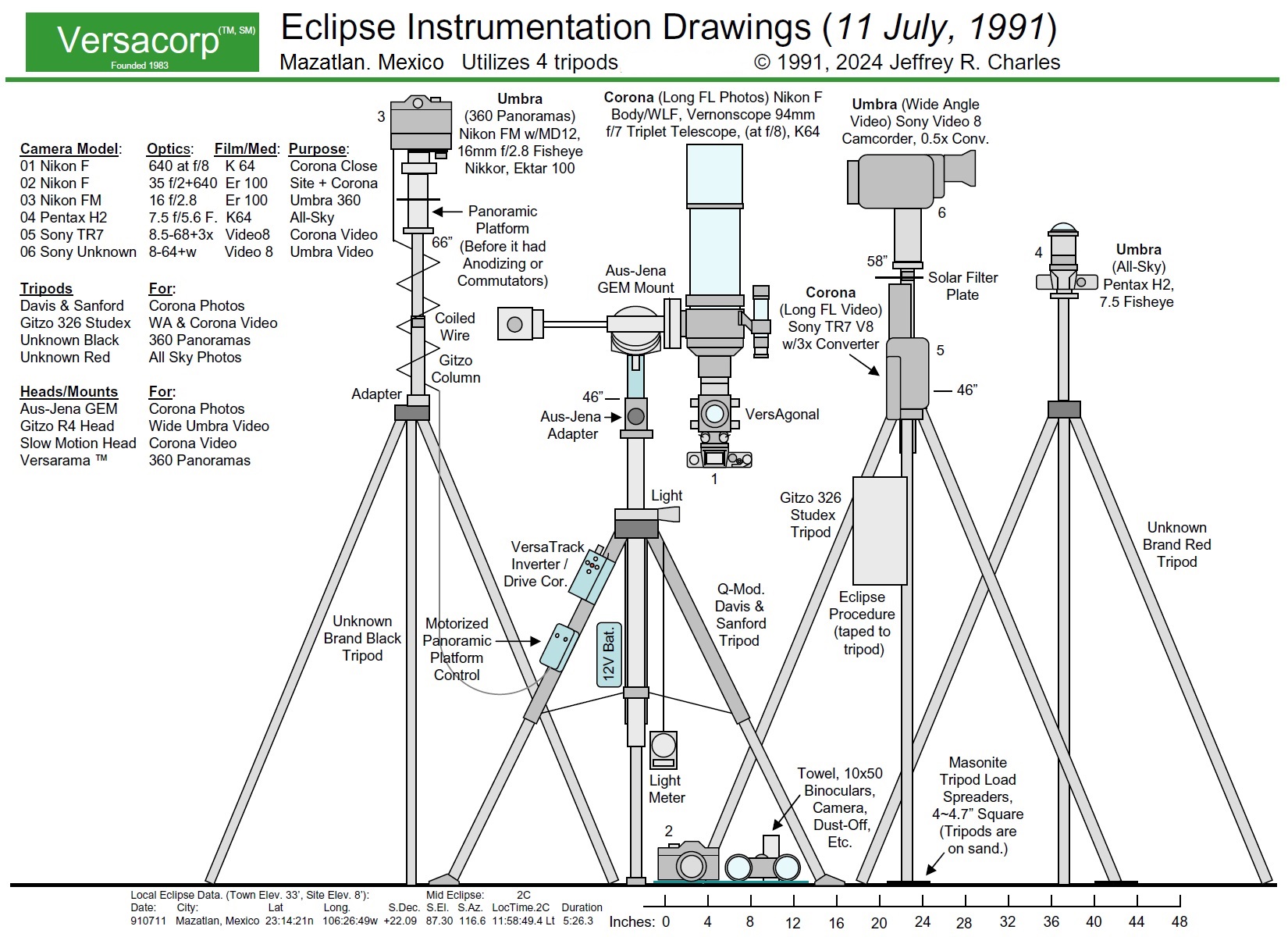
He decided to take several 360 degree panoramas at the next eclipse he observed. This would be the best way to be sure that all of the visible phenomena were photographed. In order to select potential eclipses sites with optimum conditions for panoramic umbra photos, he plotted several future eclipse paths from data in the book "Canon of Solar Eclipses". Weather conditions were important too, but weather data for a given path of totality likely would not be published until a year or two before each eclipse. He wanted to see the next eclipse in a clear sky. This would provide a better view of the solar corona, as well as making it possible to determine if dramatic umbral effects would be visible in a clear sky.
It was not going to be easy to prepare for planned eclipse observations, photography, and related data acquisition. It would require equipment that was not readily available, and that may not be cheap. Also, it had become painfully obvious that the equipment he'd used for the 1979 eclipse was not appropriate for another eclipse:
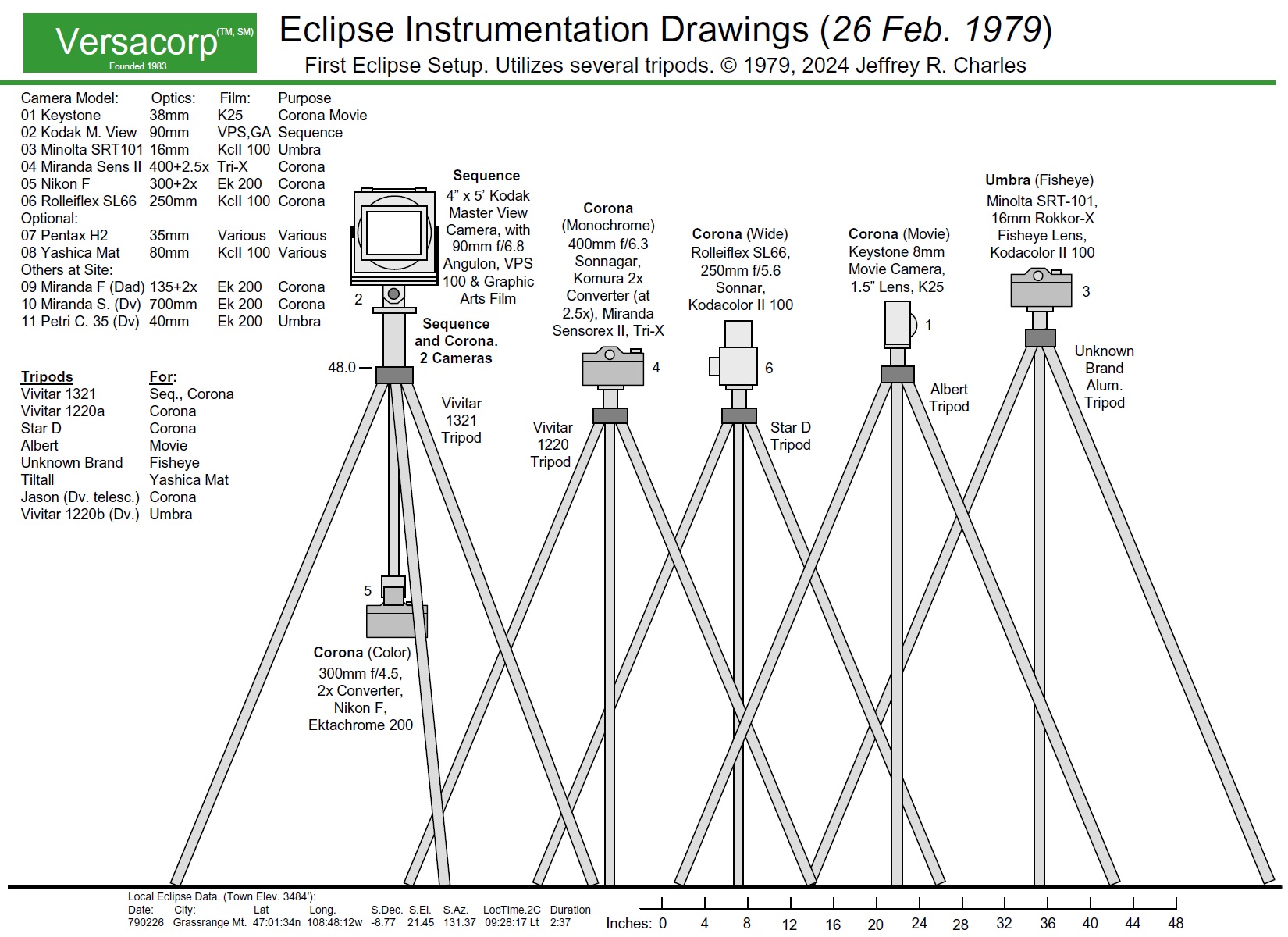
Each of his cameras had a different lens mount, which meant that a lens was more or less dedicated to a given camera body. He had used a Kodak 4x5 inch view camera with a 90mm lens for his eclipse sequence image, a Minolta SRT 101 camera with a 16mm fisheye lens for his umbra photos, a Nikon F with a 300mm lens and 2x converter for his main corona photos, a Miranda Sensorex II with a 400mm lens and tele-converter for monochrome close-up corona photos, and a Roleiflex SL-66 with a 250mm lens for wide field corona images. He had also brought a Yashica-Mat and a Keystone 8mm movie camera, but had not used either of them. These were simply the cameras he had on hand or could easily rent. The only thing he'd bought specifically for the eclipse was a small used tripod. Click here to see a drawing of the Author's equipment for the 26 February 1979 total solar eclipse.
The equipment had taken a long time to set up. This was mostly because, with only one exception, each camera required its own tripod. This also made the setup large and heavy. The equipment had literally covered an entire double bed as he was staging it the night before. And there were issues using it. The mount on one of his tele-converters had literally fallen off the night before, and lacking proper tools, he was not able to reattach it in a way that let his lens focus to infinity. This required stopping the lens down to get enough depth of field to image the corona. He also had not properly focused another camera, and had not used two of them at all. He'd obtained respectable results for a first eclipse, but could have done better. A less cumbersome setup would have helped.
So his lessons learned from the 1979 eclipse included focusing only on one or two different camera brands and lens mounts. He ultimately decided on the Nikon F mount, in large part because some Nikon F series cameras had interchangeable viewfinders, and most could be used with a motor drive. A motor drive could not be used on a Minolta SRT camera, and a drive would be important for the 360 degree panoramas he wanted to capture at his next total solar eclipse.
Another Type of "Eclipse"
After the 1979 eclipse, John had eclipses on the brain. One evening after work, he began trying to think of options for occulting objects that could block the sun, while not blocking the sky immediately next to it. He thought that an opaque blimp or balloon would be nice, since those could be used when the solar elevation angle was high. However, the odds of getting within the shadow of one of those (especially while the object was at an optimim distance) was remote.
He was still thinking about other possibilities for solar occulting objects as he was driving to work in Greeley, Colorado the next morning. While driving west on 20th street, he noticed the spherical water tower next his place of employment, which was just south of Aims College and the intersection with 59th avenue. When he was about a mile away from work, he noticed that the water tower looked to be about the same angular diameter as the sun. He thought to himself: "Hmm... This could work!" His position was almost due east of the water tower, so he glanced beside the road to see if there were suitable sites from which watch the sun set behind the tower. He was delighted to discover that there were empty fields on either side of the road! He soon arrived at work, filled with excitement.
Later, when the sun was within the range of declination that would cause it to set behind the water tower from available observing locations, he waited for a clear day to chase the shadow of the water tower. When the conditions after work were right, he took a mischievous look at the water tower, then set out in his car. About a mile east of the water tower, he found a place to park. He then took his camera with a 400mm lens and positioned himself in the field to anxiously await the "eclipse".
From his location, the top of the spherical water tower was at about a 3 degree elevation angle. He fine tuned his location in a way that positioned the water tower toward the lower right of the sun. Soon, the partial phase of the "eclipse" began behind the distant tower. His pulse began to quicken, almost like it had several weeks before at the real solar eclipse!
Only two minutes to go until the sun would be totally covered! He looked through his Mylar solar filter as the sun grew to a thin crescent. Finally, the last of the crescent disappeared. Totality! (Well, sort of anyway.)
He removed the solar filter from his camera lens and took a picture, then he looked up at the silhouetted tower. Both sides of the spherical tower seemed to be silhouetted with a razor thin bright line. He assumed this must be sunlight that is diffracted by the sides of the tower. Beyond that, there was not as much radial brightening in the sky immediately surrounding the tower as he had expected. What light he could see brightening the sky around the tower appeared to be an almost uniform pale yellow color. But neither the solar corona or prominences were visible. Yet that didn't seem to matter in the moment. He was having a blast anyway!
Less than 10 seconds after the sun had disappeared behind the tower, a bright sliver of light appeared next to the lower right edge of the sphere. The "eclipse" was over. Or was it?
Seconds earlier, when the sun was almost covered by the tower, he noticed an elongated shadow on the ground well in front of him and to his right. The shadow looked about three meters wide, and its edge was surprisingly well defined. In addition, he could actually see it moving toward him in real time. Remembering this, he turned around and could see the shadow retreating toward the southeast.
Without even giving it a second thought, he grabbed his tripod and ran southeast to catch the shadow again. The shadow was retreating fast enough that he knew getting another picture was hopeless, but he could at least SEE the event again. So he set the tripod down and continued running until the shadow of his head merged with that of the tower. He then turned around. He saw the "total eclipse" again, but then a razor thin crescent of the sun appeared only a second or two later.
He again jogged backwards to position the sun behind the tower. As he kept going backwards, he found that the shadow was moving almost as fast as he was able to jog. [An optional aerial view can show the speed and positions of he and the shadow.] He also noticed that it was harder and harder to keep himself in the shadow. The shadow was narrowing as his distance from the tower increased. He then stretched his arms out to either side so he could see the tower shadow on them. This allowed him to position himself without looking at the tower and the unsafe sun. But soon the shadow shrank to only half a meter across, and soon after that, the tower became ablaze with a thin annular sun. That was it for this "eclipse", but it had been fabulous!
As soon as he looked away from the tower, he noticed that a couple of curious motorists had stopped on the nearby road. From the way one driver was looking at him, he had no doubt that he was the center of attention. The driver then just shook his head and drove off. Such is life when one has "eclipses on the brain"! When he got back to his car, the tower's shadow was still clearly visible on the ground several hundred meters away. This was surprising, since only a penumbral shadow remained. John intercepted the tower's shadow on other days, even taking 8 mm movies on one occasion.
The water tower "eclipses" provided their share of sights and memories for a few weeks, but these paled in comparison to a real total solar eclipse. And partial solar eclipses, even when caused by the moon instead of a water tower, don't even come close. A total solar eclipse (a real one caused by the moon casting its umbra onto the earth), is truly impressive.
Several months after the 1979 eclipse, John's health declined, and he frequently came down with a severe sore throat with a 102 degree fever. Chronic fatigue, weakness, and intermittent reduced coordination soon followed. The symptoms were similar to what he had experienced after the Swine Flu shot a few years earlier, except that he was not jaundiced this time.
(The previous 1976 swine flu vaccination was not a "shot" in the usual sense. It was instead injected via a Jet Injector, which shot thin high pressure streams of vaccine through the skin without using a needle. These operated at more than 2,000 PSI, which is similar to the higher end nozzle pressure of an airless paint sprayer. It was later found that Jet Injectors posed risk of contamination, so he figured whoever promoted them for the vaccine must have seen too many episodes of Star Trek.)
Eventually, in the late spring of 1979, he was diagnosed with mononucleosis and found to have a severely inflamed spleen. He was then confined to bed for months and could not work. He decided to move back to Estes Park to be with family while he recovered. But he had to leave most of his stuff behind in Greeley and continue paying rent on his room there until he became stronger (and inflammation went down enough to be safe) to move it. The financial effects of not being able to work while bedridden (not to mention the fatigue afterward) took eclipse chasing off the table for years.
While bedridden, he wanted to go outside and look through his telescope, but his condition would not allow it. One night in November 1979, several months after his diagnosis, he made a cardboard cutout for his sliding bedroom window. He then put the cardboard in the window and fastened a long, thin, open ended box to it. After this, he opened the window and covered the entire cardboard contraption with a blanket. He then set his small 90mm Cassegrain telescope and its wedge on his bed and pointed it at the sky through the open ended box. Then, he tried to observe visible deep sky objects at low magnification while in bed, but his pulse slightly shook the image. It was workable at low magnification, but just barely. There was not enough room between the bed and the window for a tripod, so this was the best he could manage for visual astronomy. However, he later found that he could occasionally set his camera or telescope wedge on the window sill and take modest astrophotos.
He had only done this a few times before the heating bill came. With that, it became obvious that it was not cost effective to use his telescope from bed! Over time, he designed less kludged ways to make or adapt a telescope to have an eyepiece that was accessible from a bed without increasing the power bill. But he was not up to implementing any of them while in bed or while significantly fatigued thereafter. He figured he would be able to go outside and observe from near home on rare occasions after several more months of recovery, but that was still in the future. Meanwhile, his tiger cat kept him company while bedridden, but the cat sometimes looked sad while he was in pain.
[Last scene before transition to 1977 setting in Bolivia is TBD.]
The scene fades out, then:
Act 4A: Meanwhile, in Bolivia:
The scene changes to a wide view of La Paz, Bolivia.
[Caption Text low in La Paz image:]
Two Years Earlier
[Change to Second Caption low in image]
La Paz, Bolivia
November, 1977
The air is thin in the high altitude City of La Paz, Bolivia. The elevation is a little over 3,600 meters (11,800 feet), but the city has some trees due to its -16.5 degree latitude, which puts it only about 1830 km (1130 miles) south of earth's equator.
It is late November 1977, and several students have just graduated from a local university. Two women who became freinds at the school are saying goodbye to each other. One of these women is [the Heroone], and she is going back to her home city of Cochabamba Bolivia to be a teacher. After parting with her friend, she walks to the bus stop.
At 34 years of age, she is older than most of the other students. She had delayed her continuing education because she'd taken on the responsibility of raising her two younger sisters after her parents passed away over a decade earlier. Her late father was a Veteran of the 1932-1935 Chaco War between Bolivia and Paraguay.
When the bus arrives, she boards it to begin the long 380 km journey to Cochabamba. Almost four hours later, the bus arrives in Caracollo, which is nearly half way between La Paz and Cochabamba. The bus remains in Caracollo for several minutes before resuming the trip.
About 20 km east of Caracollo, the road intermittently winds as it noticeably gains altitude. It is slow going because some long stretches in the road are not paved. After about 30 more km, the winding road reaches a 4,500 meter (14,760 foot) high pass in the mountains before descending out of the Altiplano region.
The road soon begins to curve back and forth more frequently as it descends along mountain ridges. Then, 125 kilometers from Caracollo, the road comes up to a deep ravine on the northeast side of a mountain ridge. Here, the road has to perilously snake its way toward the upper end of the ravine, then work its way back away from the end to resume its original route.
There is a sign by the road, indicating that construction will soon begin on a two lane bridge that will cross the ravine. It will be called the Viaducto Alfonso Subieta, and will be a 136 meter long prestressed concrete arch bridge. The vertical clearance below the bridge will be roughly 70 meters, but because the ravine slopes down toward the east-northeast, it will appear to be higher than this to those crossing it. Completion of the bridge is expected in 1980. Even though this location is only about 60 km from her home on Cochambamba, the road's local 3,240 meter elevation is almost 700 meters higher than the 2,570 meter elevation of the city.
About two hours later, the Herone arrives in Cochabamba. The trip had taken more than nine hours. She is greeted at the bus station by her younger sister Ruth. They talk as they hail a taxi and return to the house they both live in.* (* This paragraph is subject to change.)
A new school in Cochabamba is slated to open in February. It will be called Colegio Buenas Nuevas, the Good News school. It is located in a saddle between the Wayra Q'asa area toward its north and the higher Alto Cochabamba area to its south, both being toward the southeast part of Cochabamba, and half a kilometer southwest of Laguna Alalay, an area lake. It is expected that the school will initially have more than 500 students. She is seeking to be a teacher in the primary school there.
(Text about the Heroine securing a position at Colegio Buenas Nuevas goes here.)
(Text about 15 Feb. 1978 inauguration of new Colegio Buenas Nuevas school goes here.)
(Text about the Heroine beginning to teach at Colegio Buenas Nuevas goes here.)
(Act 4B: Text briefly covering the Visitor in USA from July 1977 to Feb. 1979 goes here.)
(Act 4C: Text briefly covering the Visitor from late Feb. 1979 to mid 1980 goes here.)
[This text will be in Part 3.]
(Act 4D: Text about influence the 1980 Bolivian coup has on the school goes here.)
(Text about the 1983 inauguration of the Buenas Nuevas "B" shift school goes here.)
(Text about Heroine becoming Director of the "B" shift primary school goes here.)
(Text about Heroine taking a busload of students to Peru to see the ocean goes here.)
(Text about Heroine organizing Christian camps for Cochabamba children goes here.)
(Act 4E. Text about the Visitor's activities from late 1981 to July 1991 go here.)
[This text will be in Parts 3 and 4.]
(Act 4F: Text about the Heroine's 1990 trip to see her sister in Pasadena goes here.)
(Act 4G: Text about the Visitor's activities from 13 July 1991 to Sept. 1994 go here.)
[This text will be in Parts 5 and 6.]
(The existing story picks up again in Part 3, below, then jumps to Parts 4 and 7)
Some of the basis for the rest of Part 2 and some of Part 3 is at this link:
Eclipse Chaser's Journal, Part 1: My First Total Solar Eclipse: Feb. 26, 1979.
Syzygy, Part 3: "The Mundane and the Extraordinary"
Act 4H: The Long Dry Spell Between Eclipses (1979 ~ 1991)
(Syzygy is currently written to transition from Part 2 to THIS part, then to Parts 4 and 7-12.)
As soon as totality at the 1979 total solar eclipse had ended, one of John's first thoughts was "when is the next one?!" Not wanting to be in suspense, he began to research the matter as soon as possible. After some research, he found that most total eclipses in the foreseeable future would be observable only from distant or remote places, or even only from the ocean. This was not surprising: Most of earth's surface is covered by oceans, and most of the land then lacked the infrastructure of his home country. Thus, it follows that the narrow path of totality for most eclipses will only cross relatively remote areas. Travel to such areas can often be logistically challenging and quite expensive.
The next eclipse would occur the following year, and most of the related organized tours were to sites in India. However, since he had been bedridden for months starting in late 1979 due to a seriously inflamed spleen, he was not able to stay on at his job in Greeley. And with that, he had lost his health insurance. (There was no COBRA law in the USA back then.) He had then returned to Estes Park to be with family during his convalescence. This obviously meant that he would not have the funds or endurance to travel to a total solar eclipse in the near term.
Unfortunately, the fatigue, weakness, and intermittent reduced coordination from his 1979 medical condition had not let up much even after a year. And every month or so, he still experienced a recurring sore throat with a 102 degree fever that could last for days or even weeks. The sore throat was not always as raw as it had been while at his job in Greeley, but he later figured this could be because he was not being exposed to fumes from darkroom chemicals from the large 30 x 40 inch open trays at his former workplace. He frequently spat up blood back then, and that wasn't happening as much now.
After the long period of bed rest, his condition still limited his stamina too much to work full time (or keep regular hours due to the fever and sore throat), so he only worked odd part time jobs and repaired cameras for Western Camera, the local camera store in Estes Park. One of his early odd jobs had been working in the darkroom of a portrait studio, but this was before he made a connection between the severity of his sore throat and exposure to chemicals.
Over the time he was ill, his priorities began to shift. He still had a strong interest in photography and astronomy, but as he experienced the drawbacks of both fatigue and lacking finances, those interests began to diminish. He began to increasingly be concerned about the rights of others in similar or worse economic situations. This concern increased as he gradually became aware of the plight of the poor in other parts of the world, and how many were literally held down by those better off than them. Events in El Salvador were particularly concerning. There, death squads had attacked the poor, and even priests and nuns had been assassinated. There was also video on the news where unarmed people on the steps of a Cathedral were being shot from a distance, even as they were laying down and trying to take cover.
He was also concerned that such people in many areas may not hear the gospel, and he eventually began to consider being a missionary. However, that would not be possible while in poor health. Nonetheless, he began to look into it, because it could be possible if his health improved. He talked to a former missionary he knew, and the missionary recommended that he first attend a local Bible school to see if his health could hold up to it. If it did, then he could consider the next step. But if his health did not hold up, there would be little point in trying to pursue missions.
The missionary noted that sometimes, even healthy people had begun training for missions, only to have their health fail when field conditions were simulated over several weeks. At about the same time, a couple in the local church had to drop out of missions training when the health of one of them failed during that part of the training. And in the case of another couple from church who had been serving in Africa for a few years, one of them had fallen ill from a local disease and had not fully recovered. Therefore, they were looking into taking a sabbatical to return to the USA and seek medical treatment.
Over a few months, he sold enough of his camera equipment to fund a semester of resident classes at the nearby Torchbearers Bible school. His health did not hold up well at all during that, and this took going into missions off the table.
But an important thing did happen while he was at the school. He had heard a speaker named Bob Hobson, who emphasized Christ living the Christian life over a person trying to live this life only through their own discipline. This was much like the message he had heard from Major W. Ian Thomas back in the late 1970's. But he still could not wrap his head around it, and that was the problem. It was not something one wraps their head around. Instead, it is something (actually someone) that, in a manner of speaking, one's spirit and being become wrapped around, in that it is the work of the indwelling Holy Spirit in and through a person, and not a mental exercise. But he still didn't get it at the time. He understood the concept and knew the Spirit had really had indwelled him since receiving Christ 1974, but not how His indwelling was expressed in practice.
Another thing had also happened at the school, but it was not of a spiritual in nature. He had brought his telescope, a Celestron C 90 (90mm f/11 Maksutov-Cassegrain), to the school with him, and had set it up so other students could look through it every week or so. During this time, the few students who had cameras with them expressed interest in taking pictures through his telescope. However, it took a long time to remove the eyepiece and diagonal, then screw on the camera coupling. And the process was more difficult in cold weather. This made it impractical for anyone to take a picture though the telescope while others were waiting to look through it, so other informal times were arranged for such photography by other students.
In his own use of the telescope, he had long been aware of the difficulty of switching between visual and photography, but the impact this had when a group used his telescope made the limitations more obvious. He knew that the (expensive) Questar 3.5 inch telescope had a flip mirror (actually a sliding prism) in its built-in control box, but he could not afford a Questar. What he wanted to do was come up with a way to add a flip mirror to almost any telescope, including his C 90 or (perhaps later) a larger telescope. He began to think of an easier way to accomplish this only on rare occasions, because he did not want to be distracted from his studies.
He soon thought of a compromise that would be easy to implement. This was to adapt a star diagonal to have a camera mount on the front. On a trip to Boulder CO, he obtained a used Ad Astra star diagonal from Ray Martin the Star Tracker telescope store. At a camera store, he also found a reverse T-adapter that was made to attach Nikon lenses on the front of T-thread bellows. Since the Ad Astra diagonal had T-threads on the front, the reverse T-adapter could be screwed right into it. This made it possible to remove the diagonal in the same way as the camera, with no need to unscrew the camera adapter from the telescope. However, it was still necessary to refocus the telescope when switching to a camera, and different T-Adapter rings were still needed for various brand cameras.
One day between class sessions, he conceived of a compact flip mirror that had a built-in selectable Barlow lens that could be used for either observing or photography. The same flip mirror design could also have a built-in guiding prism or focal reducer in addition to the Barlow, plus a manual shutter to interrupt guided exposures. He made a quick sketch, but because he had few tools, he had no idea how he could build such a device. He then put the potential future project out of his mind so it would not distract from his studies at the school.
Starting a Business
After the end of his semester at the Colorado Torchbearers school, he was able to save up enough to get limited medical and dental care. His wisdom teeth had long been a problem because they were crowding his lower front teeth together and making then so crooked that some lower teeth began to creep in front of others, so he scheduled a dentist visit to get his wisdom teeth removed.
A few days before his dental appointment, he borrowed his Dad's drafting machine and started to make both scale concept drawings and detail design drawings for the flip mirror he had conceived while at the school. He soon got far enough that he knew what the approximate envelope would be, and found that there was a diminishing return on trying miniaturize it. It turned out that the envelope would only be about half an inch larger if the flip mirror was designed to accommodate 2 inch eyepieces, so he settled on that design. The main driver of the minimum practical size was the need for a clear aperture of at least 38mm (same clearance as the unthreaded inner diameter of a male T-Mount thread fitting) in order to minimize vignetting when using a 35mm camera.
When his wisdom teeth were pulled, he reacted to the Sodium Pentothal used in the anesthesia, and was unexpectedly bedridden for three weeks. During the last two weeks of this, his mind cleared enough that he could work on the flip mirror design on his head, mentally designing every part. Within two weeks of when he was able to get out of bed, he had completed dimension drawings for all of the custom parts, plus a bill of materials for the other parts.
To be practical, the flip mirror would require three sand castings, so he made balsa wood patterns, then had the metal castings made. The castings needed to be threaded, so he filed the edges to ensure that each casting would be properly gripped and centered in a four jaw lathe chuck for machining. He then hired a machine shop to cut the 42mm T-threads in the front and back castings, and 44mm threads in the top casting.
The 42mm threads in the front casting accepted the male T-threads of a telescope adapter. The rear threads accepted a rotating T-thread camera adapter that O.T.I. made for their Quantum 6 telescope, and the 44mm top thread accepted the 2 inch eyepiece holder that was made for the Quantum 6. (He did not have an actual Quantum telescope because he could not afford one.) A sheet metal part was made to covered the area between the castings.
In addition to the flip mirror itself, he designed a 1.25 to 2 inch eyepiece holder with T-threads on both ends that enabled it to be used as both a T-thread visual back and an eyepiece projection adapter for planetary photography. This was made by the same machine shop that had threaded his castings. After all of this was done, considerable work was still required to finish the castings, make the other parts, and get the front and back castings hard black anodized. It took several months to complete the project, since most of his time went to part time employment.
In late 1982, he conceived of the name "DiaGuider" (for Diagonal / Guider) for the version of his flip mirror that had a built-in Barlow lens and guiding prism, and "VersAgonal" (Versatile Diagonal) for the version without a guiding prism that could potentially have a small focal reducer lens instead. He called the enhanced 1.25 to 2-inch eyepiece adapter the "VersAdapter" (TM).
When he was finally able to see a doctor, he was diagnosed with Addison's Disease, and was then put on cortisol for it. The doctor said that the Addison's Disease had been caused by Tuberculosis in his adrenal glands, but that he was not contagious because he did not have TB in his lungs.
The doctor also prescribed INH and Rifampin for the TB, but cautioned that he should not start taking these if there was any chance he would not be able to complete the treatment without interruption. Therefore, since there was at least a possibility of moving out of state for work in the coming months, he did not start the TB treatment.
The cortisol unexpectedly provided a noticeable increase in his endurance, and he was able to resume having a social life. This even included driving 70 miles down to Denver for the DAS (Denver Astronomical Society) meetings at Chamberlin Observatory, along with going to some of their star parties.
While observing with the DAS group, some of the other astronomers saw the flip mirror he had made on his telescope, and expressed interest in getting one. This and other considerations ultimately led to his starting a small business to manufacture the flip mirror and a few other items. He used the names he had conceived earlier as Trademarks for the correspondng products, and the company was called Versacorp (TM, SM).
However, because he still did not have much in the way of finances, it would be over two years before he could actually complete commercial versions of the flip mirror. But it was possible for him to have a small quantity of the VersAdapter made sooner than that.
A commercial flip mirror also took a long time to produce because, even when he first conceived of his flip mirror, he knew that a design having a sheet metal cover over there shallow castings would be too labor intensive for more than an amateur project. He had wanted deeper castings to provide the entire enclosure even for his amateur flip mirror, but it was not practical to make casting patterns for that by hand. For the commercial flip mirror, he gradually designed deeper casting patterns.
Act 4I: Moving to Arizona
One benefit of having been put on cortisol for Addison's was that he gained enough stamina to take on a shift running the sound system at church, He was also eventually able to seek a full time day job rather than only working part time. However, he was unable to locally find a full time job of interest for some time, so he went farther afield.
Eventually, he found a full time job at a camera and telescope store in Phoenix, Arizona, and moved there. The position involved camera and telescope sales, plus making occasional telescope repairs. With the new position, he was finally able to get group health insurance again.
Shortly after this, his business hired an individual machinist to make the patters for the deep aluminum castings for a commercial version of his flip mirror. However, the machinist was out of tolerance on 117 or the 120 dimensions, and would not correct this without additional charges. This was surprising, because the tolerances were not all that tight. Given the large number of machining errors, he figured he could do better than the machinist if he machined the patterns himself.
Therefore, after he had saved up enough funds, he purchased a lathe and mill-drill machine, plus some of the required tooling. He then asked friends who were machinists for a few pointers, and read most of a textbook on the subject. He then began practicing on his machines. Within two hours, he had successfully machined a threaded part he had designed, and the result was within the design tolerances.
He then set about correcting and completing the flip mirror casting patterns. Because the previous machiist had removed too much metal in some areas, he applied metal impregnated epoxy, then machined the patterns. After this, he mounted them on a matchplate that had a 10 x 14 inch working area. After this, he had Eastern Products Foundry make 25 sets of sand castings from 356 aluminum. Machining the castings would be labor intensive, but he expected that.
He also found a local machinist named Terry who could make some of his parts in quantity, and (unlike the first machinist) this new machinist made the parts on budget and in tolerance. The custom 1/10 wave diagonal mirrors were then made by J.R. Cumberland (the same company that made Questar and Quantum telescope optics), and the Barlow and focal reducer optics were obtained from Vernonscope and Meade. The camera coupling at the back was made by Davro Instrument, which was related to some people from O.T.I, the defunct former maker of Quantum 4 and 6 telescopes. (This was under the same roof as Davro Optical Systems, which had been founded by John Schneck, formerly of O.T.I.) The control knobs came from AlcoKnob, and parts such as the lens cells, control shafts, manual shutter, flip mirror mount, and the custom flip mirror knob. were made internally.
However, this process was slow, because after he had moved to Arizona, he could not get cortisol for his condition without a local diagnosis for Addison's Disease. And for months, his local doctor would just declare he did not have Addison's, yet would not do tests to refute or validate the diagnosis. He then tried other doctors. Eventually, one did do the test, but it was later found that the ACTH test may have been defective, and the doctor would not repeat the test. Local doctors also would not prescribe INH and Rifampin, even though they did not do a TB test to refute the prior diagnosis. His prescription from Colorado was not valid in Arizona, so he figured it was a good thing he had not begun the long treatment prior to his move.
His fatigue had returned shortly after his move, and it gradually became worse. But he was still able to work full time if he gave up almost all of his social activities. Working toward getting the flip mirror to market had to be done after his day job shift, so he was not able to spend much time on it. When it finally looked like a path to completing the flip mirrors was possible, he advertised it in Sky and Telescope magazine.
After a few years, he came down with symptoms similar to what he'd had had in late 1979 and went to the doctor. A few weeks later, he was surprised that his insurance claim for the doctor visit had been denied due to his insurance lapsing. This was odd because, his insurance premiums were deducted from his check. After looking into it, he found that another employee he knew in the same camera store chain experienced the same thing! It was ultimately discovered that their employer had been pocketing their health insurance premiums! It later came to light that the camera store was entering Chapter 11 bankruptcy, and they soon closed their stores.
With this development, he again, through no fault of his own, had no medical insurance! And even though his Arizona doctor had said he did NOT have Addison's Disease, insurance companies would not sell him medical insurance due to the "preexisting condition" of having had the diagnosis. Lack of medical insurance in turn effectively led to minimal medical care, and to further declining health. And he soon found himself again only having the stamina for part time work. Because he could not keep reliable hours due to the recurring sore throat with fever, he decided to concentrate only on running his business. He would work longer hours between the times his symptoms were worse.
Looking into Medical Coverage North of the Border
Due to what health insurance companies called preexisting conditions, it appeared that he would never be able to get insurance. Medical care (or relative lack of it) had held him back on a recurring basis for a decade. And the conservative government still had their head in the sand regarding medical care. One spokesperson for the administration was so out of touch as say: "Everyone [in the USA] who wants health insurance already has it." This made it clear that lack of health insurance availability was not going to change anytime soon.
Therefore, he looked into relocating to Canada, where people can get medical care regardless. He rightly figured that his income would increase IF he could get adequate medical care, so he made a 5-week trip to western Canada to determine which areas had the industries (machine shops, anodizing facilities, etc.) his business needed to utilize, and places to potentially live that were reasonably close to these services. Another consideration was which areas had reasonably dark night skies, and which areas had reasonable laws concerning a home occupation business. Due to the latter consideration, he spent a lot of time obtaining relevant parts of zoning bylaws from cities or towns of interest. The trip took this long because he did not have the stamina for long days, and because he wanted to see the local mountain scenery.
Of the Canadian areas he looked into, anodizing services were only available in the Vancouver BC area, in Kelowna BC, and in Calgary, Alberta. As for places to potentially live, he was interested in Abbotsford if he utilized services in Vancouver, Penticton or Summerland if he utilized services in Kelowna, and Canmore or Black Diamond if he utilized services in Calgary. Of these, he ultimately settled on Abbotsford BC. He really liked the Salmon Arm BC area, but it was not practical from a business standpoint. While in Canada, he also went to the Mount Kobau Star Party, not far from Osoyoos, BC.
Without exception, everyone he met in Canada was happy with their health care system. The long wait times that U.S. news outlets and Republican politicians kept harping about only seemed to apply to certain elective procedures. (And even if there was a wait time, it was preferable to the USA alternative of no medical insurance or care at all!)
After he got back to the USA, he completed the Canadian immigration paperwork and the waiting game began. He had been in touch with Canadian authorities before his trip, so he knew what to expect in terms of wait time. However, in the end, he was not able to move to Canada because the Consulate began imposing the requirement that an immigrant's business hire two local people as full time employees. The Consulate told him that this Entrepreneur immigration status was increasingly being favored over the Self-Employed one, in anticipation of many wealthy entrepreneurs coming from Hong Kong before the area would cede back to China in the next decade. Hong Kong was then a Colony, while Canada was a Commonwealth. This presumably meant that people from Hong Kong would favor immigration to Canada (over the USA, for example) because the immigration process would be easier. So that was that (eh).
Less than two years later, he moved back to the Phoenix area from Camp Verde. Shortly thereafter, he became unable to use the restroom for more than two weeks in a row. And he had not been able to eat for the last few days of that time. Since he had not spent money to see a doctor for a while, he was able to see one. He was almost immediately diagnosed with gluten intolerance. The diagnosis seemed to make sense, because over the years, he had compiled a list of foods that seemed to be problematic, and all of those were on the list of what to avoid with celiac. Even obscure things he'd had issues with (such as caramel color in soda) were on the list.
After this diagnosis, the change in diet, and being prescribed pancreatin enzymes, his stamina gradually improved about as much as it had when he was on cortisol years before. And he knew it must be a correct diagnosis because he reacted go gluten even if he was not aware of having had it. (If he got sick after a meal, he inquired in more detail about the ingredients, and these ended up including gluten.) The pancreatin enzymes proved expensive, so he later had to get the prescription filled in Mexico. Since his health improved from this, he assumed that his Addison's diagnosis from years earlier must have been in error.
With the improvement in health, he could work more hours at his business and get it off the ground. He also then had the energy and funds to travel to astronomy conferences and set up a commercial booth at some of them. Eventually, his customers included an agency that was related to aerospace.
A few years later, a total solar eclipse would occur close enough to the USA that he could observe it before he became old enough to require a cane: The total solar eclipse of July 11, 1991 would be observable from Mexico. At last, there was going to be an affordable and relatively nearby eclipse!
Transition to Scenes of the Heroine in Bolivia:
These Acts Depict Life Events for the Heroine in Bolivia, including:
- Impact of 1980 coup on her and students at the Buenas Nuevas school
- Transition of government away from Military Rule (1982)
- Establishment of Second Shift Primary School at Buenas Nuevas (1983)
- Heroine becoming Director of the B Shift Primary School (1983)
- Heroine's sister moving to USA (year TBD)
- Heroine Visiting her sister in Pasadena, CA (1990 or earlier)
Setting then transitions back to the USA:
(The rest of Part 3 has not been written and some may not be written later.)
(Syzygy is currently written to go directly from here to Part 4 (below), then to Part 7.)
(If later written, Part 3 will summarize the following):
- Daily life in USA for the Eclipse Chaser character (The Visitor) between 1979 and 1991.
- Daily life for Heroine in Bolivia, including work at the school, coup of 17 July, 1980, etc.
Partial basis for aspects of Part 3 set in North America is outlined or covered in:
Astrophotographer's Journal, Part 2:
Between Eclipses: 1979 to 1991.
(This linked Astrophotographer's Journal is only partially completed.)
(The small part thus far completed emphasizes a 1988 trip to Canada.)
Syzygy, Part 4: "The Second Moonshadow Encounter"
Planning for the Total Solar Eclipse of July 11, 1991
(Syzygy is currently written to transition from Part 3 to THIS part, then directly to Part 7.)
The total solar eclipse of July 11, 1991 would occur relatively close to the southwestern U.S., so traveling to it would be relatively inexpensive. The path of totality would begin near Hawaii and continue across the southern tip of the Baja peninsula, into the mainland of Mexico, and down into parts of central and south America. In Mexico, totality would be visible from several major cities. This would make it possible to fly to one's destination and observe the eclipse from a comfortable hotel!
The unusually long duration of the eclipse (5 to almost 7 minutes) also meant that it would cost fewer bucks per minute of totality! He decided against Hawaii because the weather prospects were not too good. His first choice for an eclipse site was San Jose del Cabo, on the Baja Peninsula. However, in spite of the fact that the eclipse could be observed from relatively near the continental U.S., most commercial expeditions were relatively expensive. Many to the Baja peninsula and cost nearly $1,400 per person including connections from Phoenix. And accommodations there were sold out to the tour groups. Cost was also a factor because his brother wanted to go to the eclipse as well. Another disadvantage of the tours was that they tend to be overscheduled to the point of potentially wearing a person down before eclipse day. Since he had experienced a lot of fatigue in the past, he did not want to overdo it on a trip.
After more investigation, he determined that planning his own expedition to Mexico would be much less expensive and could eliminate the overscheduling problem. So he looked into arranging a brief trip to a traditionally popular destination in mainland Mexico. Clear sky prospects during totality on the mainland were slightly less favorable than on the Baja peninsula, but coastal areas appeared to be more favorable than inland areas such as Mexico City. Of these, Mazatlan was preferred, partly for logistical reasons. Clear sky prospects there appeared to range from more than 50 percent to better than 80 percent, depending on the source.
Even though Mazatlan was well north of the eclipse center line, totality there would still last about 5-1/4 minutes. This was a shorter duration of totality than on the center line, but even this was still longer than most eclipses. And there was something to be said for just walking outside of a hotel to reach a good eclipse "site". The coastal location would also offer a good view of the approaching lunar shadow, or umbra.
Package trips to Mazatlan near the time of the 1991 eclipse were hard to come by, so he explored the possibility of ground transportation. His car was almost 20 years old (and his brother's car was even older), so he was not very enthusiastic about driving either of these hundreds of miles into Mexico. Chartering or renting a vehicle for use in Mexico was another option, but the cost proved impractical. A train was also a possibility, though not a desirable one. Flying was by far the best option, but seats on flights had been hard to come by for months.
About 3 months before the eclipse, a friend who was a travel agent located some attractive hotel accommodations in Mazatlan, but there still were no flights available. (And Mazatlan was the only coastal area in the eclipse path where he found available rooms) He decided to reserve some of these rooms for himself and his brother, so at least that part of the expedition would be taken care of. The reservations were for rooms at the Hotel Riviera Mazatlan, which was well north of the port area, and almost immediately northeast of the Valentino's nightclub. (Comment added later: This hotel later became the Hotel Emporio Mazatlan, apparently sometime before 2013.)
Fortunately, about 2 months before the eclipse, flights to Mazatlan became very easy to get, presumably because large tour operators had been forced to give up the seats they had initially hogged up but had not sold.
At the next Saguaro Astronomy Club (SAC) meeting in Phoenix, he told others about his plans for the 1991 eclipse, and several others wanted to go. Therefore, he arranged a group trip, but left it to each person to book and confirm the provisional reservations he had made for them before they sold out. Setting this up, even through a travel agent, was more complex than he had expected. Some people who joined the trip had not planned on going to the eclipse because they did not want to spend as much as the Baja tours cost. By comparison, the do it yourself Mazatlan trip cost far less than half as much as those. The total per person cost of the expedition to Mazatlan came to less than $100 per minute of totality!
Exchanging Information With Other Eclipse Chasers at a Conference
The total solar eclipse if July 11, 1991 had a maximum duration of totality that was longer than any eclipse would have for more than a century. Because of this, many referred to the 1991 eclipse as "The Great Eclipse".
The May 1991 Riverside Telescope Makers Conference offered a good opportunity for eclipse ovservers to exchange information about preparing for the upcoming eclipse. There, he presented a paper entitled "Gadgets and Techniques for Total Solar Eclipse Photography". In the presentation, he described the lessons he learned from the 1979 eclipse and how he planned to apply them to his photography, video, and observation of the 1991 eclipse. It was presented as part of an Eclipse Photography Forum that featured the well versed eclipse chasers Stephen Edberg and Carter Roberts.
While John had only been to one total solar eclipse, observing the umbra as it moved across the sky had given him a different perspective than most. He had been fortunate enough to obtain relatively good wide angle photos of the umbra, so he had been invited to participate alongside these legendary eclipse chasers. He had never observed the umbra under completely clear skies, and his photos had all been taken within 90 seconds of totality, so the information he could confidently present had to be limited to phenomena that were visible either during totality or within a minute or so before or after it. He knew the umbra could be observed beyond this time frame, but did not then know by how far.
Cliff Holmes introduced the eclipse chasers. Then, they each presented their eclipse material and fielded questions from the audience. To some, the thought of such a long eclipse could make one wax poetic or musical. So after all three eclipse chasers had presented their material, John said he had written lyrics to a song about the eclipse, and asked people if they wanted to sing it to a popular tune. The audience applauded, so he projected a slide with his lyrics on the screen. The title was "The Great Eclipse", and he suggested singing it to the tune of an abbreviated version of "New York, New York", where the first two pairs of lines have the meter of the first verse, and the rest has the meter of the second verse. He then led conference attendees in the song, for which the lyrics were:
La, la, la la la. La, la, la la la. La, la, la la la, la.
Start spreadin' the ne-ws. I'm leavin' this year.
I wanna see to-tal-i-ty; the great e-clipse!-
To-tal-i-ty's lo-ng. The moon-sha-dow's wide.-
I'm gonna ex-per-'ience it, the great e-clipse!-
I wanna be there, where the umbra will cover me!
To see the prominences, bright Baily's beads,
the diamond ring and the grand corona!
So- see e-clipse views.- You'll be- blown a-way!-
When you ex-per-'ience it: the great e-clipse!-
So grab your te-le-scope, and head to Me-xi-co,
Where you can see, the, great, e-clipse!-
La, la, la la la. La, la, la la la. La, la, la la la. La!
And after he song, everyone gave themselves a big round of applause!*
The July 11 eclipse was less than two months away, and those at the RTMC who had been bitten by the eclipse bug were brimming with anticipation!
(* Comment: The Author did present his eclipse material with the other eclipse chasers in 1991, but he did not present the song. He did not write his lyrics for "The Great Eclipse" (or his companion song "The Next Eclipse") until about five years later, and it was not disclosed until it was published his 1991 Eclipse Chaser's Journal a while after that. The version above differs slightly from his 1997 version. Lyrics for "The Great Eclipse" and "The Next Eclipse" are Copyright 1997, Jeffrey R. Charles, All Rights Reserved. Above revisions to lyrics for "The Great Eclipse" are Copyright 2025 Jeffrey R. Charles, All Rights Reserved.)
Act 4J: Preparation for the 1991 Eclipse:
Several weeks before the eclipse, he wrote the county of his birth to get a certified copy of his birth certificate. More than a week before the Eclipse, he took his equipment to the U.S. Customs office at the local airport's port of entry and filled out a few "Certificate of Registration for Personal Effects Taken Abroad" forms. He also checked to see if any specific inoculations were required before travel to his destination in Mexico.
Having learned lessons from the 1979 eclipse, he practiced packing and unpacking his equipment, then practiced setting it up and performing his eclipse photography and observation. He had practiced using his cameras before the 1979 eclipse, but had not pracided packing, unpacking, and setting then up, and that came back to bite him. His brother Dan practiced as well, since he wanted to use three or more cameras at this eclipse. John encouraged other members of the group to do the same, but most of them did not appreciate the necessity of such preparation. The eclipse would occur near the zenith, which presented special problems when using a conventional photo tripod. Fortunately, a side arm accessory can solve this problem.
An eclipse expedition requires a lot of preparation. So addition to arranging for travel and preparing equipment, biological matters have to be considered. Even though the eclipse site could be only a few meters from the hotel building, heat and humidity are still considerations because Mazatlan is in the tropics. Water to prevent dehydration is then an important consideration. But obtaining safe drinking water in Mexico was a concern, at least for his Gringo GI tract that wasn't used to area water. He had contracted dysentery when visiting Mexico a few years earlier, and didn't care to repeat the experience.
The group brought along some tablets and a small heated teapot for treating and boiling water. They also brought along something to pass the time in the event that the weather was bad (oh noooo!) Some people planned to bring along a book or a deck of cards. He planned to bring a very small N-gauge model railroad.
Equipment for the 1991 Eclipse
John had designed a myriad of optical gadgets during the years he had been ill, and some of these had resulted in products for his business, Versacorp. His flagship product, the VersAgonal, was based on a gadget he had designed and built as an amateur telescope maker almost a decade earlier. He had eclipses in mind when he designed it., and was looking forward to the opportunity to use it at the eclipse. This will let him use a single telescope for both observation and photography of the eclipse without having to even refocus.
He had recently acquired a Vernonscope 94 mm f/7 apochromatic refractor. Previously, he had used a 100 mm f/8 achromatic refractor for wide field observation and a 100 mm f/15 achromat for planetary observing. The Vernonscope wasn't cheap, so he had sold his 100mm f/8 refractor to help pay for it. He liked the Vernonscope because it worked for both wide field an planetary. It was compact, and it had a two inch focuser with a sliding draw tube. The sliding drawtube allowed him to "preset" the prime focus of the telescope prior to totality. He planned to use the flip mirror to switch between photography and observing the solar corona at 20x through his 32 mm wide field eyepiece. It would be fun!
But this was not all of his 1991 eclipse setup. He was placing equal emphasis on observing and imaging the lunar umbra in the moments before, during, and after the total phase of the eclipse. At the 1979 total solar eclipse, motion of the umbral boundary across the sky was the most impressive part to him, because it was all around him. At the 1991 eclipse, he wanted to photograph any umbra related phenomena that became visible. To be sure he captured this at the 1991 the eclipse, he decided to take 360 degree panoramic photos.
In planning his equipment setup for the 1991 eclipse, he decided not to deal with the morass of equipment he had used in 1979. He'd sold most of his 1979 equipment up to a decade earlier, and it was too much stuff to transport by air anyway. Since then, he had standardized on Nikon F mount cameras and corresponding lenses. He did not like the 16mm f/2.8 Fisheye Nikkor lens as well as his former Minolta 16mm f/2.8 Rokkor-X lens, but it was a sacrifice that had to be made if the lens was to be used on a manual camera having a motor drive. The 16mm Nikkor lens would be used on a Nikon FM camera having an MD-12 motor drive.
There would also be fewer tripods, since tripods take up luggage space and slow setup time. Therefore, he decided to utilize three tripods: One for observation and photos of the corona with his Vernonscope 94 mm refractor; one for a point and shoot auto exposure camera, and one that would be shared by two cameras: his old Magnavox Newvicon video camera for corona video, and the Nikon FM camera with his fisheye lens.
To take panoramas, he had designed and built an indexing motorized rotary camera platform that could take a 360 degree panoramas in 2, 3, 4, 6, or even more photos, all by alternately pushing two buttons: One button fires the camera, and the other to rotates the panoramic platform a preselected angle. For the 1991 eclipse, he configured the platform to capture each 360 degree panorama in four photos. This makes it possible to capture nine panoramas on a single roll of film. Because he did not know how long before totality the umbra could appear, he planned to take the first panorama at 15 minutes before totality, then take others at 10, 5, 3, 2, and one minute before, plus another a few seconds before if possible. He then planned to take at least two panoramas during totality, and one afterward if there was enough film left.
His eclipse equipment was well defined by a couple of months before the eclipse, but it was large and heavy, mostly due to the video camera and its separate portable VCR. Fortunately, only a few weeks before the eclipse, he was unexpectedly able to acquire a used Sony TR7 Video 8mm camcorder at a reasonable price. Using such a compact camcorder instead of his Newvicon camera with its separate video recorder would radically lighten his luggage. The TR7 also had a smaller format image sensor and a smaller aperture lens. This would be compatible with an extremely compact and lightweight 3x Galilean video converter he had designed, so he fabricated the converter lens, utilizing a 35mm binocular objective and a strong Barlow lens for the optics.
Only a few days before the eclipse, a member of the eclipse group offered him the use of his 8 mm camcorder. He decided to use it with his wide angle converter to get video of the approaching lunar umbra prior to the eclipse. This increased the total number of cameras he would be using, but the total weight and volume of equipment with the added camcorder would not be much more than it would have been when his Newvicon video camera was in the setup. This changed the tripod situation, but a member of the group had room in his luggage for the additional light tripod.
He ended up using four tripods: One for the 360 degree panoramas with his indexing rotary platform, one for his 94 mm telescope, one for both the corona and wide angle video cameras, and one for all-sky fisheye pictures. He decided to eliminate the point and shoot camera because his 360 degree panoramas would capture everything anyway. Click here to see a drawing of the Author's equipment for the 11 July 1991 total solar eclipse.
To obtain a clear view of the approaching lunar umbra, he planned to set up on the beach, just south of the westward part of the hotel. The unstable beach sand would pose additional problems for setting up equipment, but this was remedied by making 12 cm square Masonite pads to use under each tripod leg. He also brought along towels to keep sand from getting in his equipment. And just to be safe, his brother brought along a can of dry air that could be shot into the video camcorder if its humidity sensor kept it from turning on while near the ocean.
The group was also concerned about people (particularly other tourists) bumping into their tripods in the subdued light of totality (or otherwise interfering with their equipment), so they decided to bring along some posts and twine to rope off the area immediately around them.
Act 4K: The 1991 Eclipse Expedition Begins:
On July 9, 1991, four of the seven members for the expedition met at John's folks' home in Sun City, AZ. The equipment one member of the group had with him was woefully inadequate, so John quickly made some modifications for him. Later that day, they and the other members of the group converged on Sky Harbor International Airport in Phoenix to catch their Aero Mexico flight to Mazatlan, Mexico. By 1:40 that afternoon, they were airborne and on their way to Mexico.
As they flew south, the cloud cover increased. A few hours later, they descended through the clouds and coastal parts of Mazatlan could be seen out the starboard windows. A few minutes later, The plane landed. Upon leaving the aircraft, the group walked through an extremely long corridor, retrieved their checked luggage, and went through immigration. Finally, they caught a shuttle to the Riviera Mazatlan hotel.
Upon arriving at the hotel, an employee helped with their baggage, then John gave him a tip comparable to what I would pay in the U.S. The employee looked at the top with wonder and amazement. It was clear that he appreciated it.
The sky was clear in Mazatlan the day before the eclipse. Some of the group selected a suitable beach site and practiced setting up for and photographing the eclipse. After that, the same employee who had carried the group's bags showed some of them the roof of the hotel. (The travel agent had arranged for them to have the option of setting up on the hotel roof.) He gave the employee another tip, which was accepted in the same way as the first. At 5:30 that evening, John led some of the group in a timed "trial run" for their eclipse photography.
Later that evening, Dennis, one of John's other friends from Arizona, dropped by to see him at the hotel. He was surprised at how easy it was to find him. When Dennis had asked a certain hotel employee (the same one who had helped with the luggage) about him, the employee immediately remembered and knew where to find him. Later on, John could not find the employee who had helped earlier. He later learned that each tip he'd given was equivalent to a day's wages, and the employee had taken a couple of days off! Oops!
Dennis and his group planned to take a boat out to Isla de Pajaros (out to sea toward the northwest) the next morning, and to set up near its summit to observe the eclipse. He invited the John and his group to come as well, but no one took him up on it. In John's case, he did not know how he could get all of his equipment up the steep slopes of the island, and it did not appear that there would be any local difference in the weather.
Eclipse Day: July 11, 1991
The morning of the eclipse began partly cloudy, with most of the clouds either over the mountains to the east, or out to sea toward the north and west. But the sky around the sun was clear. Occasional thin clouds passed in front of the sun, softening our shadows, but otherwise the conditions looked favorable. However, the group did not know how the atmospheric cooling caused by the eclipse could affect this. There was an absolutely clear area of sky toward the south that never had any thin clouds pass over it, but it appeared to be out over the ocean.
The humidity was high and it began to get hot. Soon, the temperature exceeded 30 degrees C. (86 degrees F.) The group set their equipment up on the beach about 20 meters from the ocean. Before long, the group of seven erected what looked like a city of tripods! For those in the group who brought Masonite pads to put between the sand and their tripod legs, their tripods were stable.
The partial phase of the solar eclipse is about to begin, and the total solar eclipse will follow almost an hour and a half later. For those unfamiliar with terms used to describe a total solar eclipse, the following five paragraphs provide a brief introduction that should make descriptions in the story easier to follow:
Certain events during a solar eclipse are defined as "contacts". Contacts are when he limb (or edge) of the Moon appears to touch, or contact, the limb of the Sun. The entire process of a total solar eclipse begins with a partial phase, where the Moon first begins to cover the solar photosphere. The photosphere is the only part of the Sun that is observable (without highly specialized instruments) at times other than when there is a total solar eclipse. The time when the Moon first begins to cover the Sun is referred to as "First Contact".
As soon as the Moon completely covers the solar photosphere, the total phase of the eclipse, or "totality", begins at "Second Contact". At this time, the dimmer solar corona becomes visible. The corona is a part of the Sun that is always there, being the Sun's outer atmosphere. The corona is not visible at other times because scattering of sunlight by Earth's atmosphere causes too much sky radiance and glare. The end of the total phase of the eclipse is Third Contact. Fourth Contact is when the Moon has moved enough to completely uncover the Sun.
In the solar corona, polar plumes often appear to be more or less radial lines that extend from solar polar regions. These tend to look more symmetrical near and during the time of sunspot minimum in the 11-year solar sunspot cycle. The plumes tend to be visible out to a radius of roughly one solar diameter from the limb (or edge) of the Sun during totality. These plumes are caused mostly, but not entirely, by the Sun's magnetic field. Similar features can be seen in iron filings if they are placed on a substrate beside the pole of a magnet.
In equatorial regions, coronal streamers usually extend out considerably farther. Depending on the eclipse and local sky brightness during totality, coronal streamers may appear to extend from two to as many as six solar diameters from the limb. Near sunspot maximum, structures at least appearing to be streamers may expand into polar regions. There are other terms, but these are the most common. Some use the terms plume and streamer interchangeably, but most literature indicates that there are differences.
The lunar umbra is the part of the lunar shadow in which there is no direct sunlight. It is the darkest part of the shadow. This differs from the lunar shadow as a whole, since the shadow technically includes the penumbra, which is the area in which sun appears to be only partially eclipsed. Because the solar diameter is hundreds of times larger than that of the Moon, the umbra tapers down to a smaller diameter as it approaches Earth. The size of the umbra where it intersects Earth's surface is one of many variables that impact the duration of totality.
First Contact!
The sun is completely in the clear when first contact occurrs at 10:32 a.m. Totality will begin slightly less than an hour and a half later, at a few seconds before 11:59. A few minutes after first contact, some thin clouds develop high overhead, but none of these are in front of the sun. A few minutes after this, lower clouds over the eastern mountains begin to move in toward the snore, but seem to keep their distnace for a while.
By 11:20, the sun is temporarily obscured by clouds. It soon appears that the clouds are widespread enough to make it impractical to travel and look for an opening. Thin clouds have spread to the extent that they cover most of the sky. The background of high clouds makes it difficult to distinguish the boundaries of lower clouds. Due to the thin clouds, there are no distinct shadows. By now, everyone has their equipment completely set up.
At 11:44, (15 minutes before totality), he takes a 360 degree panoramic photo series with his indexing rotary camera platform. He also starts taking continuous wide angle video toward the west. He further begins taping with his TR7 camcorder that is pointed toward the sun, but its moisture sensor will not let it start. To fix this, he removes the video tape and shoots some dry air his brother had brought into the camera, then replaces the tape. He was glad he'd tried to start taping this early, because he would have really been thrown into a panic if there had been less time! In the future, he will think twice before setting up on a beach.
By 11:45, the ambient light is clearly muted and the color of everything seems to be "graying out". For ISO 125 film, an incident light meter indicates an exposure of 1/125 second at f/4. At 11:50, he takes another panoramic photo series. Not long after this, the sky low in the west begins to darken a little, so he takes another (but this time unplanned) 360 degree panoramic photo series. The umbra has already appeared!
By 11:54, a few people on the beach begin to notice the approaching umbra low toward the west. He takes yet another panorama. At about 11:55, the clouds thin enough to allow the group to see the shrinking crescent of the sun. Totality is only four minutes away!
Through the clouds, the solar crescent appears to be relatively dim, but at least it is clearly defined. The group definitely will not be seeing the outer corona, but it looks as though they still have a chance to see at least prominences and the extreme inner corona.
The ambient light is now eight times dimmer than it had been only ten minutes earlier. Only one minute later, at 11:56, his light meter indicates an exposure of 1/15 second at f/4! This is three f/stops of dimming in just over 10 minutes. With three minutes to go before totality, he takes another panorama.
The Approaching Lunar Umbra
The darkening in the west has become slightly more pronounced and somewhat wider, but not much higher than it had been two minutes earlier. Due to the group's location north of the eclipse center line, the umbra appears to widen more toward the south than it does toward the north. It also seems to be approaching at a much slower rate than it had twelve years earlier in Montana. This is because the ground speed of the umbra is in fact slower than usual as it approaches Mazatlan. The site is relatively near the equator, and the sun is near the zenith. This allows Earth's rotation to counteract a substantial portion of the Moon's orbital velocity, reducing the umbral ground speed to only half of this value.
As the western sky continues to darken, some white clouds low in the distance gradually become easier to see against it. He takes another panorama. By about two minutes before totality, the lunar umbra has become very obvious. He takes another panorama, and others in his group begin taking pictures toward the west.
The nearest edge of the umbra is now well up into the sky, but it is rapidly becoming more diffuse. Soon after this, the sky low in the west begins to brighten and take on a pale salmon orange color. The trailing edge of the umbra has cleared the horizon, revealing the returning sunlight beyond. Things are getting exciting!
About one minute before totality, he can clearly see the boundary of the umbra as it moves left along a cloud bank well to the southwest of his location. A pale yellow color is visible on the clouds immediately in front of it. This is a really good light show, and he is getting excited! He pulled himself away from looking at it and another panorama.
The ambient light now now dims at an easily detectable rate and he begins to feel as though the hair is standing up on the back of his neck. His pulse begins to quicken in anticipation! The orange color low in the western sky is becoming more and more saturated, and spreading toward the southwest. He takes yet another panorama. It is still getting darker and darker. People all around start to shout and talk excitedly. They are being engulfed!
Totality!
Through the clouds, he can still dimly see the thin crescent sun overhead. At 11:58:20, with totality only seconds away, he removes the solar filter from his video camera and his telescope, knowing that it will not be safe to look into the camera on his telescope after this.
By 11:58:25, totality is only twenty seconds away! The ambient light begins dimming as fast as when the lights are dimmed in a theatre before a movie, but he is outdoors and it is almost noon! As both the ambient light and the crescent sun continue to dim, people become more and more excited!
As seen through the clouds, the sun soon appears to become an indistinct spot of light rather than a crescent. Its light gradually dims and becomes harder to see, then all traces of it just disappear! Some people excitedly exclaim how dark it is, while others grow quiet.
Totality has just begun, but high in the sky, everyone sees... nothing!
There is no trace of either prominences or the corona! The clouds have become too thick.
Seconds earlier, while the sunlight had rapidly dimmed, yellow, orange, and red color appeared around much of the horizon, particularly toward the south and west. These colors intensified as the sky overhead darkened.
Now, only seconds after the beginning of totality, the upper part of the distant area of cloudless sky out over the ocean to the south gradually grows darker as the umbra moves over it. He takes another panorama.
The ambient light is very dim, but not truly dark. He can just make out numbers on the shutter speed dial of his camera. He takes another reading with his light meter. The indicated exposure is now 3 seconds at f/4! This is five and a half f/stops (45 times) dimmer than it had been only three minutes earlier!
The orange color in the west gradually changes to yellow, but the upper boundary of the color does not appear to be any higher above the horizon than before. It soon becomes obvious that its the upper boundary of the color is defined by the bottom of some distant clouds. The true northwestern boundary of the umbra itself is no longer visible.
Three and a half minutes of totality have passed. He begins to relax. This is a long eclipse. Too bad the corona is not visible!
Before long, the sky low in the northwest begins to brighten more noticeably. He starts to take another panorama, but runs out of film before all four pictures are taken! He then quickly removes the camera from his telescope, transfers the fisheye lens from the panoramic platform to it, and starts taking hand held panoramas.
Third Contact
The sky toward the northwest continues to brighten. Soon after this, the ambient light increases. Totality is over.
The clouds overhead had thickened during the brief moments of totality, making it impossible to distinguish the emerging crescent of the sun. As people around him realize that totality has ended, some begin to holler and applaud.
Seconds later, the trailing edge of the lunar umbra becomes visible on the high clouds over the ocean as it retreats toward the south, then gradually toward the southeast. In a couple of minutes, the only remaining trace of the umbra is a slight darkening low in the southeast. A few minutes after this, it begins to rain lightly.
The group later meets several other people who had been on the beach near them. Some were glad to have seen what they saw, while others were literally in tears over having missed out on seeing the sun's corona. The latter must not have been aware that the lunar shadow can put on a nice light show all by itself!
One observer had driven his car all the way to Mazatlan from his home in Mexico City, only to be clouded out. After the umbra reached Mexico City and eclipse coverage was broadcast from there, he became aware that the corona had unexpectedly been visible from much of Mexico City, but he took it well.
The Great Cloud Caper
This was John's second total solar eclipse, but it was his first "eclipsed" eclipse! That night, he learned that people as little as 500 meters north of him had faintly seen the extreme inner corona for up to the first 30 seconds of totality, then the eclipse had become obscured by clouds.
Four to five kilometers further north, people had seen the inner corona for nearly half the duration of totality before it was clouded out. This made him conclude that he was right under the edge of a relatively dense low cloud; a conclusion later supported by his all-sky photos after they were developed. His photos showed the location of the cloud relatively well shortly after totality began. It was barely visible in a photo taken before totality, but the location of the edge was then less defined. He were right under the northern edge of it. The low clouds did not consistently extend out to sea very far, so a group on Isla de Pajaros was able to see the corona for about half the duration of totality.
After this experience, he added a wide angle visual optic such as a "door peeper" to his list of "mandatory" eclipse equipment. His all-sky photos showed that if he had been able to periodically look at the clouds through a door peeper, he may have been able to determine that he was near the edge of the cloud by 5 or maybe even 10 minutes before totality. His equipment was too cumbersome to move in that amount of time, but those who wanted to try and only see the eclipse could have frantically run down the beach without their equipment. The contrast between the high and low clouds was so low that the cloud boundary was not visible through the viewfinder of the SLR camera that his all-sky fisheye lens had been on. The dark image and the Fresnel lines on the focusing screen obscured its low contrast detail when he had looked through it to take all-sky photos before totality.
Even though the solar corona was not visible from his location, the sight of the umbral boundary moving along the cloud bank to the south before totality made the trip more than worthwhile! He later printed, mounted, and framed some of the panoramas he had taken.
(Comment: An alternate, though fictional, scenario for the 1991 eclipse is where the group joins Dennis on Isla de Pajaros for the eclipse, since the corona was visible through thin clouds for half the duration of totality from there. And the thin clouds there were intermittently thinner than those over the nearby mainland. This makes it possible to include the 1991 corona in the story. But the 1991 corona could also be included by briefly covering other observers, including those in Baja, in the story.)
Meeting the Locals
He later showed his wide angle umbra video on the hotel's only TV set. The video clearly showed the dramatic darkening before totality, and trailing edge of the umbra moving across the sky after the end of totality. A few of the hotel staff sheepishly asked if they could get a copy of the video, and he happily obliged. Most of them had not seen any aspect of the eclipse. It turned out that they had not been allowed to stop working even during the few moments of totality!
There was no way to properly copy and title the video locally, so he later mailed a copy of his video to the hotel. He addressed it to the public relations person at the hotel. What he sent was a narrated copy of the the video that he was making for other members of his eclipse group, and to possibly show at a conference. The family of the public relations person had the means (and his permission) to copy the video for other staff at the hotel.
The kindness of the Mexican people he met in Mazatlan contrasted sharply with the behavior of some of the other tourists from the U.S. For example, one rather brash tourist specimen just walked up to him, and without even saying hello, said: "Give me a copy of your video!" (Asking for things must have been out of style for him). He turned this person down. But after he did, the same tourist tried to get a copy of it by imposing on another member of the group. Of course, this tourist never got a copy of the video. He didn't even know him. In fact, he had never seen the tourist before! Now he knew where the term "Ugly American" may have come from!
Back to the USA
That evening, the group had dinner on an elevated hotel patio that had a wide view of the ocean. As he was taking video of the ocean, he noticed a wave begin forming that was larger and wider than any he had seen earlier. He kept his camera on it for nearly half a minute, then panned toward the left as it neared the shore. The wave did not break like the others, but instead flowed onto the beach and up clear over the first berm beyond the shore, soaking several people in the process.
As soon as group member Martin saw the wave go up to just short of where the eclipse site had been, he said: "Now, my knife will be nice and rusty." He had dropped his knife earlier in the day, and had not yet found it. John figured the large wave had been at least partly caused by the moon being close to perigee while still being nearly aligned with the Sun. After seeing the wave, he planned to take more video that night, just before high tide.
The weather had cleared by evening on eclipse day, and the group was treated to a beautiful sunset. Venus, Jupiter, and Mercury were lined up along the ecliptic, and the warm colors along the horizon were reminiscent of those they had seen during totality only hours before. As it grew dark in the east, he became aware of some similarities between the appearance of the lunar umbra and that of the earth's umbra as it covered more and more of the eastern sky.
That night, he went out to take video of the ocean as the tide was coming in. The shore was well illuminated by the hotel lights, but the light did not go very far out to sea. This made it impossible to see waves from a long distance, but they could be seen as they broke just before reaching the beach. Some brave teenagers were out closer to the sea than he was. Less than a minute after he started his video camera, a large wave appeared and sent the teenagers running. A few minutes later, the teens were back on the shore when an even larger wave appeared in the background. The teens did not start running in time, so they got soaked. And the wave kept coming. He started walking backward away from it and stepped onto the hotel's sea wall. The wave followed him and gently sloshed up against the wall before retreating. The Moon was definitely having an effect.
His group stayed in Mexico two more days. Each evening, the crescent moon joined the line of planets. A few liked the music played by "Marimba Palma de Oro", the band at the hotel. He had considered trying out parasailing, but became less enthusiastic about it after hearing that people had cut their feet on broken glass in the beach sand upon landing. The group also looked around town for eclipse souvenirs, but found that most of the vendors had been cleaned out for some time. Finally, it was time to fly back to the U.S.
The group was going to go back to the airport together up to a couple of hours before their flight. But one person in the group panicked, and unknown to him, suddenly scheduled a shuttle for even two hours earlier than the scheduled time. This caused a lot of confusion, because the whole group could not be located before the unplanned shuttle arrived. As a result, the whole group could not go on the same shuttle.
The flight took off just after dark, and he could see the lights of Mazatlan out the window. Only a few days before, the city had experienced what appeared to be two sunsets in a single day.
As is the case with most eclipse chasers, he could not wait to get his photos processed after he arrived home! As far as he know, no one had ever taken 360 degree panoramas of the umbra at an eclipse before. He had never seen such photos, so he was surprised when he saw his own panoramas. They were far more dramatic than he had expected! He was so impressed with them that he decided to make umbral panoramas an even higher priority than corona photos at future eclipses.
Click here to see the Author's dramatic 360 degree panoramic photos of the 11 July 1991 total solar eclipse! (The originals panoramas have high resolution, but the linked lower resolution scans were made in the mid 1990's, using a computer that had limited memory.)
Act 4L: Awakening to Latino Cultures:
A couple of years before the 1991 eclipse, he had gone on vacation to Puerto Peñasco, (Rocky Point) Mexico with a group from his church. Even though hardly any of the group knew Spanish, he and a few others took a trip from the beach and went into town to mingle with local people. To him, this was preferable to just hanging around on the beach. He had never seen Mexican people in their own culture before. And compared to many people from the U.S., most of them seemed very friendly. But more importantly, many of them, especially among the women, also had an appealing meekness that he had never personally seen in people before.
While in Mazatlan for the 1991 eclipse, he also became slightly acquainted with a few Mexican people. His good impressions of the character exhibited by a some of the locals there made him want to increase his exposure to Latino people in the U.S. after he returned from the eclipse. He then did just that and was not disappointed.
The increased interaction with Latino people in the U.S. ultimately led to his attending a predominantly Latino church in Phoenix for the better part of a year. The services in the church were bilingual, where the pastor fist spoke a couple of sentences in Spanish, then repeated it in English. He would have stayed at this church longer if he had not relocated for employment purposes.
When he later moved to California, the services at most Latino churches he visited were entirely in Spanish. He began to regularly attend one of these in Pasadena, and found that many of the individual people there also spoke English.
He eventually learned a little Spanish, and found that many in the church who did not speak English were very eager to learn it. They wanted to talk with him as part of this process, and he was happy to oblige. After several weeks, he began running the sound system for the church. He also became friends with the pastor of the church and his immediate family. They were from Bolivia.
Many aspects of Latino cultures were alive and well in their church, and almost all of the people there exhibited the same kindness and relative gentleness as some of the people he had met in Mexico, and perhaps more so with some people from countries farther south. The relative ease with which one can be exposed to some degree of this and other cultures while in southern California began to grow on him. This made it bearable to live in the city, even though he had long preferred rural areas.
Act 4M: Anticipating the Next Eclipse
In early 1992, he had moved from the Phoenix, AZ area to Pasadena, CA to begin work for an aerospace contractor. Unlike his own business, his position there provided a way to work in teams and take on projects far larger than those he could finance himself.
The aerospace job also provided a way to get health insurance benefits without regard to so-called "preexisting" conditions. Among other things, this made it more practical for him to go to future solar eclipses. The next eclipse would occur later that year in Uruguay, but the elevation angle of the sun would be low, and the weather prospects were not too good. Therefore, he decided to wait until the eclipse of November 3, 1994, which coincidentally was also in South America.
In addition to photographing and observing the next eclipse, he wanted to perform experiments in order to learn more about the visible effects of the lunar umbra. Hopefully, this would provide him with the means to predict the appearance of the umbra at future eclipses. One of the most basic requirements for predicting the appearance of the umbra is to know the altitude, or altitudes, in the atmosphere at which the umbral boundary is most visibly projected.
The umbra appears to be a dark area in the sky due to the lack of direct sunlight inside of it. Outside of the umbra, the normal scattering of sunlight makes the sky look brighter; therefore, the altitude(s) at which the umbra is visible are probably determined by the altitude(s) of light scattering aspects of the atmosphere. He did not have any information about daytime sky brightness as a function of altitude, but he guessed that the daytime sky was probably fairly dark at an altitude of 30 km or so. At least that was a starting point he could use to determine the timing for taking the photos he would use for data collection.
To collect data, finances and available time after work dictated that he use only a modest degree of equipment beyond what he already had. He decided to utilize a light meter, video camera, and 360 degree panoramic photos. (He was going to continue taking eclipse panoramas for aesthetic purposes anyway.) If the panoramas were taken at known exposures and known times before, during, and after totality, they would facilitate measurements of the umbral boundary to be taken at multiple azimuths. Data from measurements on opposing azimuths during totality could also be reduced without complex equations, and would provide a sanity check for other results which may rely on complex equations.
In order to determine optimum panoramic exposures at the next eclipse, he analyzed exposure data from his previous umbra photos. He then made a schedule of when to manually change the shutter speed on the camera atop his panoramic platform. Some of the manual settings had to be made within a short 10 to 15 second window of time. Auto exposure could not be used for the experiment, because the exposure then would not be constant for all four of the pictures that made up each 360 degree panorama. There was also no way to record the shutter speed when the camera was set for to auto exposure.
For his other eclipse "work", he wanted to refine his equipment and procedures. His equipment had worked well in Mexico, but it weighed well over 100 kilograms (even without his clothes or the N-gauge model railroad!). He wanted to travel lighter on his next trip, particularly since there was a good chance he could be traveling alone. It had taken more time than he had bargained for to organize the 1991 group expedition to Mexico, and he did not want to take on that kind of task again.
He also wanted to use equipment that could be set up faster, and making changes to facilitate this would not be easy. He had more work to do! Over a hundred hours more. Over a hundred hours more work to make it possible to properly accomplish data collection for the planned experiments in the three minute window of available time - three minutes in which there will be no second chances.
The total solar eclipse of November 3, 1994 will occur in parts of Peru, Chile, Bolivia, Paraguay, Argentina, and Brazil. After getting to know his friends from Bolivia at the Pasadena church, he had become interested in the country, and partly because they wanted him to visit their family and former church (and because he wanted to do the same), he decided to travel there to see the eclipse. This would allow him to see their family, church, and a rural mission church that they were associated with.
In addition, it turned out that a family member in Bolivia (who he was indirectly communicating with via his pastor's wife) wanted to see the eclipse too! He anticipated that the eclipse site may be off the beaten path, and looked forward to even the remote possibility of seeing the real culture instead of tourist attractions.
Local aspects of his trip were being coordinated by a sister of his pastor's wife. Over time, even before the thought of going to Bolivia had crossed his mind, he had heard a lot about her from his pastor's wife. Now that he was actually going to Bolivia, he wanted to meet her. She was the Director of a primary school in Cochabamba.
She also did things for children in the area, including those of modest means. This resonated with his long-standing concern for the welfare of the poor in Latin America. She wanted to show him her school and have him speak there if that was possible, and he was happy to do both. He heard that it had been a decade since a foreign speaker had spoken to students there. Visiting this school then became more important to him than seeing the area or its culture as a whole.
He increasingly looked forward to visiting Bolivia as the time of his trip drew near.
(As written, Syzygy is intended to transition directly from here to Part 7, below.)
Most of the basis for Part 4 is covered in:
Eclipse Chaser's Journal: Part 2: The Big One: Total Solar Eclipse of July 11, 1991.
(Comments: What follows is a partial outline of the rest of "Syzygy" (Parts 5-12),
plus text for large parts of Chapters 7-12, and a short version of the ending in Chapter 12.)
- Chapters 3-4 above still have a few gaps where only outlines are shown.
- Almost all of Chapters 7-12 are set in Bolivia, mostly in late 1994.
- The Heroine in Parts 7-12 was inspired by Willma Silvia Alcocer Borda, a
party to whom Syzygy was dedicated when first published at this site in 1997.
- Willma passed away in 8/2023. She was the "muse" who inspired much of Parts 7-12.
- Therefore: It is not likely that this Syzygy work can be fully completed to the last detail.
- Instead, outlines and partial chapters (in the state they were as of 2023) follow.
- Significant parts of chapters 7, 8, 9, 10, and 12 are completed below. Chapter 11 is outlined.
- A good part of Chapter 7 is based on my 1994 Eclipse Journal (also at this web site).
- A Character List, Plot Summary, and teaser scene list follow Chapter 12.
- Chapter 3-12 summaries, and text in Chapters (parts) 3-4, 7-12, are only story additions since 1998.
- Click HERE to see archived 1998 version of Syzygy, Chapters 1 and 2, plus J. Charles' actual 1994 experiences in Bolivia. (Those parts, and dedications, are about the same as in this version.)
- Other old versions can be seen by pasting the URL of this web page into the "Wayback Machine" at www.archive.org
Syzygy, Part 5: "Of Telescopes and Antennas"
(Part 5 has not been written and may not be written later.)
(If later written, Part 5 will summarize main USA character's work environment in early 1990's.)
Syzygy, Part 6: "Preparing for a Third Moonshadow Encounter"
(Part 6 has not been written and may not be written later.)
(If later written, Part 6 will summarize USA-based preparation for Nov. 3, 1994 Total Solar Eclipse.)
Most of the basis for Part 6 (and some of Part 7) is in Section 1 of:
Eclipse Chaser's Journal, Part 3.
The Wild One: Total Solar Eclipse of Nov. 3, 1994.
(Section 1: Covers period shortly before eclipse, including meeting key people.)
And:
Eclipse Chaser's Journal, Part 3.
The Wild One: Total Solar Eclipse of Nov. 3, 1994.
(Section 2: Covers eclipse. Has "Afterword" chapter on problems with political types.)
Syzygy, Part 7: "Familiar." 1994: (Oct. 1994 Introduction of the Heroine in Bolivia.)
(The Syzygy story is currently written to transition directly from Part 4 to THIS part.)
(Introductory notes: This chapter begins with background on the Heroine, who is an afternoon shift director at a Primary School in Cochabamba, Bolivia. After the introduction to the Heroine, the eclipse chaser character ("the Visitor") meets her when he travels to Bolivia shortly before a total solar eclipse occurs there.)
(In early parts of the chapter, the eclipse chaser character meets a woman of good character (the Heroine) who is sympathetic to plight of Bolivia's poor, much as he is. A first meeting date of 19 October, 1994 is used in the story. The actual date of the Author's arrival in Bolivia was 26 October, 1994.)
(Comment 1: Material goes here to note that the Heroine had a strep infection that progressed to Rheumatic Fever when she was young. Also noted is the lingering effect this has on her stamina in the present time. This is to show how she had to push herself to become the dynamo that she is. Also covered is how pushing herself in the service of others ultimately became second nature to her.)
(Comment 2: More of the Heroine's history is covered here. A few parts may also be interspersed through some of Part 6. If events leading up to the beginning of her working in education (and at Buenas Neuvas in particular, starting circa 1978) can be determined, this would be described here as well. Earlier in her life, the Heroine had also made sacrifices for her extended family. If parts of the story between 2 and 7 are eventually filled in, these events may be shown more or less in chronological order throughout those chapters.)
(Comment 3: The first meeting with the Heroine is very similar to the Author's first meeting with the person who inspired her character, except that this chapter condenses impressions from the whole Bolivia visit (and later indirect communication and reflection in 1994, 1995, and 1998) into the first two significant encounters. In the story, she also relates her "...like we have known each for a long time" impression directly to the Visitor character, while in reality, she only related it to others early on, then this soon got back to the Author. A huge difference is that, in the story, the eclipse chaser (visitor) character has the opportunity to spend more time with the Heroine (weeks vs days or hours) than was possible in real life. (Time with her was limited in real life due to rich men imposing themselves and their unsavory politics.) And in the story, he is able to go to Bolivia more than once, to see her in person over a long period of time.)
(Comment 4: The high pressure meeting demanded by "the Politician" on 19 October is based on an actual high pressure meeting that was demanded of the Author within two hours of his arrival in Cochabamba, Bolivia, on 26 October, 1994. If anything, the story tones it down, because only a few minutes of the hours-long imposed meeting are described. The only other significant differences between real life and this part of the story are that some of the men at the actual meeting were political climbers instead of real politicians, and one of them scolded the Heroine instead of shouting her down. In real life, political climbers, rich people, and men with political connections (to a 1993 presidential candidate, plus a future Vice President) brought so much pressure to bear on the Author for so long (hours on the first day, then intermittently thereafter), and they demonstrated so much opposition to the woman who inspired the Heroine, and to the poor - that exaggeration is not needed.)
The following Proverb illustrates the contrast between the Heroine and certain politicians and rich men in this chapter. This contrast is based on the Author's real life experience with people who were the inspiration or basis for some of the corresponding characters. The contrast is a recurring theme throughout the rest of this work:
"The righteous is concerned for the rights of the poor,
The wicked does not understand such concern." - Proverbs 29:7 (NASB)
Part 7 of the Syzygy story follows:
Act 5: The Heroine Begins Her Day. The date is 19 October, 1994:
(The "Act number" is provisional, and is based on skipping from Part 2 to Part 7.)
The morning of October 19, 1994 had begun like any other day for the Heroine. After her morning routine, she prepared to catch a bus for the first leg of her commute to her job. She is the afternoon shift Primary School Director at Colegio Buenas Nuevas, a school located well south of her residence, and about 2 km northeast of the Cochabamba airport. (Comment: This is the school where the person who was the inspiraton for the Heroine's character actually worked. A fictional school name and location may eventually be used.)
Even though today is expected to be a normal day, she anticipates that the evening could be somewhat out of the ordinary. This is because a friend of her sister in the United States is arriving for a visit that will last a few weeks. She had heard a little about him from her sister, but not a great deal. She knew where he worked, that he went to the church pastored by her second youngest sister's husband in the USA, and that he was an amateur astronomer who would be performing experiments at the total solar eclipse that would occur a few hundred kilometers south of Cochabamba.
The house the Heroine lived in was a large one that accommodated her, plus the youngest of her sisters with her immediate family. And there were rooms to spare beyond this, so a guest room was always available.
The visitor was visiting partly to see the total solar eclipse that was to only a couple of weeks away, on 3 November. But he was also there to visit her and some rural Bolivian churches that her second youngest sister's husband, a pastor in Pasadena California, had helped plant and support. The visitor had also offered to speak about the eclipse at her school, and she gladly accepted. It had been over a decade since a foreign speaker had appeared at her school.
But today, she had concerns, though these were not about the visitor himself. Instead, she was concerned because a distant relative and aspiring politician had usurped her role as host for the Visitor a few days prior. He was, without her consent, unilaterally taking over all arrangements related to her guest. And because of the extreme pressure he had brought to bear on her, she had no say in the matter whatsoever.
In other words, the visitor would no longer be her guest. Instead he would now be the "guest" of her relative. And on the eve of his arrival, the visitor doesn't even know about this change.
She was also concerned that this Politician relative had been trying to curry favor among other political climbers and certain wealthy people, telling them that "his" guest would be available to them for whatever they wanted to use him for. This also concerned her - for a lot of reasons. First, it was no way to treat a guest - especially one known to her family in the USA. Second, she knew that the Visitor's work at the eclipse could be compromised by radical and unexptected changes in his itinerary. But more importantly, the Politician and the wealthy people he was groveling to were openly hostile toward indigenous and low income people such as those who attended her school, and this would conflict with the Visitor's planned appearances there.
In fact, she had recently discovered that this Politician relative and some of these people were involved in a fledgling political movement. This movement had openly taken extraordinarily hostile positions toward indigenous people and the poor, yet was trying to call itself "Christian." As a Christian herself, she knew that real Christianity (which is a saving relationship with Jesus Christ and not a political movement) - and the positions this group had taken - were diametrically opposed.
The fledgling political movement was not something to be taken lightly. One of the Politician's closest associates had garnered over 30,000 votes when he ran for President of Bolivia in the 6 June, 1993 Bolivian General Election, as a Bolivian Renewal Alliance candidate. The vote was only a tiny fraction of what was required to win the election, but it was enough to place sixth. The Politician was not in the Bolivian Renewal Alliance, but behind the scenes, his right wing political movement had become considerably more significant than the Alliance.
All of this gave the Heroine concern that the Politician and his associates would try to dissuade the Visitor from appearing at her school, not to mention the impact their "use" of him could have on the rest of his itinerary. She was sympathetic to the plight of her students and their families, but she did not know if the visitor held similar views. If he did not, it could be easy for others to prevent his visit to her school. If he did have views similar to hers, he would be in for a fight with these people.
One day earlier, she had spoken to the Politician relative to advocate for the visitor's original (and previously agreed to) itinerary, including his planned appearances at her school, and she had been mercilessly shouted down for it. This confirmed her suspicions about the Politician's intentions regarding the visitor and her school.
And now, in only hours, the visitor will be blindsided by all of this.
(Text to introduce the Visitor, and retrospective about his eclipse preparation, goes here.)
(Retrospective about Visitor in USA, preparing to travel to Bolivia, goes here.)
(Background for Politician repeatedly imposing himself into Heroine's house goes here.)
(Text about the Politician colluding with wealthy people goes here.)
(Text about the Politcian coercing peiple to translate at presentations goes here.
(Text on Politician scheming to delay when Heroine and Visitor can meet goes here.)
(Text about the Heroine leaving work, picking up flowers for the Visitor, goes here.)
Act 6: The Visitor Prepares to Leave the USA for Bolivia. 4 October, 1994:
Since observing his first total solar eclipse on 26 February, 1979, the Visitor had wanted to see as many total solar eclipses as possible. The experience had been breathtaking. He was also intrigued about the significance of a total solar eclipse in his family history, including the role that a total eclipse had played in the meeting of his great, great, grandparents over a century earlier.
However, between 1979 and the present year, finances, work obligations, and medical issues had made it impractial for him travel to any total solar eclipse other than the 11 July 1991 eclipse in Mexico. But now, in 1994, it would at long last be possible to see another total solar eclipse. The 1994 eclipse would occur in less than a month, on 3 November.
The Visitor had long looked forward to his 1994 trip to Bolivia. And now, the trip is not far away. His flight to Bolivia leaves in exactly two weeks. This is his first opportunity to take a real vacation in nearly three and a half years, so it is fitting that the trip will begin on his birthday.
The trip will provide an opportunity to observe his third total solar eclipse. He has seen two total solar eclipses thus far. The first was from Grassrange, Montana on 26 Feb. 1979, where he saw it with his dad Roy and his brother Dan. The second eclipse was seen from Mazatlan in Mexico on 11 July, 1991, where it had been cloudy.
In 1979, seeing the leading edge of the lunar umbra move across the sky had proven to be the most impressive natural phenomenon the Visitor had ever seen in his life. It impressed him even more than the solar corona, which had been partially obscured by thin clouds. Nothing he had read or heard about total solar eclipses had even mentioned that the lunar umbra could provide such an impressive light show.
Therefore, he decided to take 360 degree panoramas at every total solar eclipse he could travel to. The panoramas were for the purpose of capturing photos of events similar to the one he had seen in 1979, since he did not know where in the sky something like this might occur. He also took the panoramas and made other measurements so he could use them in predicting the circumstances under which the umbra could appear to be the most impressive at future eclipses.
One of the most important things that influences the appearance of the lunar umbra in the sky is the range of altitudes in the atmostphere at which the boundary of the umbra is most obvious. If there were not specific ranges of altitudes at which this happened, the boundary of the umbra could not appear to be as well defined as it is when it intersects the earth's atmosphere during a total solar eclipse.
For this purpose, he had designed and built a motorized indexing rotary camera platform in time to use it for the 1991 eclipse. When combined with a camera having a motor drive, the platform could easily take 360 degree panoramas with the push of a button. It was configurable to caputre each 360 degree panorama in 2, 3, 4, 6, 8, or 12 shots. For the 1994 eclipse, he configured the platform to capture each 360 degree panorama in 4 shots. He had also added commutators to make it possible to fire the camera without the need for a cable wrap.
His ultimate goal in gathering data was to later be able to forecast, capture, and simulate total solar eclipses with enough precision to in turn be able to recreate the experience in an immersive way at a planetarium, or by some other more immersive means that had not yet been devised. He knew that this could be a decades-long project, but he also realized that nothing gets done if you don't start doing it.
He had captured 360 degree panoramas of the 1991 total solar eclipse from Mazatlan, Mexico, but thin to moderate clouds had obscured the otherwise visible projection of the umbra boundary onto higher altitudes of the atmosphere. The 1994 eclipse offers a once in a lifetime opportunity to gather lunar umbra data from a high altitude site on the Bolivian Altiplano - ideal conditions for the umbra projection experiment.
But there is more to this vacation than just an eclipse:
Back in early 1992, the Visitor had moved to California to begin work at at an agency that was involved in space flight, including building robotic spacecraft. His job at the time was related more to communications than to any specific spacecraft.
Well over a year in advance of the 1994 eclipse, the Bolivian Altiplano was selected as the observation site. This was due to weather prospects, relative accessibility, and his impression of the area's safety and political stability, (as opposed to the conditions in Peru at the time, for example). An additional benefit of the Altiplano is that the night sky is dark enough to capture good astrophotos of southern sky objects, including the Magellanic Clouds.
Some of his older colleagues at work still thought in terms of old stereotypes about revolutions and the like in Latin America, and one co-worker thought he was crazy to want to go anywhere in South America. The Visitor did not see this as a problem in 1994, but time would tell.
Shortly after starting work with his employer, the Visitor began attending a Latino church in Pasadena. He had also attended a Latino church in his former state the previous year, and liked it a lot.
At the Pasadena church, he had become friends with the pastor and his wife, who were originally from Bolivia. After having known them for some time, he wanted to see their relatives and friends in Bolivia, their former church there, some rural mission churches in that they were involved with, and other aspects of the country and its people.
In 1992, a trip to Bolivia seemed impractical. But after looking into the circumstances of the 1994 total solar eclipse there, he considered it more, since two things could then be combined into a single trip. The pastor and his wife were from Cochabamba, which is only about 200 kilometers from the eclipse path, so the eclipse offered a good opportunity to visit their part of the country.
A few months before the eclipse, he was delighted to learn that an older sister of the Pastor's wife had offered her hospitality. It would be in the house where she lived with some of her extended family. There, a guest room that was in separate living quarters from hers was available. Even better, she and others also wanted to see the eclipse! The house in Cochabamba was co-owned by the Pastor's wife, the older sister in Bolivia, and a few members of her extended family. (Or so it was thought. Later events would show that an aspiring politician was in the process of defrauding them of their interest in the house.) Staying with them in Cochabamba would allow the Visitor to become acquainted with them.
In addition to this, he was looking forward to visiting a particular Bolivian school, and speaking there about the eclipse and astronomy if they wanted him to. The school was Colegio Buenas Nuevas, and his host (the Heroine), the same older sister of the Pastor's wife, is the director (principal) of the afternoon shift primary school there. He had heard a lot about her and wanted to meet her.
Since she was to be his host, there should be plenty of time to get acquainted and talk about her work at the school, etc.
Many weeks before his trip began, the basics of his proposed schedule were reviewed with his host and another woman in the extended family, and they were very agreeable to it. His schedule will be light (particularly before the eclipse) in order to allow time for adequate sleep, adjustment to the local time and high altitude, and to locally prepare for the eclipse. Slightly more than the first 24 hours in the country are set aside for rest.
Over time, the Visitor had gradually refined his eclipse equipment and procedures, setting up the equipment and performing practice runs of his procedure after each significant improvement. Except for a few details, the equipment had been completed and tested by a few weeks before he planned to leave for Bolivia.
When it looked like his eclipse equipment was finally completed, he prepared to perform another practice run of his procedure. If it all went well, this would be the last practice run until he made a final test run a couple of days before departure. After the final practice run, he plans to directly pack the equipment for the expedition as it is disassembled. His equipment will have to be disassembled more than usual in order to fit into his luggage.
[Text/scene describing/showing a specific eclipse procedure practice run goes here.]
Murphy's Law Comes Calling Before the Visitor Leaves Home. 5 October, 1994:
As the time to leave for Bolivia drew nearer, the Visitor was blindsided by an unprecedented number of seemingly random problems that came out of the blue.
A couple of weeks before departing for Bolivia, he received his phone bill, and was surprised to discover that his long distance phone service had been switched from MCI to AT&T, then to Excel (a company he'd never heard of before) without his consent. He investigated the matter with the help of Excel personnel and discovered that the switch had been made by an unethical salesman who was associated with them, the name of whom they provided.
The Visitor was able to get his phone service switched back to MCI before he left, but he would be unable to use his MCI calling card during the trip due to the recent unauthorized carrier switch. (He could not use the card from his previous account.) This would result in a great deal of inconvenience and added expense, because he then had to make calls on his host's phone account (which did not have cheap international rates) and reimburse them. It also prevented making calls from other phones in Bolivia without incurring costs for the local account holders. This in turn precluded making calls from any phone other than the one in his host's residence: Something that would have significant implications later on.
This would also limit how often and how long he could make calls out of Bolivia. Therefore, his folks back in Arizona would not be able to hear much from him. (While he was gone, his folks told his brother that they were just in denial about the fact that he had gone to South America alone.) He later submitted a carrier restriction form to his local phone company. That should prevent future unauthorized carrier switching, but it would not help in the current situation.
14 October, 1994:
Only four days before he was to leave for Bolivia, his insurance provider (with which he'd had an inland/marine policy on his telescopes and cameras for two years and never had a single loss) said it would not cover his equipment during the trip to Bolivia unless he jumped through a lot of last minute paperwork hoops for them before he left. The insurance agent had long known that he was going on this trip because he had said so when adding a few new items to the policy in recent months. This new work took a lot of time and caused problems in regard to getting ready for the trip. He later switched insurance providers.
Foreshadowing. 16 October, 1994:
Only a few days before the Visitor left for Bolivia, he called his host family to confirm flight times and other details. But he was surprised and a little concerned when a local aspiring politician (whom we will call Roberto) answered the phone.
The Politician claimed that he was the Visitor's "host", and that he was arranging for the stay. This seemed odd and surprising to the Visitor, since his schedule had been agreed to some time ago, and the only detail that was not yet arranged involved chartering a vehicle and driver to get from Cochabamba to the eclipse site two weeks after he arrived in the country.
The Visitor said he would have to talk with the host he had previously been working with, to be sure the Politician was authorized to take over the host role. The Politician made no reply to that statement. The Politician seemed in agreement with the Visitor's schedule, but he wanted him to work in one additional presentation, possibly at a city auditorium. The Visitor thought that it may be possible, but made no guarantees.
In spite of this new person on the scene, all still seemed well. He then thought that the Politician answering the phone could just be a fluke. He had been told that his host was unmarried and was not really into politics. (In fact, he'd recently learned that some matchmaking had been afoot behind the scenes.)
Flashback to Learning that Matchmaking was Afoot:
The Heroine was an elder sister of his Pastor's wife in Pasadena, being the second most eldest of four sisters. He wanted to meet her partly because he'd heard she made sacrifices for her younger siblings in her early adult life. That was a mark of good character, and he liked meeting people of good character. There was a woman in the Pasadena church who had done similar things for her siblings. She was from El Salvador, and had come to the USA with them in 1974.
There was no anticipation that there would be any romantic interest or connection with the Heroine in Bolivia, partly because she lived on a different continent than the Visitor, partly because he'd heard her job at the school was important to her (so she would not be likely leave the country during her career, and he had not yet even seen Bolivia), and partly because she could be up to half again his age.
However, at a wedding of some church friends in Los Angeles a month earlier, he heard rumors that matchmaking may have been afoot for the Heroine and himself. At the reception of that wedding, the Bride had stopped by his table to say something like: "...when you come back, I want to see you with that lady you are going to meet in Bolivia..." This and other things he heard were significant, because he'd never spoken with anyone outside the Heroine's family about her. And little did he know: Sometimes the unanticipated can happen out of the blue.
The Night Before Departing for Bolivia. 17 October, 1994:
The night before he left for Bolivia, he had an interesting time cramming a few last minute clothes in his luggage that some people in his church wanted to send to their relatives in Bolivia, but this was accomplished by a little after midnight.
All of the late breaking drama with the phone company, insurance, and other things had used up a lot of the Visitor's time and energy, and kept him from getting much rest before the trip. This meant that he would be tired at the very start of the trip.
Fortunately, his light schedule has no obligations for the first 28 hours after arrival at his host's house in Bolivia, and that should provide time to rest after he gets there. This aspect of his schedule had been specifically arranged to compensate for unexpected Murphy's Law events such as those he just experienced.
And the next day, it will finally be time to leave for Bolivia!
Act 7: The Visitor's Trip to Bolivia Begins. 18 October, 1994:
Well before noon on 18 October, the Visitor takes a taxi to a local Pasadena hotel, then catches the airport shuttle bus a little before noon.
Upon arrival at the LAX airport, he found that sky cap service was not available for international flights, so he had the daunting and interesting task of getting a footlocker, a large suitcase, and two rolling carry on bags to the the airline check-in counter by himself. Combined, the luggage weighed more than he did. To make things even more interesting, the airport was rather busy.
By the time his place in line reached the counter and he checked in his two largest bags, the time of his departure was near enough that he decided to run part of the way to the gate. He was certainly glad that his carry on bags had wheels! He reached the gate with plenty of time to spare and got on the plane when it later boarded. There, he was able relax during the remaining minutes before departure.
The flight took off from LAX a little after 2:30 pm in the afternoon. Away at last, on his first ride in a Boeing 767! Just after takeoff, a very interesting vortex originated from the engine cowling outside of his port side window. Condensation made the 20 cm diameter vortex very obvious, and he could even see its shadow on the wing. The vortex became invisible as the plane gained altitude. This American Airlines flight was to connect with a Lloyd Aero Boliviano flight in Miami that was to leave at about midnight.
At about 10:45 p.m., the flight landed in Miami and he went directly to his connecting flight. There were a lot of people waiting for the flight, so he waited in line with them, talking with a family from Bolivia as he waited.
When the Visitor's place in line reached the ticket counter 25 minutes later, he presented his ticket and seat assignment to the airline's ticket agent, but before the agent even looked at it, he began to smirk and curtly told the Visitor that "the flight was full", and if he had wanted on the flight, he should arrived over an hour earlier than he did. This seemed unusual because he already had a seat assignment, and his travel agent had assured me that the connection time would not be a problem when he'd asked about that at the time he booked the trip.
The next flight would be 24 hours later; too late to allow preparation for his first presentation at the Heroine's school in Bolivia. He explained this situation to the smirking agent, but it seemed to fall on deaf ears. He also pointed out that he had waited in line for 25 minutes. The ticket agent responded to this by telling him that he should have cut in front of everyone else. This made no sense because the Bolivian people he spoke with in line had not experienced any difficulty getting on the same flight.
He eventually realized that this agent and the other agents had been allowing dozens of other passengers (all of Latin American origin) onto the plane, and that he had been the only Anglo person waiting to get on the flight. He reluctantly began to think that he may be dealing with a "racist" ticket agent. Praying seemed like a good idea at the time, since he was not getting anywhere with this agent.
He continued to politely plead his case, and as many precious minutes slipped by, more and more people were being allowed on the plane. Eventually, just a handful of passengers were left at the check in counter and only a few minutes remained before the scheduled departure of the flight. He had been dealing with this agent for the better part of half an hour, and he was getting desperate.
Finally, he raised his voice and repeated to the agent that he had arranged to speak at a school in Bolivia, and if he could not get on THIS flight, he would not arrive in Bolivia soon enough to be able to prepare for and make his first school presentation there (which was true if he was going to sleep at all between his arrival and the first anticipated presentation on Thursday afternoon).
At that point, the ticket agent's supervisor must have overheard him, because he signaled for the wayward agent to come back to where he was. They both went through a doorway, and several seconds later, the same ticket agent returned, looking shaken and bewildered. He huffed that he would make an "exception" and put the Visitor on the plane, and added; "You're only getting on this flight because I decided to let you on". The Visitor thought to myself; "Yeah, right". But he was nonetheless thankful and relieved to get on the flight.
By this time, all of the coach seats really were full, and the befuddled ticket agent had to upgrade the Visitor to business class - for free!
He had to run to catch the flight, and was the very last person on. He put one of his bags in the overhead compartment, took his seat in row three, and put his other bag under the seat. There were plenty of empty seats in Business class, but few if any were left in coach. Some of the flight attendants were very petite and were having some difficulty reaching the overhead storage compartments as they found homes for the few remaining bags that belonged to other passengers.
Departing the USA for South America. 19 October, 1994. 12:01 a.m.
The Visitor's eclipse expedition seemed to be off to a nail biting start. Just after midnight on the morning of October 19, the red-eye flight left Miami. Next stop, South America. This plane was a rather beat 727. It was almost impossible to sleep after his tense experience with the ticket agent, though he could tell that he definitely needed sleep.
Fortunately, the Visitor was not alone. On this leg of the flight, it was his pleasure to be seated next to Alfonso Canelas, the director of Los Tiempos. Los Tiempos was the largest newspaper in Cochabamba, Bolivia, which was the same city he was going to. They talked about the upcoming eclipse, and Alfonso eventually asked the Visitor if he or his daughter could to interview him later during his trip if he had the time. The Visitor told him that he would try to work it in, adding that someone related to his host had asked him to squeeze in an extra eclipse presentation just a few days before he began this trip.
Alfonso later said that a story about the Visitor's experience in Bolivia would be nice if he had time to write one after his expedition was over. He gathered that this would be a more likely prospect if the trip proved to be a good one. At that time, they both expected that the Visitor's expedition would be an entirely good experience, and the Visitor looked forward to writing such a journal when he got back home. Due to the possibility of writing such an article, the Visitor decided to keep detailed notes of his trip, so that little would be left to memory.
Soon, some lights became visible from the plane. The Visitor thought that it could be Havana, but he was not sure. Several minutes later, the plane started making a descent. At about this time, the Visitor started having a twang of Montezuma's revenge, probably due to sleep deprivation, which is something he was very sensitive to. (He'd been up late the night before, working last minute items into his luggage that his friends in Pasadena were sending down to their family in Bolivia.) It was a good thing he was in Business class, where there is not as much competition for the rest room! Immodium AD was not an option for him due to a condition he had.
The plane began to descend at about this time. It turned out that they were making an unscheduled stop in Caracas, Venezuela. They landed at around 3:00 a.m. He got off the plane for what he thought would only be a couple of minutes, but it turned out that the flight attendants would not let anyone back on the plane until just before departure. In the distance beyond a wire divider in the airport terminal, the Visitor could see a nun in a black habit slowly walking. At about 3:45, they let everyone back on the plane and it took off a few minutes later.
In a few more hours, the sun came up just about as they were flying over what appeared to be the Amazon river. After that, the Visitor was able to sleep for about half an hour. He had always had trouble sleeping on flights, probably because of vibration and noise.
Later in the morning, looked out the starboard window at the rain forest. It was beginning to show clear spots. This gradually gave way to vast, green grassy areas. He noticed that flight attendants were going in and out of the cockpit with increasing frequency, and whenever the door opened, he could hear male voices laughing and female voices giggling. They all certainly seemed to be having a good time. It was nice to see people having some fun on the job, just as long as the pilot remained attentive. But it would soon be obvious that perhaps the pilot was not remaining attentive!
Around eight a.m., they started the descent into Santa Cruz, Bolivia. The aircraft was making turns during the descent, but the bank angle was sometimes different than would normally be used for a coordinated turn. At these times, the Visitor could feel considerable side pressure in his seat. Suddenly, one of the meal serving carts rolled out of its closet, and with a loud clatter and a thud, it fell over in the aisle right next to him. It turned out that the closet door was missing.
A flight attendant quickly appeared and began to stand the cart up and roll it back into place. The Visitor offered to help her move it and to let her use one of his luggage straps to secure it for the duration of the flight, but she said it would not be necessary. (He was thinking that he sure would not want to get beaned by something as big as the cart if they hit turbulence). A few minutes later, near the time of final approach, the plane made another partially coordinated turn and the serving cart again rolled out of its closet and fell over in the aisle. A flight attendant again attended to it. That was the cart's final attempt at acrobatics.
A little after eight, the flight landed in Santa Cruz, Bolivia, and the passengers went into the terminal. The connecting flight was to leave in about an hour, but they had to wait something like three hours because the airline had held the plane for another connecting flight. Alfonso and the Visitor talked more, and he informed the Visitor of what to do when going through immigration. Normally, this is straightforward, but the Visitor was a bit spaced out from sleep deprivation, having had only half an hour of sleep since the previous morning.
At about eleven, they boarded the plane. Soon, the flight took off for Cochabamba. On this leg of the flight, the Visitor was in coach, which seemed very much like being in a sardine can compared to business class. It was more crammed than the coach seats he'd been in on other airlines. It was so crammed that his knees touched the seat in front of him. Out his window, he could see the plains give way to hilly terrain, then to treeless mountains. He wondered if the mountains may have had trees on them before the area's Colonial times.
Act 8: The Visitor Arrives in Cochabamba, Bolivia. 19 October, 1994:
Cochabamba is in a large valley, partially surrounded by mountains that are about 4,000 meters high. On final approach to Runway 32 of the Cochabamba airport, the Visitor noticed that they were flying over areas that looked very impoverished. These areas extended almost all the way to the runway. The plane landed a little after noon; over two hours late.
As the plane taxied to the terminal, he could see Cochabamba stretching all the way up a gentle slope at the foot of a large mountain range to the north. It was very picturesque. A few seconds later, it suddenly dawned on him that he was in a place very different than the U.S.
The plane finally came to a stop on the tarmac and everyone debarked. Two armed and uniformed men greeted them and directed them to the terminal.
The recently self-proclaimed host of the Visitor, an aspiring Politician, and whom we will call Roberto, was waiting for him at the airport. The Visitor went over to the Politician and introduced Alfonso and himself, after which time Alfonso left the airport. Alfonso did not want to linger after seeing the Politician. His apparent aversion to the Politician proved to be a harbinger of things to come.
The Politician and the Visitor talked as they waited for the checked bags. Aduana (Bolivian customs) did not bother to inspect the Visitor's carry on bags, and his checked luggage never materialized. After waiting a little longer to see if his luggage would show, they left the airport without it. The next flight would not arrive until the next day, so he'd have to do without the stuff in his checked bags for a while. This was unfortunate, because the material for his presentation at the Heroine's school was in his missing checked bags.
The Politician introduced the Visitor to his wife, who we will call Gloria, as they walked toward their family car. A pleasant though sad looking older female beggar of indigenous descent intercepted them, and Gloria eventually gave her a couple of coins, showing marked annoyance as she did so.
Just after this, a radio announcer came up, ready to tape an interview with the Visitor. He vigorously started asking the Visitor questions. There was no time to answer one question before the next was asked. It was too much to process while sleep deprived. So, the Visitor responded by saying that he was going to get some sleep (he really needed to sleep). The announcer then said he would catch up with the Visitor later. After this, the Visitor continued toward the car with his recently self-proclaimed host. The announcer was not obnoxious, but the Visitor certainly wasn't ready to be interviewed with a flurry of questions out of the blue at that time.
Unwanted "Fame." 1:00 p.m.
The Politician and Gloria told the Visitor that he was "famous" in the area, and that the interviewer was a relative of his. The Visitor had hoped to keep a low profile, and thought to himself that he did not like the idea of being "famous" if it meant people would be sticking microphones in his face at the airport. The Visitor assumed that this new found and somewhat unwanted "fame" was due to some sort of promotional effort by the Politician, and that it probably had more to do with where he worked than with anything he may have accomplished personally.
While some may like to be "famous", he did not. Especially on this trip. This was the first time in nearly three and a half years that there had been an opportunity to take a "vacation", with a brief trip to Mexico for the 11 July 1991 total solar eclipse being his last real vacation. (There had also been a rushed trip from Phoenix to Los Angeles for the January 1992 annular eclipse, which had been clouded out, but that wasn't really like a vacation.)
On this trip to Bolivia, the Visitor had anticipated, and hoped for, a quiet trip without many objectives. But he did want to accomplish those objectives, because this could be the only opportunity in his lifetime to do so. Therefore, he did not want many distractions from those objectives. And being "famous" could lead to many unwanted distractions.
The Visitor's objectives included:
- Observe the solar eclipse and conduct his umbra projection altitude experiments.
-- The 1994 eclipse is the only one in his lifetime that is optimum for this work.
- Observe southern sky, and take pictures of southern sky objects from a dark site.
- Visit churches in the Campo that the church in Pasadena had planted or supported.
- Visit Iglesia Cristiana Evangelica Bolivar, his Pasadena friends' former church.
- Meet and get to know the Heroine, see her school, and speak there if she wanted.
-- This was as important as the eclipse, because of what he'd heard about the Heroine.
The Reluctant Bolivian Car. 1:05 p.m.
The Bolivian Politician, his wife, and the Visitor arrived at his family car and got in, but the engine would not start. The Politician hailed a cab for his wife and the Visitor, then stayed behind to tend to his car. The Visitor offered to stay so the Politician would not have to call a cab, but he said it was not necessary. The Visitor was glad about that, because he was looking forward to many hours of uninterrupted and needed sleep, as allowed for in the schedule he had worked out with the Heroine (via her sister) before the Politician got involved. They got in the taxi and it took off for a wild and fast ride to the Heroine's house.
The End of Almost 23 Hours of Sleepless Travel. 1:30 p.m.
They arrived at the Heroine's house around 1:30 pm on Wednesday, 19 October. The Heroine was still at work, but some of her extended family was there. The Politician's wife came into the Heroine's house with the Visitor. She was going to stay there until the Politician could pick her up in their family car.
The grueling and nearly sleepless "door to door" travel time had exceeded 22.5 hours, starting before noon (PST) the previous day. This included the taxi and shuttle bus, the four-leg flight to Cochabamba (LAX-MIA, MIA-CCS [unscheduled], CCS-VVI, VVI-CBB), waiting for missing bags, and the taxi ride to the house. In terms of local time, due to the time zone change, the arrival time was over 25-1/2 hours after the time the Visitor had left home.
The house was quite nice, with two levels and a fully enclosed yard. It was (then thought to be) co-owned by the Heroine and members of her extended family, and it had separate living quarters (sans a kitchen or bath) where the visitor could stay. In this area, he stayed in an upstairs bedroom that had a hardwood floor and a nicely finished wardrobe cabinet.
The fact that his checked bags were missing made it take a bit longer to get ready to sleep. His mouth tasted really bad, but his tooth brush and all of his clothes were in his checked bags, as were the slides and materials he needed to make his presentation at the local school.
He had filled his carry on bags with the most delicate pieces of equipment that he would be using for the eclipse. This left little room for other items, and he had not foreseen the degree to which he would want a tooth brush so soon after arrival. His first presentation at the school was not to be until late the following afternoon, which gave him at least 24 hours to rest and prepare. (Or so he thought!) Finally, he was ready to crash.
An Unwelcome Politician Demands a Long Meeting Before the Visitor can Even Sleep:
Just as the Visitor was getting into bed, the Politician arrived at the house. He knocked on the bedroom door and said he needed to talk to the Visitor right away, so he put his shoes on again and they met in the hall. The Politician told the Visitor that he had to meet with some people at seven o'clock that evening about scheduling his presentations at schools.
He told the Politician that he thought the matter of his schedule was already arranged, and that he was speaking only at Colegio Buenas Nuevas and a maximum of one other place, and that he needed to sleep if he was to function properly. The Politician said: "Gringos always think they need a lot of sleep after they arrive somewhere, but we don't need to do that."
He was somewhat surprised by the Politician's bluntness, and reminded him that he had a migraine condition that required him to get adequate sleep, that he was currently in need of sleep, that his work at the eclipse was highly critical, that he had to acclimate to the local time and altitude, and that he could not consider continuing the trend of starting out the trip with inadequate sleep.
Showing some further loss of pleasantry, the Politician said that the Visitor really did not need to sleep, and that the meeting would not take that long. The Visitor did not believe the meeting would be very short, since its purpose would probably be to get him to do things which he had not previously agreed to do. (If he'd had a credit card, he would have left the house right then and checked into a local hotel, then not even let the Politician know where he was until he had gotten adequate sleep. Or maybe he would never let the Politician know where he was.)
The Visitor asked why he was not informed about this meeting in advance, and why it had to be scheduled in the middle of the time he had scheduled for sleep. The Politician said that the people who would be at the meeting were not available at any time other than the evening. The Visitor suggested that he meet with them the following evening. The Politician replied that they wanted him to do a lot of presentations the next day, so the meeting had to be before then. (This confirmed his suspicions about the purpose of the meeting.)
The Politician added that the people who wanted him to present the additional lectures were "influential". The Visitor said that Buenas Nuevas was the only presentation that was potentially scheduled for the next day, reminded him that the slides required for his presentations were in his missing checked bags, and repeated that he needed sleep.
At this, the Politician firmly (and with what appeared to be some degree of veiled contempt and seething volatility that seemed just below the surface), replied: "You have to do this!"
What the Politician was doing smacked of colonialist thinking, but on a microscopic scale: Find a resource (be it water, mineral, or human), then exploit it to the maximum extent possible in the short term, without any regard for the long term consequences. It struck the Visitor that the Politician was seeking some sort of short term social or political gain from the situation, but that the Politician was too simple minded and shortsighted to think ahead. Because of this, the Visitor suspected that Politician tended to coerce people on short notice instead of making long term plans.
Therefore, as a last resort, and to the degree possible while sleep deprived, the Visitor questioned the Politician about cost versus benefit (for the Politician) over the short and long term. The Visitor explained to the Politician that what he was proposing put his eclipse experiments at risk. Then, he asked the Politician if it would be better for him (the Politician) if he helped enable successful results (by honoring the original schedule that had been worked out with the Heroine) - because then, the Visitor would be in a position to acknowledge the Politician for his "assistance" after getting results.
The payoff for the Politician could begin as soon as 10 days later, when the Visitor could locally, then elsewhere, begin presenting results after the eclipse. But the Politician wanted nothing to do with it. Politician's only interests were being "in control" of the current discussion, or what could pay off for him, etc., in the next few days, without regard to how it would play out 10 days or more, let alone months or years, into the future.
It soon became clear that there was no way to change the Politician's mind on the matter, particularly in the Visitor's sleep deprived state, which made it difficult to think or negotiate on his feet. It was clear that the Politician would not stop hounding the Visitor or let him sleep unless he agreed to the meeting. It seemed odd that the Politician would be making such demands while the Visitor was staying in someone else's house. The Heroine's house, not the Politicians's house.
The Politician then left the house. The Visitor was surprised that the Politician would be so demanding while in the Heroine's house. (Years later, it would come to light that there was considerable intrigue concerning ownership of the house. Intrigue that had secretly been instigated by the Politician some time before. This later discovery would reveal why the Politician "acted like he owned the place.")
The Visitor thought to himself: "The first day in Bolivia, and already there are serious problems. I had planned to sleep off my jet lag as soon as I arrived. So much for that!"
The Visitor would have split and gone to a hotel right then if he had been able to access his bank account in the U.S. He did not currently have a credit card, and the funds and traveler's checks that he had with him were insufficient to cover lodging in a hotel for the three plus weeks he would be in Bolivia. Further, lack of an MCI calling card (caused by the October phone service slamming incident) would further complicate matters if he stayed in a hotel. It appeared that he was stuck.
He complained to the Politician's wife about the Politician's actions, and she seemed surprised that her husband had acted the way he had. She said she would talk to him about it. The Visitor got ready to sleep again.
The newly imposed meeting was only 5 hours away. But he could not sleep at all, due in large part to being concerned about the prospect of his schedule being turned upside down. This is what he justifiably feared the people would try to do at the meeting. (Hundreds of hours of work preparing for the eclipse experiments, along with considerable related financial investment, could now be at risk.) A little after six, he got out of bed, tried to take a spit bath at the sink, and got ready for the meeting.
By seven, no one but the Politician had arrived for the meeting. He told the Visitor that everyone would be there at eight. (Apparently eight was Bolivian standard time for seven as far as they were concerned.) The Politician said he had talked to his wife about the situation, and thought the meeting could be limited to about 20 minutes. The Visitor wasn't so sure about that estimate. The purpose of the meeting was to get him to do things he had not agreed to do, so he expected he'd have to push back against at least some of the demands.
The Politician then offered to delay the meeting until early the next morning, adding that he "thought" he could contact everyone in time to keep them from coming (all while making it abundantly clear that it would be a big deal to do so) but again added that the meeting would not take long. Having to get up early the next morning was not very attractive to the Visitor, and he had already gotten up for the evening meeting, so he was inclined to get it all over with. He went into the dining room, where he and the Politician waited for the others.
Act 9: The Heroine Meets the Visitor. 7:30 p.m.
At the end of her shift as the afternoon Primary school Director at Colegio Buenas Nuevas, the Heroine travels home. When she arrives home a little after 7:30 pm, she finds the politician and the visitor sitting at the dining room table.
The visitor looks haggard, which is not unusual after a long flight to Bolivia that usually involves multiple stops and plane changes. His "door to door" travel time had exceeded 22 hours.
The visitor sees her gracefully come in through the front door. He guesses that she may be ten to fifteen years older him. However, he notices a brilliance to her, in which she seems kind to the core and younger than he is.
With little hesitation, she walks into the dining room, initially oblivious to the visitor's displeasure with the Politician. Then, with a big smile, she enthusiastically says "Hola!", kisses the visitor on the cheek, and gives him a slim glass vase with a few flowers in it.
For the visitor, this is a welcome and dramatic change from the tension that has existed between him and the Politician since shortly after his arrival. In his sleep deprived state, "Gracias" was about the only response he thought of on the spur of the moment. He knew that saying more to express appreciation would have been in order, but words had left him for the moment.
He could feel that she had a comforting aura. One that inspired the kind of feeling one gets when returning home after weeks of absence. It seemed odd but wonderful at the same time; having this feeling of being home while in her presence, while in a country thousands of miles from his actual home. It was a profound moment, and he wished that he had been awake and alert enough to fully perceive her.
And there was much more than this. Only seconds after they first met, he felt like he already knew her. It was as though a whole encyclopedia about her had been read in only a few seconds. There were no words to describe this, other than the nerdy concept that had just crossed his mind.
She had also immediately acted as though she knew him, even though they had never met before. He guessed that she may have been told about him by her sister in the U.S.
But it wasn't long before she expressed what had happened in words that made sense, when she said:
"It feels like we have known each other for a long time."
He had never heard that expression before, but it was a perfect description. And it was incredibly special to hear that from the only person in the world he'd ever had exactly the same feelings for.
The Visitor's ancestors, Benton Marfold and Mariana Doyle, had felt exactly the same way when they first met under a total solar eclipse in Kansas 125 years earlier. He just did not know it.
The Heroine's sister in the US had told him good things about her, but the impression he had upon meeting her was much more significant (in a platonic way at that first moment) than just matching a face with a person he had heard about. Even with senses dulled from sleep deprivation, he perceived that she had a goodness of character that was far deeper than her brilliant smile.
He wished that his senses had not been so dulled by sleep deprivation, because on some level, he could tell that this was the most profound first meeting with another human being that he had ever experienced. Even though a lot had been perceived about her in the first moment they met, he knew that there was far more to her depth of character than what he could then perceive. So much more to her that he knew was there, but could not then perceive.
The Heroine began speaking in Spanish with the visitor (and occasionally to the politician), while looking happy and excited. She was talking too fast for the visitor to fully understand, particularly while sleep deprived. (He thought to himself: Of all the times to be sleep deprived, why did it have to be now?) She eventually went into the kitchen, but periodically came back into the dining room.
When the politician noticed that the Heroine had given flowers to the visitor, he said: "Giving the flowers is the cultural thing to say hello to a new person. I forgot to do that". The politician who had usurped the Heroine in being the "host" had forgotten one of the most basic cultural aspects of welcoming a visitor. (This oversight alone not an issue for visitor, since he didn't even know it was a custom. And it was nothing light of the Politician's overbearing impositions. It was just amusing that the "big shot Politician" who usurped the Heroine's host role would blow it like that.) Of course, the politician's motives were not to make the Visitor feel welcome. His motives were only to use the Visitor in any way he could to serve the agendas of his wealthy associates.
Before long, the Heroine sits down at the table to converse with the visitor. The visitor is surprised to find that he was not nervous at all, in spite of how profound the first meeting with the Heroine had seemed only minutes earlier. One of the members of the extended family also sits at the table, partly to act as an interpreter on occasions where the Visitor's Spanish may be inadequate.
The Visitor could speak Spanish, but not particularly well. He would be at a loss for one Spanish word or another every few sentences. For this reason, he had been informed that someone in the extended family was going to interpret for him during the two or more upcoming presentations he was going to make at Colegio Buenas Nuevas.
In general terms, some of the conversation with the Heroine was about those who are economically disadvantaged, and how there is a relative lack of opportunity for low income people throughout the globe. And yet, in spite of this, the character of such people is often admirable. They both felt that it can be deep and humbling to be around the meek (not meaning weak) among such people. The visitor considered many of these to be better people than himself. The salt of the earth. He had long felt that he would be a far better person if he could be even a little like them.
As they conversed, they both found that their views on opportunity for the poor and many other things were the same. Before long, the visitor would find that the Heroine's views were something that she lived in her capacity as a Director at the school, and in many other ways.
The visitor did not yet know the degree to which opportunities for low income people were sorely needed in Bolivia, but he was about to find out from both her and from third parties. Starting only minutes later, he would learn that many children from low income families attend the school where the Heroine is a Director, and that she is passionate about their well-being.
He would also find that her school, and her work with indigenous and low income people - was opposed by the Politician and certain local people who the Politician had represented as being wealthy and influential, and by others said to had political ties. Race had not come up at all in their conversation, but the visitor was about to discover that those who opposed the Heroine and her work also opposed indigenous people.
The Heroine's unique smile and perceived inner kindness made her face almost seem angelic. It was not a magical thing at first. It was more like an observation. Her sister un the U.S. had said this of her smile, but the visitor had figured that it was just hyperbole - until he met the Heroine himself - and he began to see that it was true. But he did not let himself dwell on this because the Politician was still sitting at the table with them.
However, it was hard to ignore the sense they have known each other for a long time, their agreement on so many things that matter to people, and her aura. He was too tired to process it all at the time, but he knew at a gut level that everything about her was significant to say the least. The Politician is still in the room, but there are times when he is barely noticed. There is just the Heroine with her depth of character, her aura, and her smile. Everything else begins to become a blur.
He wanted to tell her that he saw this and much more in her, but knew the Politician was there at a very unwelcome time. He normally would not say such things to a woman whom he had just met. But it seemed like he did know her. And this was different in a way. He was not aware of a romantic interest in her at this point, so that was not the motivation. Instead, he just wanted her to know. And intensely so. All of this was unprecedented, and sleep deprivation can do strange things in such an unprecedented situation.
Given the presence of the politician, the Visitor proceeded to compliment the Heroine in only limited ways, though he did obliquely imply the similarity between her face when she smiles and that of an angel. She appeared to approve, but only showed it when the Politician was not looking her way. At first she just smiled contently and briefly looked down at the table. Then she contently looked up and quietly joked something to the effect that the Visitor must need glasses if he thought that.
After this, she looked even more content and relaxed and than before. Sometimes she smiled with her mouth closed or mostly closed, and with her eyes having a relaxed appearance. Sometimes she looked at the Visitor, and sometimes off to one side, occasionally as if in deep thought. It was at such times that he could better sense her aura, possibly because he was not distracted by the challenge of speaking with her in Spanish. At these times, he could feel the depth and scope of his appreciation of and for her grow with each passing second.
The Visitor was surprised to find that he was beginning to be blown away by the Heroine! He was not thinking that anything like this could happen, even after he'd caught wind that matchmaking may have been afoot a month earlier. There was a significant age difference of almost 14 years, but that no longer seemed to matter. He realized that the age of the earthly dwelling doesn't matter when the right person lives there.
It was a wonderful and profound time. If only it could go on forever.
But sadly, the joy and positivity of meeting the Heroine was almost immediately followed and overshadowed by its antithesis, as people with agendas that oppose the Heroine, and most of what she stands for, began to arrive on the scene.
[Comments (added in 2023): In real life, the Author first complimented the woman who inspired the Heroine on her character, kindness, inspiration, care for children and the poor, and her smile, etc., during their second conversation, the following evening. By then, there was more to base compliments on. In real life, she had by then briefly joined him in advocating for the poor against political and wealthy men, and he had visited her school for the first time, seeing first hand how she cared for the children. In this story, 19 and 22 October correspond to real life conversations of 26 and 27 October, 1994. Compliments, impressions, and responses were more limited than during the second meeting in this story (though less limited than in the text above), because the Author and the woman who was the inspiration for the Heroine never had an opportunity to be alone together at the table (or anywhere else) until after he fell ill from burdensome demands of the equivalent of the Politician and his cronies. And when he fell ill, he temporarily lost his ability to understand much Spanish, so all communication with her then had to then be via an interpreter. This obviously limited what either person could say without setting rumors afoot. For this reason, parts of the story that describe the Visitor's interest in the Heroine were not published until after the woman who inspired the Heroine passed away in 2023. Neither this woman or the Author were able to travel internationally during the final two decades of her life.]
Clash with the Antithesis of the Heroine. 8:00 p.m.
At about eight, the Heroine gets up from the table as some of the men arrive for the imposed meeting. She will only periodically come back into the dining room as the meeting progresses. She can already tell that it is going to be a difficult time for the visitor. She has seen these men before.
Two more men arrive well after eight. Two of the four recently arrived men are wealthy Bolivian individuals, and the others are apparently the equivalent of upper middle class. One of the rich men has a very confident, presumptuous, and demanding nature. One of the others, his brother, is less confident, but can be volatile at times. The politician is weaker in conviction than either of the rich men, so his nose is the one that has become the darkest. The rest of the men seem passive by comparison.
The meeting begins with little in the way of pleasantries or introductions. The visitor is somewhat annoyed to hear the politician refer to him only as "esta gringito" (this little gringo) instead of using his name.
The men at the meeting aggressively launch into making a ridiculously excessive number of demands on the visitor's time. The politician then produces a calendar and begins writing on it. Initially, no one was ASKING the visitor if he would do anything. Everything was demanded with confidence, as though the men felt entitled to the visitor's cooperation.
It is obvious to the visitor that the men are not organized. Some of them had conflicting agendas. When they weren't pelting the vistor with demands, they were arguing with each other, though usually not loudly. Initially, it was all so hectic that it was difficult for the visitor to answer anyone, and it seemed that working with these men would be next to impossible.
The men were trying to get the visitor to make three and four presentations per day on several different days, including clear out into the week of the 3 November eclipse. Not counting travel time, each presentation (including addressing participant questions through an interpreter) could last two or three hours. Anyone involved in public speaking knows what a ridiculously heavy schedule this would be. This would triple to quadruple the obligated time on his itinerary, and prohibit nearly all of his planned activities. Not to mention that it would stand in the way of his newest priority, which was to spend time with the Heroine. So, the visitor resisted their demands.
The most confident and obnoxious among the men made more demands of the visitor. Then the more volatile one did so, but more aggressively.
The visitor maintained that he had agreed to make only one presentation per day for first two days after his planned rest day to get over jet lag. And there could also be only one presentation on the third day if the additional one (that had been asked about in a hypothetical way just prior to departure, via a family member in the USA) was included. The previously planned (and voluntary) presentations were at Colegio Buenas Nuevas, where the Heroine is a director.
The men said that this was not good enough, and that the visitor had to speak at numerous locations. The visitor said that he did not. This went on for several minutes, and the visitor was getting bewildered. He just wanted to leave the meeting and go to bed, but it was obvious that this was not an available option.
After arguing among themselves, the men finally got around to naming specific locations where the visitor had to make presentations. They proposed a couple of dozen locations in all, and set about trying to populate the calendar with them. The visitor argued further against the sheer volume of presentations that the men were demanding.
The visitor eventually realized that the men were demanding that he appear at a lot of schools and universities, but that no one was mentioning Colegio Buenas Nuevas, the only school at which he had prearranged to speak. Therefore, he said:
"I've heard you mention a lot of places you want me to speak, but I haven't heard any of you mention Colegio Buenas Nuevas. That is where I..."
One of the men then interrupted and said:
"That school is for poor people. It would not be a good use of you. And we don't want you there!"
The politician (with accent) then said:
"They are just Indians there. They would not understand what you tell them."
The visitor said:
"But that is where I had arranged to speak! Besides..."
The politician interrupted and said:
"They are only poor people there."
Up to this point, the visitor had not known that indigenous or low income people attended the Heroine's school. But now he did know. And with this knowledge came an abiding conviction that defending his arrangements at Colegio Buenas Nuevas was the right thing to do. The only thing to do.
The visitor responded:
"All the more reason to speak there. The poor have less opportunity!"
The Heroine, standing by the table and making a fist to subtly gesture with, added:
"Amen!", and continued with more words of affirmation in advocating for her school.
At this, another one of the men interrupted the Heroine during her first sentence and both rapidly talked over each other for the next sentence. Then, the man mercilessly shouted her down with many scolding words in Spanish. The Heroine temporarily looked taken aback by the scolding reply. After all, this was happening in her own house! She remained silent for some time after this, and eventually withdrew back into the kitchen.
The visitor then became very much more upset with the men who had imposed themselves. He had become too tired to react right away, even though he wanted to let the person who had shouted down the Heroine have it; verbally and perhaps otherwise. But he held back, partly because something wasn't adding up. These men had just shouted a woman down in her own house, yet other members of the household who were in earshot had done nothing. This left the impression that these could be powerful men. Even so, the matter could not go completely unanswered.
The visitor then raised his voice and said:
"I am speaking at Buenas Nuevas. The poor here have less opportunity!"
More heated debate followed and the Heroine again left the room.
The Visitor was favorably impressed that the Heroine would enter the fray and join in standing up to those men, all while probably knowing, or at least suspecting, how harshly they might respond to her. He was very, very impressed with her. And he gained more resolve as he contemplated this.
The Heroine had been taken aback by the rude and somewhat dramatic way that one of the men had reacted to her brief words in support of the Visitor's appearance at her school. She knew that the Politician and his cronies opposed the poor and her work at the school, but she had not expected it to be expressed so early, strongly, or suddenly as to catch her off guard. She was capable of being very no-nonsense and assertive when defending her students, but those were usually situations where she had not been suddenly blindsided by influential and aggressive men in her own house. It seemed that there may be no end to what such men might do in promoting their agendas.
The Heroine began to reflect on what could happen if the ideology of these men (and their fledgling political movement) was to gain momentum. Indigenous and low income people would need even more advocacy - but from where? Society limited their power to advocate for themselves. And very few other people seemed interested in working with the poor, some due to related perceived social implications. She had given her all to the students at the school for years, but now it appeared that even this soon may not be enough.
She decided to pray. To pray for strength to shout back when shouted down. To pray for even more endurance beyond her own. To pray that others would be advocates, in spite of the potential cost.
Back in the meeting with the Visitor, one of the men began to claim that they had already promised all of the other schools that the visitor would appear at them, so he HAD to appear. The visitor was quite shocked that they would really have done this. He replied that he had prearranged to speak at Buenas Nuevas, and that if they did not have a problem with trying to get him to break his commitment there, he couldn't worry about them having to break theirs.
Another reason the Visitor defended appearing at Colegio Buenas Nuevas was to simply show respect for, and deference to, the Heroine, because she was originally supposed to he his host. It was obvious that the Politician had usurped much of this role without her consent. And the fact that she advocated for the Visitor's appearance Buenas Nuevas showed that it was important to her. Therefore, resisting the men on this was a reasonable thing to do in her house, whether the Politician liked it or not. It was a show of respect for the Heroine. But the Politician didn't see it this way. He took it as a slight. And he would later demonstrate that he had a long memory about such things.
The Politician was trying to use his usurpation of the host role to work against the Heroine, while in her house. By actively trying to keep the Visitor from appearing at the school where the Heroine worked, it was obvious that the Politician was actively trying to PREVENT the very things that the Heroine wanted, and had been looking forward to, in regard to the Visitor's trip to Bolivia. It was obvious that the Politician was hostile to many aspects of what the Heroine wanted. The Politician was also using his usurpation to actualize the disdain that he and the rich men had for the poor.
If the Politician's goal had been to coerce full compliance from the Visitor, he set himself up for failure by opposing the Heroine. The Politician's disappointment in failing to gain full control over the Visitor was of his own doing. The Visitor didn't feel sorry for him at all. The Politician was a pest.
After the exchanges with the visitor over his planned appearances at Colegio Buenas Nuevas, the men cut back on openly trying to take Buenas Nuevas off the table. Instead, they tried to schedule engagements that would conflict with appearances at Buenas Nuevas, but the visitor caught them every time they tried this.
This got them to quiet down on that point, but it did not affect the grand scheme of things at the meeting. The continued demands of these men were wearing down the Visitor, even though the men were gradually becoming less aggressive.
The visitor could not believe how rabid these men were about trying to deny even a small thing like his presentations to indigenous and low income people of the area. They actually seemed to believe that the poor were less capable, a view much like the antiquated racial and social views that were prevalent in the United States up through the early 20th century.
Many if not all of the men harbored prejudice against indigenous and low income people. And it was clear that they did not want indigenous or poor people to benefit even from little things like the visitor's presentations. It wasn't enough for them to get more for themselves. They also wanted to prevent gains by financially disadvantaged people. To hold them down. The extreme prejudice of the men bothered the visitor infinitely more than the effect their actions could have on his itinerary.
In light of this, the visitor perceived that the poor in Bolivia should be given much more in the way of advocacy. The men kept trying to set up presentations that would conflict with his appearances at Colegio Buenas Nuevas, but he was able to at least hold the line and retain one favorably timed presentation there, plus another that was less favorably timed.
He was concerned about the way these people felt "entitled" to change his itinerary, but what really galled him was their bias against the poor, and a sustained and vicious racism such as nothing he had ever seen in person before. This was not just a matter of racial slurs. This was a functional racism and prejudice that sought to hold people back based on their race or economic status.
The Visitor Perceives a Threat to the Heroine, so He Partially Capitulates. 10:00 p.m.
The visitor was also concerned about something else: Upon seeing that no one in the Heroine's extended family had done anything in response to the Heroine being shouted down by the men at the meeting, and that no one had done anything to defend him either, he became concerned for the Heroine, her extended family, and himself.
He wondered if the men could pose a threat to the Heroine or members of her extended family, either near term or after his trip. The men were very confident and aggressive. No one was wielding a rubber hose or a cattle prod, but the experience was intense enough to make him wonder what could eventually happen if he did not cooperate to some degeee.
(More detail text about the visitor becoming concerned about the threat that the men could pose to some in Bolivia, including the Heroine and her relatives, and giving in to some demands - just in case the men posed a threat to them, may later be added here.)
The visitor was too sleep deprived to think it all through rationally, so he eventually decided to be on the safe side and ultimately give in to many of their demands. He ultimately agreed to up to three lectures per day, though not that many on every single day.
But he refused to cancel all of his presentations at Colegio Buenas Nuevas. The rich could have their more. But the rich were not going to take from the poor on his watch.
The meeting was finally over. It was grueling and had lasted more than two hours, with the most intense part being in the first hour or so. The visitor resisting these people to the extent that he did had radically increased the duration of the meeting, but it had also paid off in the sense that the maximum number of major engagements per day was now three instead of the four the men had wanted. And he only had to present material on only one day during the week of the eclipse instead of the three or four that the men had initially insisted on.
In all, he had succeeded in eliminating about half of the work the men had initially sought to impose on him. However, the remaining number of imposed presentations were still a copious burden, tacking up to ten extra hours per day onto his schedule for several days. Also, having to present any talks at all on the week of the eclipse was going to interfere with his planned preparations for it. But on the bright side, he had succeeded in preserving both of his appearances at Colegio Buenas Nuevas, though only one of these was optimally timed for the school.
More importantly, the imposed burdensome schedule will also limit his time with local people of his choosing, such as the Heroine. Her sympathies regarding opportunities for poor people seemed in alignment with his, and this was consistent with his initial good impressions of her. In fact, everything he was aware of that she had said or done thereafter was consistent with those first impressions. He wanted to know more about her. He wanted to know her better. A lot better. She was extraordinary.
Even though he had taken on a substantially heavier schedule, the men making demands of him still were not satisfied. They would not have been satisfied unless he had capitulated to every one of their demands, which would have been humanly impossible. They were dissatisfied partly because he had refused to cancel all of his planned appearances at Buenas Nuevas. But by then, he did not really care what their feelings toward him were. The men were presumptuous, abrasive, and insufferably annoying. He just wanted to get away from their oppressive presence.
Unfortunately, this was not the end of the Visitor's problems with these men. It was only the beginning. In addition to the numerous presentations at universities or schools for rich kids that were imposed at the meeting, a plethora of other unscheduled impositions followed.
Before the Visitor crashed for the night, he saw the Politician alone in the combined entryway and hallway of the house, and asked him who the men were. The Politician said that he "had not even heard of them" until a couple of days before the Visitor arrived, but that they were "influential".
The Visitor went to bed, but could not sleep well, partly due to the stress of his new circumstances, and partly due to jocular conversation the men were now having in the other room. Even though they were speaking in Spanish from some distance away, he could overhear and understand a good part of what was said. He was shocked to hear the Politician laughingly make light of his desire to allow 10 hours a day for rest and sleep in the days before the eclipse.
It was obvious that the Politician had known these men for some time, and that he had lied when he said he "had not even heard of them" until shortly before the Visitor arrived. It appeared that some of the first actions of this self-appointed "host" Politician were to coerce his "guest", and then lie to him.
The Visitor reluctantly began to realize that the Politician was likely a patsy or a chameleon, and that these particular men were probably too indifferent or unsophisticated ("illiterate" in the local vernacular) to appreciate the preparation that is required for exacting work at an eclipse. And they had not treated the Heroine well either. Everything about these men was wrong.
Getting more was not enough for those men. They also wanted to take from the poor. And throughout his time in Bolivia, the Visitor would find that almost all Euro Latinos he met in the city were against indigenous peoples and the poor. From all this, and from observing the country's extreme socioeconomic inequality, the Visitor had the impression that socialism would be inevitable in Bolivia. He was not in favor of socialism, but the signs were there.
Act 10: The Dizzying Hodgepodge of Events Begins. 20 October, 1994. 8:15 a.m.
When the Visitor awoke the next day, he found to his chagrin that he had developed Montezuma's revenge. This made him a few minutes late in being ready to leave for his first presentation, but his ride was equally late as well.
This development could easily result in the need for some short notice stops on the way to various places. All of the clothes the Visitor was not wearing on his flight were in his checked bags, both of which did not arrive with his flight. So he had no spare clothes to bring with him in the event of an "accident".
Less than 24 hours after his arrival in Bolivia, he is about to leave for his first presentation. His dizzying new schedule will have him so busy it will be hard to tell which way is up. It seems that he has become a commodity. This particular morning, he will have no available time or energy for pleasant distractions like taking pictures, or for errands like picking up a tooth brush.
Aduana. 9:40 a.m.
(What follows is a factual account of the Author dealing with Aduana in 1994. It needs no embellishment, even for this story. The slides for the school presentations are sadly in the Visitor's other missing piece of luggage, though this was not known until after the trip to the airport. The Visitor missed his first school presentation due to a nearly hour-long delay with Aduana.)
Soon, the person we will call Simon (the same person who had scolded the Heroine during the previous night's meeting) came by to pick up the Visitor for his first presentation. Simon was driving a white to off-white vehicle that looked like a VW van that had been converted to a pickup truck. Simon was going to interpret at the presentation, but the airport had to be the first stop because the Visitor needed his slides and other presentation materials from his tardy checked bags.
When the Visitor got in the vehicle, he was obviously displeased to be around Simon again, but he decided to try to make the best of it. Nonetheless, a long, icy silence followed.
Finally, Simon said:
"I wanted to see you speak at more Catholic schools. The others are always against Catholic schools."
Simon was not Catholic, so his preference seemed unusual at first. The Visitor thought Simon should have realized that he had been unable to significantly influence the outcome of the meeting they had both attended the night before, so he indignantly replied:
"You know perfectly well that I had precious little to do with what was decided last night! I don't know why you're complaining to me about it."
The Visitor felt somewhat badly about unloading on Simon, so he was more courteous after this. He'd only had an hour or two of sleep since the previous Tuesday morning, and this sleep depravation tended to erode his diplomacy and other social skills.
After a few more minutes, they arrived at the airport and went in to look for the Visitor's luggage. The related flight had arrived some time before, so no passengers were left in the area. Unfortunately, only one of his two bags had arrived, and it was not the one that had his presentation slides in it; however, it did have some reference material he could use to prepare a lecture. He needed that material because he was too spaced out to even remember his well-practiced presentation. The outline for his presentation was with his slides in the bag that was still missing.
When he tried to get the luggage through Aduana, or customs, the agent inspected the contents. When the agent saw the Visitor's telescope mount, he agent told the Visitor that he had fill out some forms and leave the mount and other items with him for several hours while the forms were processed. The Visitor had been warned (by his Bolivian friends in the USA) not to go along with this scheme if he ever wanted to see my equipment again.
He had previously been informed that the usual solution to this type of problem was to pay the agent a bribe in the amount that the agent would subtly indicate with his fingers. He watched the agent's fingers, but did not see the characteristic signal. He did not really want to pay a bribe; both because he did not want to spend the money, and because he did not want to contribute to the delinquency of an adult (the Aduana agent, in this case).
The Visitor offered to check his bag back into the airline's custody and come back later, when dealing with the customs situation would not conflict with his school presentation, but the agent would have no part of it. The Visitor patiently continued to argue with the agent, while Simon interpreted, for about 40 minutes. He considered the possibility of waiting by his equipment all day while the customs agent "processed" his forms. Praying came to mind again, and shortly thereafter, he realized that there may yet be an expeditious way to end the situation.
He recalled that, on his flight to Bolivia the day before, he had been seated next to the Director of Los Tiempos, the largest newspaper in Cochabamba. The paper's Director had asked the Visitor about writing an article for the paper about his experience in Bolivia (particularly if the experience was good), then they had both discussed the matter. At the time, the Visitor fully intended to oblige, and he realized that his experience with this Aduana agent was just as much a part of his experience in Bolivia as anything else.
So, in the hearing of the agent, he said to Simon: "You know, I've been asked to write an an article for a local newspaper, and I sure would hate to have to mention that I was not able to appear for this morning's school presentation because I had to wait in the airport due to a difficulty with Aduana".
At this, the agent looked at Simon and, in Spanish, asked him what was said (Que dice?). Simon then interpreted the Visitor's last remark to the agent, and the agent instantly lost his confident demeanor. The agent then went into a corner office and began talking with another person. When he came back a couple of minutes later, he waved Simon and the Visitor through, and said they could leave immediately with the luggage!
The First Bolivian School. 11:45 a.m.
They then drove to the first school that the Visitor had been newly scheduled to speak at. As was the case virtually everywhere he visited that day, his first order of business was to use the restroom. The facilities in some schools were far more primitive than even the most basic facilities in the U.S.
In order to attend this presentation, the students at this school were going to stay past the usual end of their school day, but most of them had left by the time Simon and the Visitor got there. Apparently, Simon and the others who pressured the Visitor had not been organized enough to even call ahead and inform the school that they would be late.
The fact that even the scheduled presentation time was after school hours made the Visitor begin to wonder if maybe even the school had also been pressured by the same people into allowing a presentation that day. If that was the case, it would be tragic indeed.
The few students remaining were all identically dressed girls who appeared to be in their later years of high school. They looked sad as they expressed disappointment in not being able to see the presentation. The Visitor felt sorry for them, but there was nothing he could do other than try to squeeze a short talk to their school in between his later imposed presentations. This was a highly unlikely scenario, so he did not mention the possibility. But he later learned that Simon had.
Even though the people who pressured the Visitor into presenting claimed that they had "arranged things" with all of the schools in advance, he began to wonder if they had really done so. Planning, communication, and attention to detail, were not their strong suits.
As it was, the possibility the Visitor had raised at the airport turned out to be what actually happened: He had not been able to present at the school due to a difficulty with Aduana. The Visitor wondered if delays caused by the apparently racist ticket agent at the Miami airport could have had something to do with his checked bags (and thus his presentation material) arriving so late.
When they left the school, Simon expressed concern about the Visitor not having any presentation materials. The Visitor had been equally concerned, because the sheer number of students anticipated for his next presentation could make the use of even a blackboard impractical. He would at least need view graphs, so they went to a store and bought some blank view graph material and some view graph pens. He also asked if they had toothbrushes, but they did not.
Making view graphs meant that the Visitor could not take a nap before the next presentation, which was at 3:30 that afternoon. But there was at least one good thing about that afternoon's presentation: It was at Colegio Buenas Nuevas, where the Heroine was a director. This is the only school he had prearranged to appear at.
He thought to himself: Yea! I get to go to Buenas Nuevas! That was his first happy thought of the day.
The Unwelcome Politician Returns. 12:40 p.m.
Simon and the Visitor arrived back at the Heroine's house and went inside. Lunch had been prepared by the Politican's Quechua maid. She had been brought there by the Politician, who had also brought all four of his children. It seemed odd that the Politician and his whole family would come over to the Heroine's house for lunch when she wasn't even there. He was acting like he owned the place.
After lunch, the Visitor set to work on his view graphs. His Spanish had gotten rusty since the night before, and his Spanish dictionary was in his missing suitcase. He was too spaced out to remember how to spell some things in Spanish, so he checked with the Politician. Unfortunately, the Politician did not know how to spell the words that were needed either, so the Visitor guessed at the spelling. If he spelled a few words wrong, it would probably make for some good laughs among the students.
Before the view graphs were finished, the Politician told the Visitor that a television reporter was coming by to interview him later in the day. This was another unscheduled imposition. He was not happy about this idea, because he had not been able to shave or brush his teeth since the previous Tuesday morning due to his missing luggage. Not to mention that this also would prevent getting any rest at all.
The Politician then started telling the Visitor about a lot of interviews and other events that would be happening at the Heroine's house between his presentations. None of these events had been scheduled or even so much as tacitly agreed to, and it became clear that the Politician had no intention of allowing the Visitor any time to rest. It was then obvious why the Politician had come over to the Heroine's house again.
The Politician's family did not seem to approve of the way he was treating the Visitor, but it appeared that they were in no position to do anything about it.
Even though the Politician was not an owner of the house, he seemed to be "in control" of many things there. At the time, the Visitor thought that this may have been due in part to the patriarchal nature of the culture, but that wasn't enough to explain it. (He would later find that there was considerable "intrigue" concerning the Heroine's house, in that the Politician had designs on it.)
The First Visit to Colegio Buenas Nuevas. 2:50 p.m.
A little before three in the afternoon on 20 October, Gerardo, a person who will be interpreting at the visitor's afternoon presentation, arrives to take the visitor to his first appearance at Colegio Buenas Nuevas. Gerardo is a very personable college student, and he and the visitor began to talk.
The visitor eventually said that Colegio Buenas Nuevas was the only school where it was pre-arranged that he speak (he had volunteered to speak there before he had even left home), but that he had been pressured into making a lot more presentations that he had not planned on. He added that these presentations were all at other locations. Gerardo asked the visitor if he knew the names of the people who had pressured him, and he mentioned the names that he could recall.
Upon hearing the names, Gerardo became visibly disturbed. He said that some of the same people had pressured him to interpret at the presentations, adding that he had final exams in the next two weeks. Gerardo was concerned that the impositions on him could compromise his studies. He said that he did not like those people, and he added that he did not like the Politician very well either.
The visitor's unfavorable perceptions of the Politician and the other men appeared to be congruent with their local reputations. To the visitor, it seemed that the Politician, while tall physically, was a socially small man who wanted to rub shoulders with big shots, and who exploited others in his efforts to do so. It appeared that the Politician bartered labor that he coerced from others to try and impress influential people. Yet all the while, this Politician was only being used by them, but not respected by them. And beyond this, the Politician was always trying to hatch one type of scheme or another.
The Visitor enjoyed Gerardo's company, but felt badly about the pressure that interpreting so near the time of his exams was putting him under. As it was, Gerardo was going to miss the trip to the rare total solar eclipse due to his exams. The people who appropriated him apparently had little interest in doing much of the related work themselves.
Even though Gerardo was under this pressure, he enthusiastically volunteered to give the Visitor a tour of some of Cochabamba as they drove between various schools and the house where he was staying. The visitor appreciated this incremental tour with Gerardo because, as it turned out, that was the only tour of the city that he would ever get to have.
The Visitor was staying at the school Director's (i.e. the Heroine's) house, but in completely separate living quarters there. This house, and its separate quarters, had both become intermittently infested with presumptuous politicians, wannabe politicians, and pushy wealthy people - all of whom the Heroine had not invited, but that her Politician relative had invited - into the Heroine's house!
This meant that the only way the Visitor could avoid all of those pushy people was to avoid the house as much as possible during waking hours, then only go there to sleep. This had the unfortunate effect of limiting time with the Heroine, but at the house, the pushy uninvited people imposed themseves so thoroughly that it was rarely possible to even talk to her while there anyway.
Therefore, in the rare times when there were no coerced presentations to make at rich schools, most of their time together would be in the immediate area of her school, before or after her shift. There, they could go on reasonably long walks without being disturbed. It seemed odd that the Heroine's own house was the one place where they could not spend time communicating, due to all of the intruders. This was true even during meals there.
As Gerardo drove the Visitor south toward Colegio Buenas Nuevas, the town around them gradually took on a more impoverished look. As they drove up a hill to get to the school, the visitor was able to look out over the vast area of Cochabamba. It was a beautiful sight, with tall mountains rising beyond the north and west sides of the city. Finally, they arrived at Buenas Nuevas around 3:20, parking in the dirt median of the wide road in front of it.
Gerardo and the Visitor got out of the car, then Gerardo gave a Boliviano (about 22 cents, US) to an old Indian lady who was sitting under a small tarp by a "Foosball" table. The Visitor asked Gerardo why he was paying her, and he said it was so she would "watch" his car. The Visitor knew exactly what he meant, but asked to verify that it was so. It was for "protection".
Colegio Buenas Nuevas is an unassuming complex of red and yellow brick buildings. It is attended by about 1,800 students. Half come in the morning and half come in the afternoon. But the buildings are not what matters. It is all about the staff and what they teach there.
The Heroine, director of the afternoon shift primary school, meets them out near the street, by the northwest corner of the school complex. She then leads them a short distance up a side road, then through a wrought iron gate and onto the school grounds. From there, she escorts them to the auditorium, where at least 400 students are seated on benches and at a few small desks.
Most of the students are twelve years of age or younger. All of the students have identical white gowns or smocks over their regular clothing. The visitor had never seen this type of uniform in person before arriving in Bolivia, but liked the idea of this type of school uniform. He thought it could help level the perceived economic playing field between students while they were at school.
Gerardo and the visitor went to the stage at the front of the lecture hall, then the Director introduced the visitor to the students. All of them then loudly and enthusiastically responded "Buenas Tardes (visitor name) Char-les!" in unison. This was impressive, and both Gerardo and the visitor were pleasantly surprised! Gerardo even did a double take.
The Director made a few additional introductory statements and led the students in a prayer. The visitor had noticed that prayer was practiced in virtually every Bolivian school he had visited, he liked the fact that prayer was both allowed and utilized. There were people in the U.S. who would not like the idea, but after seeing it first hand, his argument for prayer in school (particularly voluntary prayer) would be one of results:
He knew that people will usually put something first in their lives, and if God is not allowed in the school, students will seek out someone or something else that they can put first. For some, this may be their studies, but for others (particularly in the U.S.), it will be drugs, guns, or gangs. Lethal violence in U.S. schools is the legacy left by high court decisions concerning prayer over the last few decades. Prayer is allowed in Bolivian schools, and there is less violence in Bolivian schools. Go figure.
After the prayer, the visitor began his presentation. Owing to his missing luggage, he only had four view graphs that he had made by hand earlier that afternoon, so he quickly ran out of material. Most of the newly made view graphs were to explain the difference between a partial and a total solar eclipse. Cochabamba was outside the path of totality, and the visitor realized that few if any of the students would be able to go to the area where the eclipse was total, so his emphasis was on safe viewing methods for the partial eclipse.
After presenting the view graphs, he wanted to use a light and some balls or disks to illustrate the sun, earth, and moon. He asked the Director if anyone had any of these items on the school grounds. One of the teachers went out of the room, and soon returned with something that pleasantly surprised him.
She returned with a beautifully made articulated mechanical model of the earth, sun, and moon. It was the neatest gadget he had seen in a long time. After he finished marveling at it, he used it to illustrate how a solar eclipse occurs. He then began a questions and answers period.
The children were well behaved and had a good attention span, particularly considering the fact that he had no photos to present due to his missing luggage. As they we leaving the school after the presentation, a few of the students came up to grab or shake his hand. They seemed very appreciative.
There was little no time to speak with the Heroine because she had to be about her work activites at the school. In the short time she was seen, she seemed very happy, as though this had been an important day for the school. The Visitor wished that his presentation slides had been available, as opposed to being in the remaining missing piece of his luggage. He then could have given the school a far better presentation.
As Gerardo and the Visitor left the school and made their way to Garardo's car, he mentioned to the Visitor that he was very tired from the experience of standing and speaking for so long (over 45 minutes in this case, including the question and answer period), and he did not know how the visitor was able to have the energy to make more than one presentation per day.
The visitor responded that it was not easy, and that he would never schedule more than one or two presentations per day if it was up to him. But Buenas Nuevas was the one place where he did want to provide presentations. He had volunteered to present there before he had even met the Director (the Heroine). But all of the presentations at other locations had been coerced on short notice by the Politician and his rich cronies.
Playing Hooky - From a Politician - Not from School! 4:30 p.m.
Gerardo and the visitor left the school and started back to the Heroine's house. As Gerardo drove away from the school, he offered to show the Visitor more things around town "on the way" back to the house. The Visitor accepted because the Heroine herself would not be home for some time, since her shift as the afternoon shift Director would continue for several more hours. Therefore, they went back to the house via a very indirect route. The Visitor's Monty's revenge was not as bad at this point, so fewer related stops were needed.
Avoiding the house also reduced the risk of more unwanted encounters with the Politician and his pushy cronies. The Visitor had the correct impression that the Politician had long been infesting the Heroine's house any time he wanted to, and she may have had little if anything to say about it.
They stopped at a few music stores, where the Visitor bought some Bolivian music he had on his shopping list. Some of it was to use in an amateur video about the trip that he had initially planned to produce. They also stopped at a few places to get a toothbrush, but were unable to find one after a reasonable time of searching, and the Visitor wanted to rest.
They then stopped at a furniture manufacturing shop that one of Gerardo's relatives owned, and the Visitor was able to rest there for well over an hour. They each had a soda and casually talked for a while.
When Gerardo dropped the Visitor off at the Heroine's house at around 7:15 (about 45 minutes after sunset), the Politician was there again. He told the Visitor that he wished he had arrived home sooner so he could have done a bunch of other things that he (the Politician) wanted him to do.
Given that the Politican had come to the house, the Visitor was glad that he had gone on his little detour with Gerardo. It was a vacation from the Politician's incessant demands! The Visitor more or less ignored the politician, and the Politician left just before the Heroine returned home.
When the Heroine returned home, she could tell that the Visitor was not particularly well, so she offered him some Linaza tea, which he gladly accepted.
At the same time, the Heroine received a phone call saying that the Visitor's other checked bag had arrived at the airport, and that Simon had gone to get it. Simon was going to bring it to the house, so the Visitor waited for Simon to arrive with it for it before going to bed.
The Visitor's views of Simon had softened a bit, because of all of the men at the meeting the night before, Simon was the only one who was helping out with the actual work of facilitating the extra coerced presentations.
The Visitor biefly laid down to rest, then got up shortly before Simon was expected to arrive with his missing luggage. He and the Heroine briefly talked while he waited for his suitcase. It was mostly small talk, given that Simon would soon arrive. During this brief time, the visitor found that he increasingly liked the sound of the Heroine's voice.
A few minutes later, Simon arrived with the Visitor's suitcase. The first thing the Visitor unpacked was his toothbrush. After days without a toothbrush, he really wanted to brush his teeth. He then got out his presentation slides and notes, reviewed his notes, packed both in a shoulder bag to be ready the next morning, then went to bed.
Act 11: 21 October, 1994:
On this morning, there was no need to go to the airport again, and the Visitor's first presentation was not until 10:30 in the morning. This made it possible to sleep in a little, and the Visitor felt somewhat better after finally getting some sleep. He was still too tired to juggle giving eclipse presentations and taking pictures (and keeping track of both a camera and the presentation material) so he did not bring a camera.
Gerardo picked him up and they drove to the Emanuel school for the Visitor's 10:30 morning presentation. The school was brick complex having a much different layout than Colegio Buenas Nuevas, in that many areas were out in the open. The Visitor had some lingering Monty's revenge and had to use the rest room. It proved to be little more than a raised trough with a separate basin of water and a can which is used for "flushing".
Other than Colegio Buenas Nuevas, Emanuel would prove to be the only school at which the Visitor had been "allowed" to speak where the students were from something other than rich and upper middle class families.
At Emanuel, the presentation was done was in a shaded meeting area that was partly outdoors. After Gerardo and the Visitor arrived, uniformed children started coming down some stairs from their classrooms. Many were carrying their desks down the stairs with them. This no doubt required considerable effort on the part of the students. It was a little time consuming, but amusing to see.
They made the presentation with the Visitor's 35mm slides, most of which were pictures of eclipses. The Visitor was delighted to find that the projections of his slides were visible in the relatively bright outdoor surroundings. The Visitor was still tired enough that he made a few errors, but Gerardo had corrected these errors on the fly during his interpretation, based on a briefing about the talk the Visitor had provided in the car on the way over.
After this, they went to Colegio Buenas Nuevas for a second time, arriving a little after noon. This was the only window of opportunity prior to the eclipse that the Politician and pushy rich people had "allowed" him to make a presentation to the morning classes there. But it was not optimally timed for the school, because it was after the end of the morning shift classes. (It seemed that everything the Politician and his wealthy friends touched became disorganized or even got ruined. It also seemed that the Politician had deliberately scheduled the other school presentation first, so it would conflict with a more suitable time at Buenas Nuevas, in order to frustrate the Heroine.) The Visitor and Gerardo presented the talk, and it went a little better than the the one at Emanuel earlier that morning.
After the talk at Buenas Nuevas, Gerardo challenged the Visitor to a game of Foosball, on the table next to where his car was parked near Buenas Nuevas. It had been 15 years since the Visitor had played Foosball. Gerardo gave the Indian lady by the machine (the same lady who "watched" his car) some coins, and she gave him balls for the game. Gerardo easily beat the Visitor. For the next game, Gerardo offered to play with just one hand. He beat the Visitor again, but it took a little longer.
Playing Hooky Again - From a Politician. 1:30 p.m.
They drove to a few places "on the way" back to the Heroine's politician-infested house. He showed the Visitor the college he was attending and told him about his girl friend. He remembered the exact year, day, and even the minute, that he first met her. (She would probably be impressed!)
Near his school, the traffic was particularly crazy and he nearly got stranded in the middle of an intersection as he was trying to turn left. He was worried for a while, but made it through. Even though relatively few intersections have traffic control signals, he said that one could get a traffic ticket if they got stuck in an unsignaled intersection.
Gerardo later mentioned that, if the Visitor wanted to, they could go out of town for target practice after he had finished his exams early the next month. The Visitor wanted to take him up on that after the eclipse, but he did not know if his condition (or the continuing coerced presentations) would permit it.
Less than an hour after they left Buenas Nuevas, it started to rain. Gerardo said it was the first rain they'd had for months. The rain made driving difficult, so he again took the Visitor to his family's furniture business, but showed him around this time. They then had a soda and the Visitor got to rest for the better part of an hour. After the rain let up, Gerardo dropped the Visitor off at the Heroine's house.
The Short Sighted Politician: 3:45 p.m.
When the Visitor came into the house, the Politician was there yet again. And, as might be expected based on the Politician's M.O., the usual impositions prevented him from even taking a nap. This confirmed to the Visitor that "playing hooky" from the house had been the right thing to do, since it was the only way to get any rest from the Politician.
This time, it was being demanded that the Visitor does not grant Los Tiempos (the paper directed by Alfonso Canelas, the Visitor's fellow passenger on the flight to Bolivia) an interview during his trip, and that he instead "had to" grant an interview to a competing paper at five p.m. that day. While the Visitor did not say anything at the time, he was inclined to just disappear when the time of the competing interview arrived.
The Visitor did not want to stiff Los Tiempos, and he also did not like the idea of being interviewed before he was able to be more rested. Fortunately, the competing reporter never showed up.
What the politician was doing seemed very short sighted. Here, the largest newspaper in Cochabamba had asked the Visitor not only for an interview, but also to (if he wanted) write an article about his experience in Bolivia for the paper. If the Politician had honored the original schedule that Visitor had worked out with the Heroine, he could have thusly helped facilitate work at the eclipse, then had positive exposure in such an article.
But now, the Politician probably knew that he had blown that opportunity, so he now wanted to keep the Visitor from even interviewing with the paper.
The Visitor eventually called Alfonso at Los Tiempos and informed him that he could have some difficulty meeting with him during his trip, but that he would still try to do so. However, he never had the opportunity to meet him again. The Visitor did not mention the problem with the Politician, but Alfonso may have already known:
When Alfonso and the Visitor had arrived in Cochabamba two days earlier, the Visitor had noticed that he seemed to bristle at the sight of the Politician, and he did not linger at the airport after seeing him. Based on what he knew now, the Visitor figured that this would be the reaction any normal person would have to the Politician. Maybe that's why the Politician had never been elected to any office.
The First University. 6:30 p.m.
The next presentation was at seven p.m., at Universidad Mayor de San Simon. The Politician was interpreting this time. The talk was rather sluggish because the Visitor was still tired and the Politician was only able to haltingly interpret a few words at a time.
After the Visitor's presentation, there were a lot of questions, but the meeting was pretty much over by around ten thirty that night. Many people were bilingual, and some commented that the Politician's interpretation was not very good.
Just as they was getting ready to leave, a few people came up to the Visitor and told him that they were going to the center line of the eclipse too, and they wanted to show him their material. He very much wanted to see what they had, but was tired so he did not accept as enthusiascically as he ordinarily would. They were obviously unaware of his difficulty earlier on the trip.
The Visitor was glad he did stay to see their material, because that meeting was the beginning of a decades-long friendship with the director of Astronomia Sigma Octante (ASO).
What they showed him was very impressive. They had independently produced a table for the 1994 eclipse from the Besselian elements. The table had detailed eclipse data for every major city in Bolivia. It was obvious that this was their own work rather than a copy of a NASA publication.
They had much more material that they wanted to show him (and that he wanted to see) so he got one of their business cards with a phone number. Then, they invited him to their next meeting, which was on the Saturday night following the eclipse. They even offered to pick him up. He accepted, contingent on the state of his health. The group was called Astronomia Sigma Octante (ASO). It was led by German Morales, and they met at Centro Simon Patino. He was glad to have met fellow astronomers in Bolivia.
The Politician and the Visitor left the university. The politician seemed excited about the people from ASO whom the Visitor had just met. The visitor was somewhat cynical about the Politician's enthusiasm, because he was probably just looking at them as another commodity he could try to use.
The politician didn't seem to pick up on the fact that the director of the group didn't appear to like him, as he had been interrupting the Visitor's conversation with the group, and acting as though he was a slobbering fan wanting a celebrity's autograph or something.
After hearing the Visitor speak with the ASO group, the Politician may have finally begun to realize that serious astronomy, including an eclipse expedition with related experiments, is not a thing one can just go out and do without some preparation. The Visitor had told him this before, but it never seemed to register.
After this, the Politician's impromptu demands began to taper off. And it seemed that he intermittently began to show the Visitor some respect, though only for a while. This at least made it possible for the Visitor to better tolerate the Politician.
Unfortunately, much damage had already been done in terms of lost sleep and preparation time, and there was no way to get out of doing the coerced presentations over the next ten days or so. This would make it a challenge to properly prepare for the eclipse, and it would also still limit time with the Heroine.
Act 12: 22 October, 1994:
For a Saturday, this was a busy day for the Visitor. On this day, his coerced schedule called for him to appear for an hour-long live radio program that began at 11, then there was a 2:30 presentation at Laredo University. After that, a presentation to a local civic organization had been scheduled toward evening.
It turned out that the latter presentation had not actually been arranged in advance with the organization (as the Politician had claimed), so it didn't happen. However, the Politician still hung around at the Heroine's house until an hour before sunset.
After the Politician left, there was finally an opportunity for the Heroine and the Visitor to have time for conversation. Up to this point, they had only been able to speak directly to one another for half an hour on the Visitor's first night in Bolivia (while the Politician was there, but before the other men came over for the imposed meeting), and for another few minutes since then. By contrast, the Politician had imposed himself on both of them for many hours each day. The Politician was proving to be quite the pest.
The Second Significant Conversation with the Heroine:
As the Heroine and the Visitor began to converse, their conversation turned again to opportunities (or lack thereof) for the areas's low income people. This was at the top of both of their minds, especially after the men at the imposed meeting three days earlier had tried for hours to get the Visitor to cancel his appearances at her school.
They recounted to each other how such a long argument with those men had been a significant situation to be thrust into only minutes after they first met. But it had also heen enlightening. It was enlightening both in relation to seeing the ideologies and forces arrayed against the areas's poor, and in terms of revealing their own views and priorities.
It was as though they were immediately on the same page in terms of what was important to them. What was important to her had already been important to him long before they even met. And this was just one of many areas where this was proving to be true. The events of three nights before had driven what proved to be their common interests and priorities - in a number of areas - to the forefront. The difference was that the Heroine was in a position to live out her convictions through her service to the students at the school. Some people merely put their money where their mouth is. But she was puttng her life where her mouth was.
He could see that there were many impressive things about her. He could see that she cared greatly about the children at her school, and that her position there was far more than just a job to her.
There was something else that he knew was true, but that could be painful for her to talk about, so he did not bring it up at the time. While at the Heroine's school, he noticed that her affect was far happier than it was when she was home at times when the Politician was there, or even when there was a prospect of the Politician coming there. She seemed inhibited if the Politician was anywhere near the house, or if it seemed he might come over, but she seemed free and happy at the school.
It was as though she was in her element at the school, but that the presence of the Politician took all of that away and began to suck the life out of her, even when she was in her own home.
She and the Visitor began to talk more about her work at the school. At this, a visiting 9-year old girl from the extended family, who had incidentally overheard, came to the table and said that the Heroine had organized various trips and camps for the students, and even for children beyond the school. She said that the Heroine had organized Christian camps, and that she had at least once taken some of her students all the way to another country on the west coast of South America so they could see the ocean. (Bolivia is a land-locked country.) The young girl seemed fond of the Heroine. After this, the girl retired for the night, even though it was not very late.
As the Heroine and the Visitor continued to talk, there were occasionally short pauses where the Heroine would just sit there and look content. At other times, she would turn to one side and stare off into the distance, as if in deep thought, all while also looking happy and content. At those times, it seemed as though her contentment grew while he was looking at her. During other brief pauses in the conversation, she would just smile. As was the case three nights earlier, it was at these times that the Visitor could better sense her aura.
In addition to the Heroine's aura making her presence feel like home, she was so kind and caring, so principled, so dedicated, so unpretentious, and so much more that it could not all be written. She cared for the poor (she was the only Bolivian person he'd met thus far who obviously did), and she wanted the best for her students regardless of their poverty or wealth.
And she had the rarest of noble qualities, in that she seemed guileless. This was shown in part by her always finding a way to say something good about someone or what they do or have. Rarely if ever did she say anything contrary. Such an extraordinary woman.
Her radiant smile and a myriad of perceived inner qualities made her face increasingly seem like that of an angel to him. More so than just three days ago. It was not yet a magical thing, but it was beginning to be more than just an observation. He again remembered that her sister had said this of her smile, but that he had figured she was just exaggerating - until he met the Heroine himself. Three days ago, he began to see that this was true of her. But now, he could fully see it was true! Marvelously true! It was not long until this observation gave way to the magical.
He didn't know what to make of all this: The sense they have known each other for a long time. The way that everything she had done and said since they met had matched his first impressions of her. The immediate delving onto meaningful (not superficial) conversation. The agreement on so many things. Her care for and commitment to the children. Her care for the poor. Her unpretentiousness. Her perceived essence. The sound of her voice. Her aura that made her presence feel like home. Her angelic smile. All of this and more in one person!
It didn't matter if he could figure it out. Because here they are! In the present tense, she is here! There is just the Heroine with her depth of character, her aura, and her angelic smile. Everything else is a peripheral blur.
He had wanted to tell her what he saw in her for three days. And now there was so much more that he saw in her. He wanted to tell her that he saw all of this and much more. He normally would not say such things to a woman unless they had known each other for a long time. But it seemed like they already did know each other very well, though in what capacity he could not tell. And even his now less severe state of sleep deprivation could do strange things in such an unprecedented situation. And now, there was no Politician at the table to overhear.
So he dared to tell her some of this, and doing so did not make either of them tense or nervous. Quite the opposite of nervous. She appeared to like what she heard, and in such a short time after their first meeting, he already knew her well enough to know that she would like what was said, and that saying it so soon would not be too forward in this situation. It was, to use her words from three days before, as though they had known each other for a long time.
They were both very conservative, and would ordinarily take even verbal things very slowly, but everything about this conversation was different. For the first time in his life, everything was different. He was quite relieved to have said at least some of the things that he'd almost felt compelled to say to her. And these were but a tiny fraction of the endless words that she already constantly inspired.
They were both content to keep things to only words for a long time into the future, and not to delve beyond that. They didn't even need to express this verbally. They just knew. Such was their conservative nature and their understanding of each other.
He was so conservative that he had long purposed not to even so much as kiss a woman unless the relationship was going to be a permanent one, and by God's grace, he had kept to it. He had based this partly on the Biblical verses 1 Thessalonians 4:3-7, and partly on his having known women as platonic friends, and seeing their heartbreak and shipwreck when they went to far with their guy and then things went south shortly thereafter.
When with the Heroine, so great was his respect for her person that he could not bring himself to look at any part of her except her face or the hair on her head. So great was his respect for her that he did not even try to look anywhere below her face. Who was behind her eyes is what mattered. And most important of all, they both knew Jesus Christ as their Savior.
The Visitor had also found that everything that he had seen or even heard of that the Heroine had done or said - was completely consistent with his first impression of her. It is again, to use her words, just as though they have known each other for a long time.
Only three days after first meeting her, and following less than two hours of conversation, it is as though she is more familiar, and more trusted, than anyone he has ever known before. Even in comparison to people he has known for months or even years.
And there is soon little to compare to: Faces from the past fade away as every available brain cell spontaneously sets out to remember every aspect of the Heroine's face.
After a few more minutes, they prayed together and then bid each other goodnight, retiring to their separate living quarters.
It had been a joyous, deep, and memorable time for the Visitor. Could it be that such a wonderful person really exists? Is this a dream? Less than a week ago, he could not have even imagined this could be possible. That such a wonderful and blessed time would even be possible in this life. He hoped that she was as happy and content on the inside as she seemed to be on the outside.
In his whole life, he'd never had such strong feelings toward anyone. Not even close. Even when only the platonic aspect of what he saw in and felt for her was considered all by itself, its intensity exceeded the full scope of anything he had seen in, or felt for, anyone else before. But it was not like burning with passion. This was much less volatile than that. This was calm, not raging. Content, not urgent. Constant, not coming or going in waves. Abiding, not fleeting.
All of the upcoming coerced presentations demanded by the politician and the other men was no longer on his mind. There was just thanksgiving to the Lord for the Heroine. Thanksgiving that they both knew Jesus as their Savior. And that knowing the Heroine was drawing him closer to the Lord and not farther away. It was a peaceful way to fall asleep.
[Author Comments (2023): In this story, the general conversation subject matter, and impressions the Visitor has concerning the Heroine on 19 and 22 October, correspond to real life conversations of 26 and 27 October, 1994. And, some impressions about the Heroine were developed over a much longer period of time throughout the time in Bolivia, and additional reflection over a few years that followed. Most of the latter reflection was after the Author had recovered from the extreme exhaustion that had been caused by the impositions of the equivalent of "the Politician", and after he had heard more of (and indirectly from) the person who inspired the Heroine via visiting relatives over a period of almost four years. Also in reality, an interpreter was present during parts of both conversations, so far fewer compliments were said or responded to than what is implied during the conversation of 22 October in this story. And, given the need for an interpreter (because the Author soon lost his ability to speak Spanish after becoming ill on the trip) neither party spoke to the other about what type of feelings they had. The Author always wondered if he would have developed the stronger impressions of the woman who inspired the Heroine while he was still in Bolivia, if there had not been so many impositions by the person who was the equivalent of the Politician. This is a fictional story that is based in part on actual people, ideologies, and events encountered in Bolivia. Most factual accounts are in the Author's 1994 Eclipse Chaser's Journal, at eclipsechaser.com.]
Act 13: The Visitor Goes to Church with the Heroine. 23 Oct. 1994:
(Misc. related text goes here.)
(In real life, the church was Iglesia Cristiana Evangelica Bolivar, and a larger group went to the church together on 30 October. The Author went to small churches in the Campo (Huasarancho and Tarata) on the other Sunday he was in the country.)
(Text about how the Heroine and visitor grow in courage to defend low income people against those arrayed against them, and how they draw strength from the Lord and from each other, goes here.)
Glaring Inequality. 24 October, 1994:
(Misc. text goes here.)
On Monday morning (24 October), the Visitor spoke at the school attended by the Politician's children. The school was by far the most affluent looking one he had been to. Students wore uniforms here too, but these were "fitted" uniforms. He sort of liked the simple smock idea at some of the other schools better.
The Politician drove the Visitor there himself because he (the Politician) was going to be the interpreter. He had not planned on this, but one of the people he had coerced into interpreting had become indisposed. His wife had also come along.
The Visitor began his presentation at about 10:45. The school had wireless microphones and other fancy gadgets, but the children there did not have the attention span exhibited by students at other schools. Nearly all of the school's nine hundred students in attendance, so this audience was the largest for any of his presentations.
The Politician's wife video taped some of the presentation with the Visitor's camera. After the presentation, one of the men who had been at the 19 October meeting with the Politician appeared and gave a short talk to the students that was unrelated to the eclipse, then he helped in interpreting student questions and the Visitor's answers. The Visitor attempted to answer one question in Spanish, but did not do too well at it. His answer was understandable, but the syntax was not quite right.
After the end of the questions, some bilingual people came up to talk to the Visitor. One said that the Politician's interpretation was not very good, but that the second interpreter did a decent job.
After the presentation was all over, the Visitor went outside to look around. The school had nicely cultivated gardens, ornate white buildings, and other amenities. It was much larger and fancier than the part of Colegio Buenas Nuevas he had seen, but it only had half as many students.
He had nothing against this ritzy school, which could easily be mistaken for a school in the U.S. But it seemed that the people at this school had ample opportunities, and that his presentation (predictably) made no difference to them. He was just one of many guest speakers. By contrast, it may have been more than a decade since the last foreign speaker had appeared at a school like Buenas Nuevas.
In the distance toward the south side of town, the Visitor could see the hill near where Buenas Nuevas was located. He recalled the kindness and dedication of the Heroine and the rest of the staff, the unison greeting he had received from the students, and their seeming eagerness to learn from just about anyone, including him. He felt a connection with the faculty and students at Buenas Nuevas, and he wanted to be there again.
After remembering the way that some wealthy local people had strongly resisted his speaking at Colegio Buenas Nuevas, and how these wealthy people even seemed hostile toward its staff and students, he wondered what would ultimately happen to the students there:
Would they be held back by racial and economic inequality, or would they grow up in a Bolivia that offered them equal opportunity and privilege? Will any of them have the opportunity to be engineers or scientists at NASA? He hoped they would get the chance to do so if they wanted. He knew that there were things more important than what one does for a living or how much money one has. Things like strength of character, which no one can take from them.
Like Father, Like Son. Like Politician, Like...
The Visitor and the Politician with his wife all left the fancy school, went to their house to pick up their Quechua maid, then went to the Heroine's house. Later on, the Politician's kids came there after school.
This gathering at the Heroine's house had been prearranged by the Politician so the Visitor could give his family some eclipse viewing goggles. The Visitor also provided extra goggles so their Quechua maid could have one. His children looked at the goggles and treated them with great care. The Politician and his family remained at the house all day.
The Visitor was delighted to find it was being advertised that the largest local newspaper, Los Tiempos, was going to issue eclipse viewing goggles with the paper that was to come out just before the eclipse. He had by chance been seated next to the Director of Los Tiempos on the legs of his flight to Bolivia that covered between Miami and Cochabamba.
He also noticed that well made television commercials were being aired to inform people not to look at the partially eclipsed sun without proper filtration. Also, local authorities appeared to be doing a good job of locating and shutting down operations that were selling defective or unsafe solar viewers, one of which was using only (unsafe) developed color film as the filter.
This was a rare day when the morning presentation was the only one for the entire day, which made part of the day available for eclipse preparations. With all of the past and upcoming presentations, there would not enough time to prepare for the eclipse properly, but at least he could finally get started unpacking and checking his equipment.
While the Visitor was unpacking his eclipse equipment, the Politician's kids (two daughters and two sons) came into the room carrying two of their pets. The Visitor had not seen the animals earlier in the day, so he assumed they must have been outside. As they came in, two of them were holding their cat, Perico, over their heads and in a position similar to that of Superman when he flies. The Vistor took a break to take some video of the flying cat, who did not seem to like his flying lessons. He later heard that the cat ran away from home for six days. One of the other kids was carrying a dog named Pelucha.
The Heroine had a dog of her own named Snoopy that the Visitor had not yet seen. Snoopy had a reputation of being something like a Tasmanian Devil, so whenever guests arrive, Snoopy is kept away from them so he can't try to eat them. At one point, Snoopy got loose and ran into the house. The Visitor saw a small dark blur shoot past the door to his room at about Mach 2. (Maybe he really is a Tasmanian Devil?) With alarm in her voice, the Politician's wife told him to shut himself in his room for his own safety, and not to open the door until he was told it was safe. He eagerly did so while the combined families risked life and limb to apprehend the mystery creature and put him back in his room. Once snoopy was safely back where he belonged, the Visitor cautiously emerged from his room. They had herded the creature back to his place so quickly that he figured they must have done it in the past.
The Politician and his family presumed to stay at the Heroine's house for dinner. This was why they brought their maid. So much for any thought that they would have brought her there to be given the eclipse goggles or otherwise for her own benefit. The Politician's maid began to prepare dinner so it would be ready shortly after the Heroine got home.
In the evening, the Heroine came home. The Visitor gave her a couple of dozen eclipse viewing goggles for some of her students. He put them on the cabinet near the dining room table while he and the Heroine talked nearby. What happened next really surprised him:
As soon as the Politician's younger children perceived that the goggles were for the students at Colegio Buenas Nuevas, they went over and grabbed them off the cabinet and started carelessly playing with them, even beginning to play tug of war. They were soon made to stop by the Heroine and their parents, but it was an almost unbelievable thing to see. Even the children were showing disrespect for indigenous and poor people. And there was no hesitation at all before they did so.
One of these same kids had also shown disrespect for the Politician's Quechua maid, by pulling her hair on several occasions. The Visitor did not think it was right that the maid had to put up with that, but then, one of these kids had also pulled his hair on a number of occasions. He had told the kid to quit, but the maid may not have been at liberty to do so. It bothered him to see the maid have to put up with this, because she seemed to be a very disciplined, sensitive, and gentle person. A better person than many of the local affluent people he had met.
When dinner was served, the Politician dominated the table, acting like he owned the place. For the visitor, it was difficult to be at the table, just over a meter from the Heroine, and not be able to talk with her because of the Politician's braggadocious bloviating. There were other ways to communicate, but they chose only to share subtle expressions. They didn't engage in the universal language of playing footsies: She wasn't that kind of girl, and he was similarly conservative.
Throughout the entire meal, the Politician presumed that the Visitor would only want to hear what he said, so the Politician's voice continued to dominate the table. The Politican and those with him left as soon as dinner was over. Washing the dishes was left to the Heroine and the Visitor. After dinner, the Visitor couldn't remember a single word the Politician had said.
At this time, neither the Heroine or the Visitor suspected that this would be the last day of peace for the Heroine, and for the children, friends, and co-workers she cares about - for a long while. Soon, unpleasant things will begin to happen to her or someone she knows almost every day.
There was more to the Politician than his recurring domineering presence in the house and his annoying bloviating. Something sinister was afoot that involved him and the political movement he was associated with.
(Misc. text goes here.)
(Text about politicians and elites colluding with mercenaries and others, goes here.)
(This is where the elitist connection to the Politician who imposed on the Heroine is described.)
(Remainder of Chapter 7 is under construction.)
(Place Holder for remainder of Chapter 7.)
Syzygy, Part 8: "Opposition" (Breakout of atrocities against the poor, etc.)
(First part of Chapter 8 is under construction, but most later parts are complete.)
(Below, in parenthesis, is partial outline of the beginning.)
(The outline is followed by a few details and the rest of the chapter:)
Act 14: 25 October, 1994:
(Active opposition to the Heroine who works with the poor, to those similar to her, and to the poor themselves, begins. This is not done by the Government. It is done mostly by members of the fledgling political group and associated operatives and mercenaries, while the Government looks the other way.)
(These atrocities against indigenous people and the poor continue as some well-to-do citizens who support a new Regime feel at liberty to make incursions into areas that are populated predominantly by indigenous and poor people.)
(Some of the wealthy citizens do this themselves, while others manipulate others to join them or act independently. Still others hire mercenaries to terrorize people. Even at this time, the Government still is not directly involved in these atrocities.)
(Some people in the attacked areas become separated from each other for long periods of time.)
(Elites who have certain politicians in their pocket, along with the wealthy and others who have been terrorizing indigenous and low income people, begin to secretly form a network that can better coordinate attacks and ultimately challenge the Government.)
(At this point, they also begin to harass, and even kidnap, some of the people who work with indigenous people or the poor, or who are otherwise openly sympathetic to their plight.)
(Some of groups that are hired by the wealthy are led by people from the lowlands. These groups begin to act with increasing boldness. A few groups start making incursions into major cities, often on motorcycles.)
(On 27 October, one of these motorcycle groups enters Cochabamba, just as shifts at some of the schools are about to change.)
The Heroine Stands in the Gap. 27 October, 1994:
Most of the students have arrived for the second shift classes at Colegio Buenas Nuevas, but a few who walk to school are still up to a block away. The Heroine (the school's afternoon shift Director) is at the main gate on the west side of the school, welcoming students and a few parents as they arrive.
The gate is made of black wrought iron. Each door of the double door gate is a little over 1.5 meters wide. At this time, the north gate door is closed, but the south door is open. The gate is accessed from an inclined side street, at a point a few tens of meters away from the main road.
Suddenly, there is the sound of several motorcycles. They are coming from the east. As they approach the school on the unmarked and mostly dirt road, they deviate from normal traffic patterns in an attempt to harass the children still outside of the school gates. The children run to evade the riders, and none are hit.
A group of three motorcyclists turn off of the main road and boldly ride uphill toward the school gate. The lead cycle rushes up and stops just over two meters outside the open gate, with the others right behind. The sudden appearance of the cyclists did not allow time to close the single open gate door. Something like this has never happened before, but it is obvious that attempting to close the gate now will result in the motorcyclists charging into the school.
The Heroine walks outside of the gate, to a point slightly beside and in front of the lead motorcycle. She attempts to speak to the lead cyclist, wearing a forced version of her charming smile in hopes of defusing the situation. But she struggles to speak loud enough to he heard over the motorcycle engines. Her normal speech is moderately soft spoken, and the maximum volume of her voice, even when she tries to shout, is not particularly loud.
It soon becomes obvious that the cyclists intend to ride into the school on the sidewalks and terrorize the children. Her expression quickly changes to one of concern and resolve as the cyclists begin to rev up their engines to make the charge.
However, just as the lead cycle is about to move, the Heroine suddenly steps back to the school gate, positions herself right in the middle of the gateway, faces the cyclists, and spreads her arms out toward either side. At the same time, a few inside the school become aware of the situation and begin to run up to the gate. But they are not in time. The Heroine stands alone in the gap.
Her sudden actions startle the lead cyclist to such an extent that he slams on the brakes before his cycle moves much more than one meter, and his engine dies at the same time. One of the cyclists behind him then collides with his now stopped motorcycle and his cycle almost falls over, then his engine dies as well. The third cyclist shuts off his engine so he can try to make sense of what just happened.
The lead motorcycle is now stopped - less than one meter from the Heroine. It is then relatively silent - quiet enough that her voice can be clearly heard.
The Heroine, now with a determined look on her face, stares at the cyclists as though they were children who had deliberately broken a window, only with a newly found wrath in her gaze that she would never use in a look toward a child. She then boldly cries out the Spanish equivalent of:
"You shall NOT enter this school!"
"You will NEVER enter this school!"
("NO entrarás a esta escuela!")
("NUNCA entrarás a esta escuela!")
The lead cyclist, having lost confidence after his engine died, and in the face of such a determined school director, decides not to enter the school. Those inside the school take the opportunity to start pulling the Heroine inside and they begin to close the gate.
As this is happening, one of the cyclists from the lowlands tries to goad the lead cyclist into attempting another charge into the school, but without success. In frustration, he then hurls insults at the school director just as the gate is shut.
It quickly becomes clear that publicly insulting the school director was the wrong thing to do, because people on the street start converging on them as soon as the insults begin. The Heroine is a well-liked school director. And you don't mess with a well-liked school director!
The cyclists then start their motorcycle engines and leave the school.
Then, the rest of the nearby staff and a few students rush up to the Heroine.
She had not planned on standing in the gap, but when there was a threat to the children, it was her automatic reaction. Not even a microsecond of hesitation. Perhaps a maternal instinct kicking in to save children that were not even her own in a biological sense.
She finds herself shaking with nervous relief as more staff members arrive on the scene to comfort her. When asked what happened, she said she had been quietly praying while the cyclists were there.
Students who saw her stand up to the cyclists are awestruck. They had always respected her, but now that respect is on a whole new level. Word quickly spread among all of the students, then later to the parents and beyond.
When later repeatedly asked about what happened, the Heroine always maintained that it was an answer to prayer. She never took any credit for the outcome.
She remembered her prayer for strength and endurance on the night when she first met the Visitor, during that awful meeting with the downright mean politicians and rich men who had shouted her down and coerced the Visitor. That was on 19 October, only 8 days earlier. She had also prayed similarly a few times since then. And God had already answered her prayers.
The only resulting down side was that the incident had put her on the radar of the elites and those who work for them.
The Visitor is informed of the day's events long before the Heroine gets home. He is concerned that people would even think of doing something like that at the school, but he also is not surprised that the Heroine did what she did.
The previous Sunday, they had both discussed the way the Holy Spirit is ready and willing to live the Christian life through any Christian that will let Him do so, and that He is then the source of His own activity through anyone who fully yields to Him at any given moment.
They knew this was not just something reserved for church services. It is how Christ lives the Christian life on earth every moment of every day. He does this through those who believe in Him as Savior and then "get out of His way" so He can work through them and others, as implied in Colossians 1:27, 2:6, 2:8, and surrounding verses. This is beyond worship. This is faith in action. The indwellng Holy Spirit is infinitely stronger than what any human being can muster within themselves.
And the Visitor knew that the Heroine prayed about everything. So he also knew that the power behind the Heroine's response to the motorcyclists was from more than the Heroine herself. And that she would be the first to acknowledge this.
He briefly smiles and thinks to himself: "Yep, that's the Heroine!"
It is similar to being proud of her, except that it is a different and more noble feeling than pride, because the Lord's essential role in it is recognized.
[Author comments: The original 1997 version did not have the motorcycle incident at the school. The original concept had a different, and somewhat less threatening, scenario. However, after learning that some lowlands people actually did use motorcycles to stage attacks on people of all ages in rural areas near and during the time of the 10 Nov. 2019 coup in Bolivia, the story was changed to reflect that situation, with only the location being different from that sad 2019 reality.]
Act 15: Abducted! 30 October, 1994:
(Shortly after the Heroine and the (Eclipse Chaser) Visitor leave an 11 a.m. church service that they attended on the morning of Sunday, 30 October, 1994, a small group of political operatives and mercenaries attempt to abduct them, but fail.)
(However, they do abduct others in the same area who have worked with or associated with local indigenous or low income people. This includes two of the Heroine's co-workers from the school.)
(Those abducted are then taken to a secret location on the Altiplano, where political operatives and mercenaries are holding several other people they had recently abducted. The new captives are brought there on 1 November, 1994. Two days before the total solar eclipse.)
A Day of Decisions. 1 Nov. 1994: (Partial Outline with a few Details):
(Late in the morning, a woman known to the Heroine arrives at her house while the Visitor is there. She has information indicating that those abducted were probably taken to the Altiplano, possibly to Huari, or to a small town near it. The woman also mentions that, in numerous rural areas, there has been unusual activity by people dressed in green and cammo clothes. Some of these people are armed, but they do not appear to be related to the Government.)
(In the afternoon, the Heroine and the (Eclipse Chaser) Visitor decide to go ahead with plans to take some of the students from her school to see the 3 Nov. 1994 total solar eclipse from Sevaruyo, on the Altiplano. (They were originally going to go to Pampa Aullagas, but heard that the road was in poor condition.) Most of the plans had already been made, but some changes are now needed.)
(They are going ahead with the trip partly because they were informed that people they know are being held on the Altiplano, possibly in Huari, Sevaruyo, or somewhere near these. The trip will provide a chance to check this report out, possibly at a time when some may be distracted by the eclipse. The towns are all within the path of totality, so the eclipse will provide a good cover for their being in the area.)
(However, they keep a low profile in light of the increasing harassment of people who work with or otherwise associate with the poor. The Heroine and a local Missionary come up with a scaled back expedition plan that will utilize only three vehicles: A bus, a van, and a pickup truck or another vans.)
(Changes in planning include bringing far fewer people, so everyone can fit in a single vehicle if the other breaks down. This is also to allow space for the abducted people they know - if they are found and rescued. This also makes it possible for one vehicle (the one with the students) to be in hiding while a few in the other are out looking for people. It's a long shot, but still worth accounting for, just in case. Objectives of the trip are now very different than those of only a week before.)
(The visitor will still bring most of his eclipse equipment, but not just for the purpose of using it. Instead, different parts of it will be set up in two locations, so one location can be a decoy. The equipment is insignificant compared to the people who are at risk, and finding them is the priority. The Politician (the one who is a distant relative of the Heroine) has seen the tripod with the Visitor's panoramic platform. Its unique appearance may make it identifiable to any operatives that Politician may have been in touch with. No one in the group knew if the Politician had anything to do with what was going on, but this was at least suspected by the Visitor.
(A few local people of means are also in the expedition, partly because they want to see the eclipse, but also to provide cover for the low income students. Moderately expensive clothes are borrowed (via contacts the Missionary knows) to mask the economic status of lower income students that the Heroine is bringing with her. There are far fewer students than originally planned, because of the new arrangements and the potential risk.)
(The group will leave Cochabamba for the trip to the Altiplano on the morning of 2 November, 1994.)
(Remainder of Chapter 8 is under construction.)
Syzygy, Part 9: "Escape!" (Partial Chapter and Outline)
(First part of Chapter 9 is under construction. Partial outline with a few details follow:)
(Much of the following was written by 22 Feb. 1997. However, because it was not a complete chapter, it was not published until 2023.)
(People escape mercenaries and political operatives in imaginative ways.)
(The 3 Nov. 1994 total solar eclipse is also in this chapter.)
(Some of this chapter was written in 1997 and 1998, and may later be added to this site.)
(Text about the Heroine, Visitor, and others preparing to go to the eclipse goes here.)
Act 16: A Memorable Trip to Oruro. 2 Nov. 1994:
(Text about leaving Cochabamba for an area near Sevaruyo goes here.)
While on the road between Cochabamba and Oruro, the bus is met by a jeep that is traveling in the opposite direction. It is occupied by armed men. The jeep quickly stops, turns around, and begins overtaking the bus. It soon passes a vehicle that is traveling some distance behind the bus and continues its pursuit.
As the jeep gets closer, people on the bus can see that the armed men have their weapons ready. But only a few hundred meters before the bus reaches a large bridge that spans a deep gorge, the Jeep moves up to pass it, with all occupants, including the driver, pointing their guns at the bus.
At the same time, a truck is just exiting the bridge in the oncoming lane. The driver of the jeep does not see it in time, so he has to take drastic evasive action. This is not entirely successful, and the jeep is sideswiped by the truck. The jeep then loses control and begins to swerve off the road. It is no longer heading for the bridge. The jeep is able to slow, but not enough. The occupants jump out of the jeep just before it misses the right side of the entrance to the bridge and sails down into the deep gorge below.
After all of this, the bus finishes crossing the bridge. The convoy continues long enough to put a few kilometers of distance between them and the jeep's former occupants, then stops.
Most people exit the vehicles, then the Heroine leads everyone in prayer. In this part of Bolivia, it is unusual for a woman to lead a mixed group in prayer, but none of the men stepped up to do it. She was also in her element while she was with some of the students from her school.
After this, some in the group discuss whether or not to continue the journey to the eclipse site, now that they have apparently been discovered. They soon discover that they have no choice but to continue the journey, because they see men in another jeep setting up a roadblock in the distance behind them. It is decided to continue at least to Oruro, partly because it may be easier for the vehicles to get "lost" in the city. It is obvious that those who menaced the bus and those setting up the new roadblock are not associated with the government, so their actions probably will not influence upcoming checkpoints.
It is later decided to proceed to the total eclipse path, but not to the specific site that had been discussed with others in Cochabamba. This will make it possible to follow up on leads indicating that those abducted on 30 October may have been taken to Huari, or to a town relatively close to it.
(Text about the rest of the trip to Oruro goes here.)
(Background about the recent establishment of a safe house in Oruro goes here.)
(Text about stopping at a safe house in Oruro goes here.)
(Text about discussing possible locations of recently abducted people goes here.)
The Wild, Wild, Altiplano
(Text about the leg of the journey from Oruro to Sevaruyo goes here.)
(Text about the evening before the eclipse (2 Nov.) goes here.)
Act 17: 3 November, 1994. The Day of the Total Solar Eclipse.
A little before 6:00 on morning of 3 November, several in the Herone's group go into Sevaruyo and a few outlying areas to look and ask around about their abducted friends, but find nothing. Even at that early hour, there were many distractions in Sevaruyo because several foreign eclipse chasing tours had recently rushed through the area. While there, the Heroine perceived that someone she encountered may have (inadvertently or otherwise) informed on them the night before, but to whom she did not know. It was just a feeling. They then decide to get back to the camp site instead of going farther afield to set up the Visitor's decoy equipment. But they feign that they are going in the direction of the main north-south road while in sight of the suspected informant, before circling around on back roads and returning to the camp site.
The partial phase of the eclipse will begin before the group can get back to the camp site. But well over half the main group had remained at the site so they would not have to take the bus into town. Some in the group plan to leave the site shortly after totality so they can be back in town when eclipse chasers come back through. It is a longshot, but they want to ask if any of them saw anything. (There won't as much rush among visiting eclipse chasers after the eclipse.) If the group does not learn anything, they'll observe what they can as they progressively encounter towns between there and Oruro. But this was before the Heroine's inking thad someone in Sevaruyo may have informed on the group. Decisions will have to be made about how visible the group wants to be.
Meanwhile, one of the leaders of political operatives on the Altiplano has been looking into the whereabouts of various people who oppose their far right wing group's ideology. Their political ideology is the same as that of those who imposed themselves on the Visitor, and they are part of the same political group as the Politician in Cochabamba. The political group is actually larger than anyone could have imagined. It is not a mere fledgling group as some had thought.
Upon his people having questioned a few people just outside of Huari and Sevaruyo the night before, the local leader of the political group discovered that some vehicles that could be associated with the Heroine and the Visitor had been through the area the night before. One of the informants had heard one of the Visitor's many recent (coerced) eclipse presentations in Cochabamba, and had no idea that his conversation with a secret contact of the poltical operative could be harmful. Also, some back in Cochabamba, including the Politician, had related that the Visitor had intended to observe the eclipse from Pampa Aullagas.
The Heroine and the Visitor are by no means the only people he is looking for on the Altiplano, but he has leads about where they may be.
The Partial Phase of the Solar Eclipse Begins
The moon takes its first apparent bite out of the sun at 7:19 in the morning.
There is little interest in the eclipse among the political operative or his associates on the Altiplano, but a few look at it through solar filters every now and then. The Cochabamba newspaper Los Tiempos had previously published a thorough article about the eclipse that was written by German Morales of the organization Astronomia Sigma Octante, and one of the men had a copy of it with him. The paper says that the total phase of the solar eclipse will occur at 8:22 in Sevaruyo.
A little after a quarter to eight in the morning. The eclipse is approaching 50 perent, and totality is only about 35 minutes away. The operative and his associates are at the intersection of 30 and 603, and it will take them almost half an hour to reach the Visitor's expected location. (Actually longer, due to the effect that recent rains have had on the road.) Most of the armed men are being sent to Pampa Aullagas, but two jeeps are being sent toward Sevaruyo, just in case the condition of the road to Pampa Aullagas made the eclipse party change their mind. He'd also heard that an associate of the Heroine was sighted in Sevaruyo the previous evening, but he did not think the source was credible enough to focus only on that location. Sevaruyo is a little closer to his location than Pampa Aullagas, but in a different direction.
Some of the Altiplano operative's underlings have advised him to wait until after the total phase of the eclipse before making their move, saying that it will get dark during the total phase. But to the lead operative, it does not appear to be uncomfortably dark when the eclipse is at 50 percent, and he does not expect that it will get much darker. He has seen solar eclipses before, and it didn't get all that dark during those.
He is reminded that this is a total eclipse, but he doesn't know what difference that would make, so he acts accordingly. He is also of the opinion that people will leave the eclipse site as soon as the maximum part of the eclipse is over. So, he orders his men to immediately set out toward Pampa Aullagas and Sevaruyo.
As it turns out, the Heroine and the Visitor did not go to either Pampa Aullagas or Sevaruyo. Instead, they selected a site that is just under two kilometers west of Sevaruyo. This was deliberate, because the Visitor recalled that he had told some in Cochabamba that Pampa Aullagas was where he expected to observe the eclipse. Under current circumstances, the place where he was expected to be would be the last place he would want to go.
Saved By a Total Eclipse:
It is now 8:15. At the eclipse site, the Visitor has only set up his telescope on a large tripod, and two cameras on a separate ligher tripod. He informs the Heroine and others that there are only seven minutes left until totality.
He has set up less than half of his equipment, so it will be pssible to leave the site shortly after totality. But it is mostly because the searches for the abducted people the Heroine knows has not been fruitful thus far. This is on his mind more than the eclipse. The group had searched longer than anticipated, so there had not been time to set up any of his equipment as a decoy at another location.
Suddenly, one person in the group sees lights (and dust rising) in the vicinity of Sevaruyo. Before long, the group hears distant but sparse gunfire. The Visitor trains his telescope on the source of the rising dust, and sees two jeeps that are both occupied by armed people in greenish or cammo garb.
He recommends to the Heroine and to Gerardo that everyone get into the vehicles so the group can prepare to make a run for it when the eclipse becomes total. But he adds that they should not use vehicle lights or do anything to raise excessive dust that could call attention to their location before and during totality. The relative darkness during the total phase of the eclipse should provide a good opportunity to escape if the vehicle lights are not used.
People in the group who had been on nearby hills scramble to grab their belongings as they prepare to get into the bus and the group's other vehicle.
Meanwhile, through his telescope, the Visitor observes that the jeeps are about to start coming up the same dirt road that their group had used to get to the site. The group's vehicles had been backed up to only about 30 meters away from the road. And with the distant jeeps approachng, it is time for a new plan.
The group decides to move both vehicles farther from the road at a time when the sparse local topography will temporarily obscure their line of sight to the distant but approaching jeeps. In the dimming light of the eclipse, this may add enough distance to keep the group from being discovered. Timing will be everything.
The Missionary and the Visitor recommend that, if the jeeps do pass them by, the group's vehicles should start to head back toward Sevaruyo no more than one minute after the jeeps make their closest approach. The vehicle engines are started in anticipation of the move.
Meanwhile the operatives in the jeeps are complaining among themselves about being sent out before the eclipse was total. The increasing darkness has required that they turn on their headlights when traveling at speed, and this will make them obvious. They also browbeat one of their own for having fired his weapon for no apparent reason, which had also called attention to them. Further, the eclipse has dimmed the sunlight so much that they can't tell if any tire tracks on the road are recent.
At the eclipse site, a few people start getting on the bus by about four minutes before totality. Because the bus will not be moving very far, most stay outside the bus and will just walk over to the new location. This will also reduce the load on the bus tires while the bus is off the road.
The Visitor removes his telescope from its large tripod, then leans the tripod over and lays it on the ground. This will keep the tripod silhouette from being visible to those in the passing jeeps. He then grabs the lighter tripod in his free hand and walks away from the road with the group.
Meanwhile, the lunar umbra is causing a growing area of the sky to darken toward the northwest.
By a little over two minutes before totality, the jeeps have at last become invisible due to the low but sufficiently high features in the local topography, but everyone knows that they are on the move. It is time to move the vehicles.
Since there is no longer line of sight to the jeeps, vehicles back away from the road. For now, the reverse lights do not pose a risk of the group being discovered. Backing the vehicles up will make it possible for them to drive forward when later getting back to the road.
The vehicles start their slow move toward a point a little over one hundred meters father from the road. Some of those who are walking outside act as spotters for the bus.
By 90 seconds before totality, yellow color becomes visible along the horizon toward the north and south. The yellow color then slowly intensifies.
As the vehicles are still moving, the sky overhead slowly darkens to a deep twilight blue, and the ambient light level begins to fall so quickly that it is obvious in real time.
As the vehicles slow down, the Visitor lays his telescope on the ground and rushes to set up the smaller tripod that has both a video camera and a still camera on it, points his video camera at the remainig thin sliver of the sun, and removes its solar filter. The video camera had been recording since even before the tripod was moved. He does not pay any attention to the cameras for a while after this, and instead walks the short distance over to the Heroine.
Less than 30 seconds after the vehicles are stopped, the eclipse becomes total. The timing had been perfect. This rare alignment, or syzygy, of the sun, moon, and earth had solved the group's biggest problem at exactly the right moment. The Heroine bows and quietly says a prayer of thanksgiving.
A few seconds later, the glow of headlights is seen as the two Jeeps emerge from behind a small ridge. The jeeps drive right past the former position of the bus and disappear over a small rise. The eclipse is behind the jeeps, so those riding in them don't notice it. All they know is that it's dark, though not as dark as night.
The Heroine and the visitor had stayed outside the bus with the others, so they had a good view of totality for several seconds. But now, it is back to business.
It had been decided that it would be best to go back to Sevaruyo and hide before the Jeeps come back. The bus promptly begins to move back toward the road, with several people walking to lighten the load on the bus while it is not on the road. The Visitor carries the telescope and light tripod onto the bus with him, but leaves his large tripod behind to save time. Its location on the ground was not obvious in the dim light of totality, and finding it would take time.
As both vehicles reach the road and the people who were walking finish getting into them, only half of three minute duration of totality is remaining. The lower part of the north through western sky has already begun to brighten a little.
The bus and othr vehicles slowly head toward Sevaruyo without their running lights. The road is visible, but the contrast is low. The ambient light is about as dim it would be half an hour after sunset, and in most directions, the horizon is ablaze with the colors of a sunset.
Ahead of the bus, the totally eclipsed sun is visible, with Venus only a few degrees to its upper right. Below the eclipse, the edge of the lunar umbra still appears to be descending slowly toward the horizon. (It is actually becoming more distant and is not moving downward, but this is not obvious to most observers.)
Less than half a minute later, the entre western half of the sky brightens considerably, and totality ends several seconds after that. A dark area remains in the sky toward the lower right of the sun, but it quickly gets smaller, while also brightening enough that it becomes difficult to see.
The bus is only about half way to Sevaruyo, but it arrives there about two minutes later. The vehicles move slowly into town, to reduce how much dust is raised.
The Hideout:
After arriving in Sevaruyo, the bus goes up a side road, then is backed into something that looks like an abandoned stable, except it has mud or masonry walls that are about as tall as the bus. The front of the bus is then concealed. The other vehicles are driven into a different stable-like structures.
At the Heroine's suggestion, a few people get out of the bus and wipe the vehicle tracks from the ground outside of the structures. All of this is completed by about eight minutes after totality, or six minutes after the group's vehicles arrived in town.
Now, the waiting game begins. Some wait on the bus, while others consider options.
A little over twenty minutes after totality, the jeeps drive back through Sevaruyo. They go right past the hiding group without even slowing down, then turn onto the road to Oruro.
Someone observing through a crack in the concealment by the gate said they saw a person in the jeep holding one the Visitor's tripods. If this is true, it could explain the long delay before the jeeps returned.
The group's eclipse site had been on a loop road that ran about three and a half kilometers west of Sevaruyo before looping back. If the jeeps had only made one circuit of the loop road, they could have arrived back in town less than four minutes behind the group, which would have been a close call at best.
The group assumes that the jeeps must have made two circuits of the road, and the second circuit, along with the jeep occupants finding the tripods, may have distracted the jeep occupants long enough for the group to hide their vehicles.
Several minutes later, some jeeps are heard again. These only make a single pass through town, then they go onto one of the side roads and leave.
The Visitor suggests waiting at the stable for up to an hour or two, until some of the tourist eclipse expeditions pass near the town, then mix in with them on the road back to Oruro. This will provide a lot of witnesses, which should make everyone safer.
It is not unusual for eclipse tours to remain at an eclipse site until well over an hour and a half after totality, because some eclipse chasers like to stay until fourth contact (the end of the partial phase), and others require a lot of time to take down and pack their equipment.
The group decides ahead of time that, when they do leave, one vehicle should go well ahead of the other, but remain in sight. The lead vehicle is to change lanes (to the extent that there are any lanes) and then turn around as a signal to warn the other if road blocks are spotted ahead. Some anticipate that these could be set up closer to Oruro. If there are any, they will not be government road blocks.
In the event there are roadblocks, it may be possible to backtrack to some of the smaller towns they had been through, or to even use different roads on the Altiplano. But this would be a last resort because the roving jeeps with armed men could be anywhere. One thing that now had to be avoided was travel at night, since the roads could easily be blocked and there would be few witnesses for protection. The group had to reach a town or city of significant size before sunset.
About a hour later, what appears to be a tour vehicle is seen in the extreme distance. The Visitor put his telescope on the lighter tripod he still had, then finds a suitable nearby elevated vantage point. The vehicle appears to be a bus through the Visitor's telescope. The vehicle is approaching Sevaruyo, presumably to continue on the main dirt road to Huari, then on to Oruro. As it gets closer, it is possible to confirm that it is a tour bus through the telescope. Everyone quickly gets into their respective vehicles, then both vehicles move toward the intersection with the road to Oruro and stop in as inconspicuous and shielded a place as possible.
After only a minute or two, the sound of a small airplane is heard. The performance of the plane is marginal at the high altitude of the Altiplano. It soon becomes obvious that the airplane is in a search pattern. In the distance, dust is visible behind the tour bus. The airplane flies toward the bus, descends to within about a hundred meters of the ground, flies over the tour bus, then gains altitude, turns to fly parallel with the road, and flies directly away from the group's location.
But by the time the slowly moving tour bus is is just under two kilometers away, the aircraft has circled back and is heading in the group's direction. The aircraft ignores the tour bus as it passes it a second time, then it descends to about 100 meters as it approaches the group's position and flies over. The plane then begins to circle around for another approach. As it draws near for a second pass, one occupant opens a window or door and produces a pistol, but then the plane turns and flies away before any shots are fired. The approaching tour bus is getting close by now, so some figure that those in the plane did not want to do anything rash in front of dozens of witnesses.
[Author Comment: In the original 2/1997 version of this segment, the tour bus has not yet been seen when the plane comes back for the second pass, and one of the plane's occupants shoots at the bus, but does not hit anyone. As the plane is coming in for a third pass, Gerardo shoots at it with a high power rifle, then it stalls and crashes a few seconds later. Some in the group then go and gather the (deceased) operatives' weapons from the crash site. Gerardo had a rifle with him because, prior to the when people had been abducted on 30 October, he had put a high power rifle (an M16) into the smaller vehicle, in anticipation of he and his friends using it for target practice on the Altiplano after the eclipse. Having to shoot down a small plane in self-defense was not what he had in mind. He did not remember that he had the rifle with him until only a few minutes before he used it.]
Act 18: Saved By a Tour Bus:
The distraction of the airplane had prevented flagging down the tour bus early enough for it to stop. So the tour bus drove by, with its occupants apparently oblivious to the danger presented by those on the plane. But the tour bus driver must have noticed the group's belated attempt to flag down his bus, because the bus began to slow. This is the group's chance to get away, so they pull their vehicles out onto the road right behind the tour bus.
The smaller vehicle in the group then overtakes the tour bus, and is able to signal for it to pull over. All of the vehicles then stop on or beside the road. Some people in both groups then exit their vehicles, and the Heroine's group is able to discuss their predicament with those on the tour bus. Several people on the tour bus know the Visitor, either directly or though familiarity with his eclipse presentations at conferences in the U.S.
While the Visitor would normally discuss eclipses with other eclipse chasers, the focus of his conversation is on those who had been abducted in Cochabamba on 30 October. He also emphasizes introducing them to the Heroine and informing them of what had happened to her in recent days. Several people from the tour bus speak Spanish, so they begin to speak directly with the Heroine. They are impressed with her selflessness and care for others.
While they were talking, a second tour bus approaches. However, the tour operator in the second bus did not want to get involved, so they leave after only a brief stop. Members of the first tour group had been given the opportunity to leave the area with the second tour bus, but all of them wanted to stay. A few wanted to see if what was in store might be a bigger thrill than the eclipse had been, but most stayed because they genuinely wanted to help.
A few people on the first tour bus mention that they had seen several people in one of the small towns as their bus had gone by early that morning. They noticed the people because some were dressed as though they were going to a church in the city, even though they were on the Altiplano on a cold Thursday morning. A few other people near those who were dressed up were seen wearing in military and cammo garb, and the locals seemed to be avoiding all of them.
With this new information, the Heroine speaks directly to those on the tour who speak Spanish and had seen the people, describing what some of the people she knows look like. The descriptions fit some of the people that the group had seen.
The Rescue Plan:
Based mostly on discussions between the Heroine and the tour operator, it is decided that a rescue attempt will be made with the vehicles available to both parties. Only volunteers from either group will be actively involved.
After an informal briefing and some rushed preparation, the first proposed step is for the buses from both the tour group and the Heroine's group, as well as the smaller vehicle, to stop slightly outside the nearest part (the south part) of the small town. As the vehicles approach the town, the smaller vehicle will go well ahead of the rest and scout for a good place to stop.
Then, as many people as possible from both buses will get on the tour bus, and it will drive through town on the main road by itself. The tour bus is not the one the operatives would be looking for, and this gets everyone safely to the north side of town, which is the side closest to Oruro. This will also provide a way to check and see if the abducted people are still in an accessible part of town. The Heroine will be on this bus because she can most easily identify some of the abducted people.
If none of the abducted people are seen, a "Plan B" will be necessary. The tour bus will feign a rest stop, a few may search on foot, and the bus or the smaller vehicle may return to the rest of the group so the occupants can report what is known.
After going through town, most on the tour bus will disembark in (or just beyond) the north side of town. The best location will depend on if the passengers need cover, based on what is learned as the bus passes through town.
Then, the tour bus (with only the Heroine and a few others on board) will turn around and drive back into town at a predetermined time. A TV reporter had happened to be on the tour bus, and he will be on board the bus with his camera when it goes back into town.
Meanwhile, the smaller vehicle from the Heroine's group will have left the south side of town only a few seconds behind the Tour bus. It will take back roads through town and meet up with the tour bus on the north side of town before the bus turns around. They will go slow, to keep from raising too much dust.
Those in the smaller vehicle will then get a report from those on the tour bus on the whereabouts of the abducted people, then take back roads through town toward the south, and provide the information to those on the other bus.
The bus the Heroine's group had used will then drive into town from the south at a predetermined time, and both busses should arrive where the abducted people were last seen at about the same time. (However, the bus from the Heroine's group may remain some distance back and temporarily out of sight if it appears that operatives in the town can identify it.) The simultaneous arrival of two nearly empty busses should make it possible to quickly board any people that can be rescued.
All of the people who will be going through town on the tour bus get on board, and a few final preparations are made before the plan is set in motion.
The tour operator tells the Heroine that he is impressed by her forethought and planning abilities. (These sentences in parenthesis added in 11/2023: One of the staff members from her school quickly chimes in and says that the Heroine used to organize field trips and camps for her students and other children. Some of the field trips were even to other countries.) The Heroine politely downplays what the staff member said, then says that she had prayed about what to do. She does not take any of the credit for herself.
She remembered how the Lord had enabled her to confront the motorcyclists at the school only a week before, and how the total phase of the solar eclipse had begun at exactly the right time to save them from armed men in jeeps only hours ago. Things had worked out well when she put her trust in Him.
Words from the children's song "Jesus Loves Me" came to her mind: "...Little ones to Him belong; They are weak, but He is strong. Yes, Jesus loves me..." Compared to Him, she recognizes that she is also a little one who belongs to Him. And that He is her strength.
The Rescue:
(Text about the rescue of abducted people goes here. There were very few guards. Outline is:)
(Text about the tour bus not seeing any trace of the abductees goes here.)
(Text about the tour bus then stopping in town so people can look around goes here.)
(Text about Heroine again perceiving some encountered people informed on them, goes here.)
(Text about the smaller vehicle spotting the abductees on a back road goes here.)
(Text about getting this information to people on the tour bus goes here.)
(Text about getting this information to people on the other bus goes here.)
(Text about holding back the south bus in case the group was informed on goes here.)
(Text about the actual rescue and getaway goes here.)
(This includes the revised plan for the bus on the south side of town.)
(More text about what else happens on the Altiplano after the eclipse goes here.)
(Text about returning as far as Oruro goes here.)
(Text about the group checking to be sure they are not being followed goes here.)
[Author Comment: In one of the Author's early outlines, rescue of the abducted people is what happened during the total solar eclipse. That was not implemented in this version because it would not have been practical to attempt a rescue as early in the day as the actual time of the eclipse. However, in another outline, the Heoine and the Visitor are the people abducted. In that version, their escape is what happens during totality. In one variation of that version, the Visitor is recaptured during the escape, but the Heroine is rescued. It then takes a long time to locate the Visitor.]
Back to the Oruro Safe House:
(Text about arriving back at the safe house in Oruro goes here.)
(Text about secretly treating certain rescued people who had hypothermia goes here.)
(Dialogue about size of political movement the Politician is associated with goes here.)
(Text about establishing code and signs for when Politician is at Heroine's house goes here.)
Back to Cochabamba. 4 November, 1994.
(Text about further discussions of concern about the Politician's associations goes here.)
(Text about returning to Cochabamba goes here.)
A Changed Cochabamba. 5 November, 1994.
(Text about sensing tension in the air within some parts of Cochabamba goes here.)
(Text about temporarily hiding the rescued people in Cochabamba goes here.)
(Misc. text goes here.)
(Text about determining it is safe for the Visitor to attend the ASO meeting goes here.)
Astronomia Sigma Octante (ASO) Meeting of 5 Nov. 1994:
The second Friday before the eclipse, the Visitor had met German Morales and one other member of Astronomia Sigma Octante (ASO) after one of his presentations at Universidad Mayor de San Simon. This was about the only good thing that had resulted from his having to make so many unscheduled and unplanned presentations before the eclipse.
ASO is a center for astronomical research in Cochabamba, and German, the director, had invited the Visitor to their meeting of Sat. 5 Nov., 1994, which was held at Centro Simon Patino. The Politician had met German and liked him quite a bit, so he did not try to prevent the Vistor from going to the ASO meeting. (If he had, he would not have gotten a vote.)
After the ordeal on the Altiplano two days earlier, the Visitor just barely had enough energy to attend the meeting, but he really wanted to go. German had asked if he could bring any eclipse video he had, so ASO members could see it and possibly copy it, and he was happy to oblige. Members of ASO were unaware of what had happened to the Heroine and the Visitor on the Altiplano, and he decided not to tell them, in order to reduce the risk of their putting themsleves on the elitist radar by talking about it.
A little before sunset, German arrived at the Heroine's house in a cab and the Visitor went with him to the meeting. Centro Simon Patino was a nicely landscaped area that was originally inhabited by a person who had become very wealthy from mining in Bolivia. The meeting room was not as large as some used by astronomical organizations in the U.S., but it was certainly adequate for the group's size at the time. The meeting area also had a large recess in the wall which was covered by a wood door. This area served as a library for star charts and archives of ASO observations.
The Visitor became most acquainted with German Morales Chavez (the director), Marcelo, and another person named Marcelo, who was an electrical engineer. The meeting with them was enjoyable.
The ASO meeting was entirely about the solar eclipse, which came as no surprise. Being an eclipse chaser, the Visitor was delighted! As the meeting began, he was also delighted to see that some of the basics were being covered in both English and Spanish, which made it a lot easier for me to follow everything. German started by showing his eclipse slides. At first, the projector jammed and projected bright white on the wall, but they took it in stride. The first Marcelo joked: "This is the sun", then German chimed in: "Closeup of the sun", after which some in the group had a good laugh.
German had photographed the eclipse at the Cassegrain focus of his 20 cm f/10 Celestron Schmidt-Cassegrain telescope. He got excellent results, and had very good images of the transition to totality at second contact. He also had good images of the prominence that was visible during the early seconds of totality.
Marcelo showed his slides next. He had used a Celestron 80 mm f/12 refractor, and took a wide range of exposures. On his longest exposures, the corona would not fit in the picture area, but he had positioned the eclipse off center in a few pictures, which allowed him to record a greater extent of the polar plumes and equatorial streamers.
The ASO group's video had been shot by a person who was not in attendance and was not available, so the Visitor's video was shown next. Prior to the meeting, he had hooked his camcorder up to a VCR, so the group could copy his video as it was being shown to the group. But he did not connect the audio cables, so as to avoid playing audio that could reveal what happened on the Altiplano. He only showed the part from a few seconds before totality to less than half a minute into totality, because he had begun to walk back toward the road near the eclipse site at that point.
After his eclipse video video, the Visitor showed a brief part of another video from several days before the eclipse. It was from when he had set up his eclipse equipment at the Heroine's house and was attempting to perform practice runs for his eclipse procedure. It was taken at a time when the Politician and several of his associates were at the house, and they were all around his equipment. One was even waking between the Visitor and his equipment. While watching the video and seeing the relative chaos in the Visitor's immediate surroundings, one of the astronomers (possibly joking, possibly not) said: "Don't the accessories for your telescope include something like a sword for these people?"
ASO Insturmentation and Experiments:
After the video, the group showed the Visitor their photographic prints. It was then that he realized just how serious the group was about astronomical observation. He had never thought they were mere armchair astronomers, and their pictures and experiments revealed an impressive degree of sophistication in their work. More than what he had seen from most amateur astronomical groups in the USA.
Among other things, they had constructed an instrument having multiple photodetector sensors to obtain data for a light intensity graph of the eclipse at multiple wavelengths. This may not sound like a big deal at first, but it is quite impressive when one grasps how scarce electronic components and materials are in Bolivia. They had to use what resources they could get, and had to resort to using 3mm thick Masonite (R) type material for the circuit board. He was impressed that they would take on and successfully implement a project like that, since many in the U.S. won't take on a project unless there is an off the shelf "turn key" solution.
After the group showed him their still pictures, German gave him a look at the ASO library. In addition to star charts and other media, they had detailed maps of the path of totality and literally hundreds of pages of sunspot and variable star observation reports. He had never seen anything like it in a U.S. astronomy club.
Of course, ASO was more than just an astronomy club, being a center for astronomical research. The real emphasis of their work was in observation and documentation for scientific purposes. Rarely do they just go out and take astro photos purely for aesthetic purposes or have "star parties" for casual observation. German had been a contributing observer since about 1976.
In addition to documenting observations, ASO is also involved in promoting astronomy in educational institutions, and they occasionally present lectures at local universities. They also had plans to built an observatory and seek support for a planetarium in Cochabamba. ASO was also looking for financial and other sponsors in order to obtain a 50 cm aperture telescope (preferably a Cassegrain) for their planned observatory, and to expand their outreach efforts. Thus far, most ASO activities had been funded by the ASO members themselves. This severely limited them, since their talent far exceeded their financial resources.
At the end of the meeting, the Visitor was able to take video German as he described a brief history of ASO in Spanish, then some of the other members presented brief abstracts of their work for his video record. The ASO meeting was one of the most enjoyable astronomy meetings that the Visitor had ever attended. They invited him to a later meeting that was on the night before his departing flight, but he did not know if he could go, given all of the things that had recently happened.
Visiting the ASO Director's Home:
After the ASO meeting, German invited the Vistor and a few ASO members over to his house for dinner. There, he got to meet German's family, including the newest addition, Margarita, a well behaved orphan pup dog. After dinner, the first Marcelo briefly showed the Visitor a notebook containing roll after roll of solar photos which he took for sunspot records, then German showed him some of his instrumentation, including a home made piggyback mount with longitudinal adjustment for his Celestron 8. While they were visiting, German was playing music he liked which was recorded by a former member of the group "Yes".
They later went up to German's computer room in the attic. The stairway was a curious arrangement of a single inclined post having risers attached to it. German was a system analyst by profession, and was well versed in many computer languages, including Assembly, FORTRAN Cobol, RPG, Basic, Pascal, and C. He liked C the most, and for ASO work, he had settled on using C and Assembly language almost exclusively. He then showed the Visitor the animated simulations he had written for the eclipse. These simulations had been used on local television in some parts of the country, and frames from it were also published in Los Tiempos, the largest Cochabamba newspaper.
German had also written a program to predict the times for the eclipse in various areas, and their predictions for the Vistor's observation site were within four seconds of what his video (which had been synchronized with WWV before the eclipse) of second contact. The predictions had been generated directly from the Besselian elements.
At the time, German was also in the process of writing a star chart program having a 50,000 star data base. There was also a computerized database for ASO which had a lot of bells and whistles. After seeing all of the ASO work, they just hung around and talked for a while. A little after eleven, German called a cab, and the Vistor returned to my the Heroine's house.
Act 19: The Campo. Sunday, 6 Nov. 1994:
One thing the Visitor had wanted to accomplish on the trip was to visit some rural evangelical churches that the USA church he attended (the Latino church in Pasadena) had been supporting. And Sunday, 6 November was the only remaining window of opportunity to actually attend services at these churches.
Much of the tension that the Heroine's group had sensed in Cochabamba early the day before seemed to have subsided by 6 November. No one knew what the cause of the tension was. Given the reduction in local tension, the Visitor decides to go ahead with his originally scheduled visit to churches in the Campo. However, he does not inform anyone in Cochabamba who does not already know except the Heroine and those with whom he is going to the Campo.
Gerardo, who had interpreted some of the Visitor's previous presentations, had offered to bring the Visitor to these locations. The Politician already knew the Visitor wanted to go to the Campo from his original itinerary (the itinerary he and the rich men threw out the window at the October meeting he demanded). But unexpectedly, the Politician offered to drive the Visitor to the Campo as well. However, since Visitor saw the disdain the Politician seemed to have for indigenous or low income people, he wondered if there might have been some sort of hidden agenda, so he went with Gerardo instead.
Something that neither the Visitor or Gerardo knew until the evening before was that one of the services started at 6:30 a.m! Fortunately, the services sometimes start late, and can last up to several hours, so people can arrive late and still catch some of the service. In fact, this proved to be the norm, because the service actually repeated every hour and a half, and continued for over four hours.
Gerardo arrived at the Heroine's house in a pickup truck, with a musical group that was going to perform at some of the churches riding in its bed. The truck had previously been purchased by the pastor of the Pasadena church, for use by the rural churches. The Visitor's morning started out with a twang of Montezuma's revenge, but he decided to still go to the campo because he did not want to miss seeing the churches he had heard so much about from his pastor. He hoped there would be conventional restroom facilities where they were going, but this hope was in vain.
With Gerardo driving, the Visitor and the musucal group left for the campo at about 8:30. The ride was rough, and they made a stop or two before reaching the edge of town. Toward the southwest part of town, they picked up the father of the Pasadena Pastor. Once out of town, the road got rougher, which made controlling Monty's revenge more challenging. But he wanted to see the churches, and no pain, no gain.
Iglesia de Huasarancho
Finally, they arrived at the first church in Huasarancho. The church building was a structure having only two complete walls; one at the front and one along one side. The other sides were made up of a partial wall and supports for the roof. The structure probably started life as something other than a church.
The service was still in progress when they arrived. The 20 or so people in attendance were Quechua, the area's local people of indigenous descent. There was a really neat quality to the people that was something the Visitor could not quite quantify, but it was consistent with what he had described when speaking with the Heroine during the first few days of his trip. Even though he could not speak their language (Quechua is different from Spanish) he seemed to sense a great depth to them, particularly in some of the older women. At the church, he was also able to meet the uncle of Vidal Juarez, the pastor of the Pasadena church.
The service alternated between short sermons, birthday acknowledgements, and congregational songs that were accompanied by a large drum. After an hour or so, the musical group that had come with them sang and played using zampoñas and other musical instruments commonly used in Bolivian folk music. They were really good. He'd heard that the name of the group was "Cojunto Mosoj Kanchay".
Some wanted the Visitor to speak in front everyone in the church, but at that moment, he was not in a condition to stand and be continent. But he did say a few words while seated, which were interpreted by Gerardo. The service ended well before noon. Afterward, one of the men served a drink to everyone out of a bucket. The Visitor had some, since he figured he had already had any kind of bug he could catch anyway.
He finally reached a point where he had to find a rest room. During the service, some had told him where the rest room was, but he had not been able to find it. Now, after the service, he was able to get more detailed instructions. He had walked right past it, because it was not a rest room in the conventional sense. It was instead a doorless adobe structure is less than a meter square and 1.5 meters tall. It was not tall enough to even stand up in, and the "toilet" was a removable cement plug in the center of the floor. It gave a whole new meaning to the term "public" restroom!
There were no paper products of any kind, so he was glad he'd brought some. There was a domed adobe structure near the rest room structure that seemed to be for cooking, but there was no provision for washing one's hands. Fortunately, he had brought a small bottle of water along. After observing the area back when they first arrived, he had expected that there would be more in the way of rest room facilities, since he had seen several television antennas on the adobe huts and houses in the area. Apparently, in spite of the impoverished conditions, many of the area's residents at least have a televisions. It appeared that many of the area's people farmed, since the area was immediately surrounded by fields.
Church in Cliza
As the road enters Cliza, it road passes under an arch at the edge of town.
(Text about visiting the Cliza church goes here. Visiting the Cliza church was one of the things that the Author wanted to do in real life, but it was not possible, so the story's account visiting this church will be fictional. Accounts of visits to the others are factual.)
Iglesia de Tarata
From Cliaa, the group went to Tarata. The town of Tarata had more infrastructure than Huasarancho, with several dozen of its buildings being made of something other than adobe. The Tarata church service was in full swing when they arrived, but like many (but not all) area churches, one can come and go during the service without causing a fuss. Another thing the Visitor liked about the Latino (and as of that day, indigenous) churches he had visited was that the service wasn't all programmed like in many churches attended by his fellow Anglos.
The Tarata service seemed to be segregated, with the men on one side and the women on the other. They were all very friendly people and seemed contented in spite of the way they were denied equal opportunity within the local culture. Not even one Quechua person there or anywhere else complained to him about their situation. Visiting the Tarata church and meeting the 100 or so Quechua people there was a really neat experience.
The music in the church was loud and they did not have many instruments, but it seemed spontaneous and the musicians were pretty good, making it both enjoyable and memorable. None of the songs had familiar tunes, and he video taped some of the music.
The Tarata church service alternated between brief periods of preaching, longer periods of special music performed by local members or the visiting musical group, and even longer periods of congregational singing. People clapped their hands to many of the songs, but it seemed like only a few of them actually sang along with the song leader. One thing is for sure; the people there seemed to be having a good time!
At one point, the Visitor was asked to go up front and talk to the people, even though he did not speak Quechua. Gerardo told me that the people would not care whether or not he spoke their language, but that just the idea of a visitor addressing them was what they appreciated. He had a combined English and Spanish bible with him, so he read from it in Spanish, but said almost everything else in English. He figured that if any people there were bilingual, Spanish would be their most likely second language.
The Visitor spoke in part to them out of concern about some radical, sensationalist U.S. televangelists who pushed the false teaching such as the "prosperity gospel", and expressed his hope that related doctrines would not influence their church. (He had seen some Latino and other churches in the USA succumb to this.)
He had to look for a rest room in Tarata too, and initially, the facilities offered were similar to those in Huasarancho, only there was a door and obvious treads for one's feet were molded into the concrete floor. Gerardo eventually found someone who allowed the Visitor to use a detached restroom at his house, which was more like what he was used to. This was very helpful, since it had a real three dimensional toilet.
On a couple of occasions, the church had visitors line up at the front, so that people in the congregation could greet them if they wanted to. The greeting was different than an ordinary hand shake. People would shake hands, then each would gently touch the other's shoulder with one hand, then both would shake hands again. He got the hang of it after a while.
Even though he could not speak their language (the Quechua language is again different from Spanish) he once again seemed to sense a great depth to the people, particularly in some of the older women. They seemed to have a quality of meekness combined with depth of character. He usually did not get such impressions about people, so it was neat to have an impression of what good character in a person is really like. Some of the people seemed so deep that it made him feel shallow.
The service ended at about 2:00 in the afternoon, and some church members began serving rice and chicken (aroz con pollo) to anyone who wanted it. Of the churches he visited in Bolivia, the Tarata church is one he would really like to visit again.
The Wayward Truck Keys
With the church service over, the Visitor thought he'd be able to get back to Cochabamba and rest at the Heroine's house, but this assumption was wrong. Unknown to either Gerardo or himself, the members of the musical group that had come with them had taken off on foot for a birthday party in or near Tarata -- and they had inadvertently taken the truck keys with them! Tarata was too large of a town to look for them door to door, so they just had to wait. Many people from the church were still in the area, so Gerardo asked them about the musical group. No one seemed to know where they had gone.
The Visitor alternated between sitting and laying down in the bed of the truck, but he could tell that my condition was going down hill. He needed rest, but for some reason, he seemed to be getting more worn out even though he was just doing nothing. Around 4:00, the wayward members of the musical group returned (with the truck keys) and the group was able to leave for Cochabamba. On the way back, the musical group played music as they rode in the back of the truck. It sure was better than listening to the radio!
When the truck reached the house the Pasadena Pastor's father lived in, they dropped him off there. The road was toward the southeast part of Cochabamba, and was divided in that area. While there, about 10 teenage girls in pink dresses from a quinceanera celebration were crossing the street. It was not an easy process, given the traffic. The Visitor crashed when we got back to the Heroine's house.
The day's church visits had proven to be pleasant, with no significant problems other than the Visitor's group being stranded in Tarata for several hours after the musical group took the pickup truck keys with them when went to a birthday party.
(Text about other events of 6 Nov. 1994 goes here.)
The Heroine's Birthday Party. 7 Nov. 1994:
On this day, the Visitor had been scheduled to make three presentations. When the Visitor arrived at the Heroines's house after the second one, the Politician was there (as had become all too usual), and informed him that the evening presentation had been canceled.
The Politician said that there would be a party at the Heroine's house that evening, and that he wanted the Visitor to set up his telescope again so the guests could see Saturn through it. The Visitor did not know what the purpose of the party was, but decided to make the best of it and accommodate the Politician without resistance.
The gathering proved to be a "star party" in the literal sense, with food, live music, the works, all in conjunction with a telescope. In this context, the Visitor could see the benefits of the house owned by the Heroine and her extended family. It has a yard that is completely enclosed by a high wall. This offered good privacy and a major reduction in noise from the outside. He wondered why this type of thing was seldom implemented in U.S. housing developments.
The party turned out to be an enjoyable time. To make it more enjoyable was the fact that part of the festivities were a birthday party for the Heroine. The party ended a little after eleven at night.
It surprised the Visitor that the Politician would do anything to benefit the Heroine, since the Politician seemed to loathe her work. He had known the Heroine's birthday was coming up, but he did not expect that the Politician would even acknowledge it.
After the party, The Visitor and some others decided to go out of town so they could try to observe the night sky from a dark location and the Visitor could take astrophotos. Unfortunately, it became cloudy before he was able to set up his telescope mount, so they drove back to town. He crashed a little after 2:00 am. Nothing was scheduled for the next day, so he got to sleep late.
(Text about events of 8 Nov. 1994 goes here.)
(The Politician is conspicuously absent most of the time on 8-10 Nov.)
In the days after the eclipse, the Visitor had occasionally watched TV to see if there would be any late news coverage about the eclipse. There was some, but soon, there was considerably more coverage about a bomb scare in town. Apparently, Bolivian authorities had located the leader of a Bolivian coup which had failed in the early 1980's. The person under arrest was Luis Garcia Meza. When the Herone saw this, she mentioned that he was a General who had become President of Bolivia after a military coup in 1980. He was only President for one year, and had allegedly been linked to drugs and killings before losing power and fleeing the country. In Bolivia, he had been sentenced in absentia to 30 in prison, but had escaped detection for years.
The news report said that Meza was under arrest in Brazil, and Bolivian authorities were trying to extradite him. His operatives responded to this by planting bombs in Cochabamba and at various other locations in Bolivia. The news showed that one such device, about half the size of a shoe box, was found in what appeared to be the same local city government building that the Visitor and members of the Heroine's extended family been at only a few hours before. (It was hard to know for sure, since the news only showed an outdoor staircase area that looked similar.) Fortunately, it had been possible for the authorities to take the device out of town and explode it with no damage to people or property. However, precautions concerning the threat posed by Meza's operatives would soon become evident at the airport.
(Text about events of 9 Nov. 1994 goes here.)
Act 20: The Staff and School Children of Colegio Buenas Nuevas Say Goodbye:
When the Visitor got up at 9:30 on the morning of Thursday, Nov. 10, 1994, he did not have much of his stuff properly packed. His flight home left the next day, so he had plenty of work to do if he was going to pack all of his equipment, newly purchased Ponchos, and extra stuff that the Heroine and the Politician's wife wanted to send to their families in the U.S.
A little after he got up, a member of the Heroine's extended family informed him that the Heroine had called from Colegio Buenas Nuevas, and she was asking if he could go to Colegio Buenas Nuevas so the children in at least the afternoon classes could say "good bye" to him.
The Visitor was pressed for time, but there was no way that he would turn down the Heroine's request that he go to Buenas Nuevas. Seeing to the welfare of children at Buenas Nuevas was obviously more than just a job to the Heroine, and he wanted to contribute to her effort there in any capacity he could.
Also, they had both been thrust into defending his appearances at Buenas Nuevas only hours after he first arrived in Bolivia, and he wanted to do anything he could for the children in lower income parts of town. It was obvious that much was arrayed against the poor, and he wished he could stay in Bolivia long term if it would make a difference for them. But the reality of having to get back to making a living prevented that.
The Heroine said the best time would be about 3:30. He was glad he went, because it was a real treat.
Conditions in Cochabamba had been relatively calm since 6 November, so it appeared that there would be no risk to either him or people at the scool if he went there.
The Politician had been conspicously absent since the Heroine's birthday party of a few days earlier, and as a result, there had recently been more of an atmosphere of peace at the house. Gone was the tense, forced laughter that her extended family had felt obligated to do whenever the Politician told a joke. People were free to be themselves, at least for now.
The Heroine's younger sister Gloria (a different Gloria than the Politician's wife) was going to come to the school as well, to handle the logistics of the taxi ride for the Visitor, and to interpret if needed. The Heroine had been working at the school for almost 18 years, but this would be Gloria's first time visiting there.
Gloria and the Visitor got in a Taxi and went to Buenas Nuevas. As they entered the area of the town where the school was located, the Visitor thought he could sense tension in the air, as though this was some sort of a calm before a storm that could envelop this area, but not the affluent parts of town. He did not know what to make of it.
When they arrived at Buenas Nuevas, the Heroine was out in front of the northwest corner of the school to greet them. She then escorted them into the school. After the motorcycle incident of a couple of weeks earlier, the school gates were now usually kept closed, then only opened when people need to pass through. However, during busy times, they occasionally leave the gate open and place a watchman on the main road who can signal a gatekeeper about any potential threat.
As they reached the west school entrance, the south door of the two gate doors was opened. A Quechua woman had arrived at the gate at about the same time they did, and the Heroine invited her to go in front of her. This would seem like common courtesy, but the Heroine was the only person the Visitor ever saw do this during his entire three plus weeks in Bolivia. The rest of the staff would no doubt do this too, but he just was not there to see it.
When he entered the school grounds, the Visitor was literally "swarmed" by appreciative children, and a mass of children hung on to him as he made his way through the school and toward the library. He took video initially, while his free hand was being held by the children, with a different child holding each finger. He had not been around children much in years, and this was a joyful and touching experience.
Eventually, he had to put his camera away in order to keep his balance. After he did so, more children grabbed on to his other hand. As the Visitor approached the library entrance, the Heroine told the children to let him go so he could go inside, and they instantly did so in response. He pointed his video camera at the students and asked them to say hi or bye (their preference) into his camera, which they enthusiastically did. Almost all of them said "Chao". Once in the library, the Heroine introduced him to some of the staff.
Whenever the Heroine and the Visitor entered an open area, the Visitor was at times surrounded by a sea of enthusiastic children out to a radius of up to two or more meters! It was neat. All the while, the Visitor felt that the Heroine was the one who the children should be showing appreciation for. They probably did not know how strongly she advocated for them and the school. They probably did not know about the long argument with wealthy men who had tried to prevent him from visiting their school.
He was given a tour of the school, meeting various staff members in the process. The tour included a lot of the school, including the afore mentioned library, the auditorium (where he had made eclipse presentations weeks earlier), a few playgrounds, and the equivalent of a kindergarten crafts area. He was surprised and impressed to see the sophistication of the kindergarten art projects, which were much more ornate than what he recalled doing at that age.
While he was being shown the art projects, some children entered the room. One who had a missing front tooth smiled really wide and waved at his video camera.
After they left crafts room and went outside, a little girl carrying a bouquet of flowers took the Visitor's hand and held it as they walked to the same auditorium where he had made eclipse presentations a few weeks earlier. He'd never had a child do something like that out of the blue before. It was neat, like so many other things about the students and staff at the school.
By the time he was led to the auditorium for a second time later in the day, the school had set up a VCR and television so the students could see the Visitor's video tape of the eclipse. He had anticipated that this might happen, so he had brought a copy of the tape with him. While showing the tape, he narrated various events, and Gloria interpreted as needed. Gloria had been to the total eclipse with the group, and she seemed to know quite a bit about the eclipse and the video, so she sometimes narrated in Spanish without the need for the Visitor's input. Some additional children were outdoors, and looking in through the window to see the video.
When the presentation was over, a large group of students converged on the Visitor, so he sat down on the front of the stage where he could greet them and take video of them, partly to show to the Heroine's family in the USA.
When he left the auditorium, many of the students followed him, and he occasionally continued shooting video. Some of the girls would giggle whenever the camera was pointed in their direction. After a while, the Visitor noticed that one of the boys was carrying a nicely painted wood cutout of a animal cartoon character that may have been one of his school projects. It was sort of amusing to see his antics with it.
The Visitor was invited to have a late lunch and "going away party" in a classroom with about 70 of the students. The Heroine started the event with a prayer. The students had what looked like a chocolate drink for part of their meal. He was told that it had a full complement of vitamins.
To his pleasant surprise, the staff and some of the students had made him a nice wooden apple, a wood picture frame, and a clock shelf. He was also given three flowers, and one child even gave him a piece of candy (a chocolate relleno). He was also presented with a Psalm 128 poster which had been signed on the back by some of the students and one staff member, though the Heroine had not signed it.
A little before leaving the school, the Visitor was able to interview a few members of the faculty about the eclipse. It was a happy time, even though he had to occasionally communicate via an interpreter. One staff member said she was so overcome with emotion during the total phase of the eclipse that she was glad when it had ended.
At this, the thought crossed the Visitor's mind that this was part of why he had wanted to do a briefing for the group before the eclipse - so the group would know what to expect during totality.
But of course, no one could have expected what happened on 3 November. Their eclipse experience had been like none other, to such an extent that even the eclipse itself was insignficant in comparison to the drama that had unfolded on the Altiplano that week.
As their time drew to a close, the Heroine and one of the staff members thanked the Visitor for selecting the eclipse site for them, for many other things, and for visiting the school. They said goodbye together while several students were still nearby. It had been his privilege to speak there, and to be shown the kindness of their goodbye luncheon. It was a time he would treasure for the rest of his life.
As they were about to part, the Heroine seemed sad for a few seconds, and he was sad to see her sad. He had never seen her cry, but he could tell she was on the verge by the way her upper lip crossed above her teeth and how the corners of her mouth began to pull back. She began to bow her head and clench her eyes, and her upper teeth remained visible even with her head bowed. But then she sighed in a way that her voice barely came through, raised her head and began talking again. She was smiling again before she finished the next sentence. The most beautiful face was also the most expressive.
This had only taken a few seconds, but the Visitor could tell that some of the students behind the Heroine could "feel" her, because their mouths became slightly agape, and some of them almost looked sad for a few seconds. The Visitor's eyes had moistened a bit as well. They bid each other farewell, and Gloria and the Visitor began to walk toward the school gate. He already missed the Heroine before they even got to the gate.
As Gloria and the Visitor left the school, several children hung around with them until near dark. There was no school bus pick up in the usual sense. There were some buses, but only a few of them showed up at any given time. Many of the children are from relatively poor families. Some have to walk fairly long distances to a bus stop, while others may have to walk to school.
Of Zampoñas and Police Dogs:
At about sunset, Gloria and the Visitor tried to to locate a manufacturer of zampoñas, a type of musical instrument used in Bolivian folk music. He had wanted to buy a set of three zampoñas, but impositions by the Politician had prevented it.
He could have looked for zampoñas during the sparse time he could be with the Heroine, but zampoñas were very low priority compared to this. He had never bought up the subject of zamponas with the Heroine because their conversations had been about more meaningful matters.
He had given up on being able to get any zampoñas, but then was told that a zampoña maker was located very near Buenas Nuevas, and right across the street from where the city kept its police dogs. However, through a mix up in interpretation, someone thought that he actually wanted to see the police dogs themselves, which was not his intention. And soon, his interpreter had taken him right to them.
The sound of the dogs had the highly undesirable effect of discouraging the children from Buenas Nuevas who were still with Gloria and the Visitor, so the students left him there. He could sense disappointment in their voices as they said goodbye, and wished that he could have bid them farewell in a more normal way. (He thought to himself: "Now I am really in the dog house!") But it was probably just as well that the students got home before dark.
He then reluctantly saw the dogs, and took video of all 18 of them. Many were German Shepherds, and some were quite large. The police dogs were very obedient. One whistle from the trainer and all of the barking instantly stopped.
At the end of the Heroine's shift at Buenas Nuevas, some students must have told her where the Visitor ended up, because she came to his rescue. She led them out of the police dog facility and to the south side of a dirt roundabout that was a block or so west of Buenas Nuevas. They did not get to talk during this brief time, possibly because the Heroine seemed to be in a hurry and didn't look happy about where his interpreter (who liked dogs) had taken him. The Visitor thought that this must be where they would catch a taxi back to the Heroine's house. But the Heroine had a plan in mind that he did not yet know about.
The Heroine said a quick goodbye to them, then walked to the west end of the roundabout. She then began to walk northward along the west end of the roundabout, toward a street that led to the northwest. As she continued walking north along the west end of the roundabout, the Visitor wondered if he would see her again before his flight left the next day. He thought that perhaps she was going to catch a bus back home, and wondered if he'd get to see her again before he went back to the USA.
Looking west-northwest from where he stood, the ground sloped away behind the Heroine, with a vast part of Cochabamba in the background, and with mountains beyond that. Even though she was still in sight, he already missed her. She was only about 20 meters away, yet she looked small against the vast background. He pulled himself away from his emotions and took wide angle picture of the scene. He then looked in her direction again until she became obscured by a local building. With her disappearance came a sinking feeling.
He wanted to see her one more time, but there was no nearby vantage point that would work. A scene from the movie Doctor Zhivago came to mind, where the Doctor desperately ran upstairs in the house at Varykino and broke an iced over window so he could see Laura one last time as she was taken away. He felt like that.
Partly because both of them had been conservative and had not even gone as far as kissing each other, it was not an amorous feeling like that portrayed Doctor Zhivago, but it was no less intense. Hers was the presence and aura he wanted to be around more than any other. She was the one he trusted, and whose work he believed in. The one whose absence left a hole bigger than that left by the absence of any other human being. It felt as though he was about to be undone in the first moments of her sudden absence.
For some nerdy reason, he wanted to know how much area on his eye's retina the image of the Heroine had occupied as she began to walk toward the north. So, in nerdy fashion, he set out to calculate this in his head. The Heroine was about 20 meters away at that point, and she was just under 1.6 meters tall, so the ratio of her height to her distance was 1:12.5. The optics of a human eye have a focal length of about 17mm, so her image would be about 1/12.5 of 17mm, or 1.36mm tall. At the angle he saw her, her average apparent width was a little less than 1/5 of her height, or about 0.27mm on his retina. Thus, her image occupied only 1.36mm * 0.27mm, or roughly 0.37 square millimeters of his retina. An image no larger than the size of a hyphen in the text of an average paperback book. He marveled at how so much emotion had been evoked by such a tiny image of her.
In reality, the Heroine was not leaving them at all. She was locating the zampoña manufacturer. Before dark, she returned to the south side of the roundabout with the news that she had found it. The zampoña maker worked out of his house, which was near where the police dogs were kept. That was music to his ears! And seeing the Heroine again, if only briefly, was even better!
While the Heroine was with the Visitor and Gloria and by the south side of the roundabout, the lights of Cochabamba were visible over the moderately distant Police Dog facility fence. The Visitor briefly took a brief video that panned across the scene. His relatively new SVHS-C camcorder had a "slow shutter" feature that made it possible to capture night scenes.
The Heroine had developed a slight cough just before they went to the zampoña maker. She then went to the zampoña manufacturer's house/shop with Gloria and the Visitor, and her cough got better once whe was indoors. She soon left the Visitor and Gloria there there and caught a ride home. It was not a setting where they could talk much more, and he would be there for several more minutes.
The zampoñas and other instruments were all made by members of a single family. The man of the house was also a musician. He was very skilled and had no legs. But this did not slow him down. He did not have the three sizes of zampoñas the Visitor wanted in stock, so he offered to make them that evening and deliver them to him late that night. The Visitor accepted his offer because it was his last chance to buy musical instruments.
On the way back to the house, Gloria took the Visitor La Cancha, which is a market where a lot of independent vendors sell their wares. He purchased some ponchos and a few other items. He bought most of the items from only two vendors. The first vendor was two very pleasant older Quechua ladies, and the second was a younger Euro-Latina. With the exception of an unusually fine alpaca fur item, he bought almost everything from the two Quechua ladies.
While speaking with them via Gloria's interpretation, the subject of the Altiplano came up, and he mentioned that he had been on the Altiplano for the eclipse. After this, one of them joked that he should visit the Altiplano again in the fall, because that's when the alpacas turn into llamas.
When they got back to the Heroine's house, she had long since retired for the night. This was one of the few times on the whole trip that he had entered the house without the Politician being there.
The Visitor knew that his ponchos, zampoñas, and items that the Heroine and the Politician's wife wanted send to their families in the USA with him would require an additional piece of luggage. The Heroine had left out a small suitcase in anticipation of this, and had left a note saying that it could later be returned to her by visiting relatives.
The fact that the Heroine had left a note probably meant that she did not expect to see the Visitor before his flight, which would explain her brief sadness at the school.
The Visitor resumed packing for his flight the next morning. The zampoñas were delivered to the house a little after midnight, and packing was finished about an hour later. He then turned in for the night.
The Visitor was overwhelmingly thankful that he had met and become acquainted with the Heroine. He did not know that such a person could even exist until he met her. And he already missed her.
He was already looking forward to returning to Bolivia to see the Heroine again. This would either be near the middle of the next year, or more likely after the middle of the following November, when the Heroine would have a little time off.
The Visitor Departs. 11 Nov. 1994:
(Misc. text goes here.)
(Text about the visitor departing goes here.)
(It is not possible to extend his trip because of leave policies where he works.)
(He will not be able to return to Bolivia for six months, after accruing enough more leave.)
(Text about the return flight and arriving back in Pasadena goes here.)
(Text about the Heroine resuming her routine goes here.)
(Remainder of Chapter 9 is under construction.)
Syzygy, Part 10: "Rise of a Regime" (Rise of a Fictional Regime in Late 1994.)
(First part of Chapter 10 is under construction. Partial outline with a few details follows:)
(Emphasis is on the rise of a Regime that oppresses indigenous people and the poor.)
(Note: Paragraphs or full lines of text in parenthesis may describe what happens in the story, but are not necessarily the final text of the story. This text may be more vague than the rest of the story, and it may not necessarily describe the actions or words of specific characters.)
Act 21: Collusion: 8 November, 1994:
(These events occur three days before the Visitor departs Bolivia, but do not involve the Visitor. The Politician is involved to a degree, and the events from this day forward explain why he is not at the Heroine's house as much as he used to be.)
(Text about secret high level political and logistical planning for a future near term coup and Regime goes here, as does text about leaders of the political group being concerned about some who have begun to act too early, putting the secrecy of their plans at risk.)
A Problem with Free Agents:
(Text about the actions of a few overly enthusiastic military and political people goes here. Some of these people are associated with the military and Police, while others are with the same political group as the Politician. Some of these people are acting on their own, or at least at a much earlier time than when their respective organizations want them to.)
(One of the problematic military people has recently relocated to a part of Cochabamba where two and three story masonry structures line both sides of the street. A car alarm has been repeatedly going off and annoying him and nearby residents. Some residents had informed him that the alarm has interfered with their sleep for almost a month, and that the car owner won't do anything about it.)
(One day, the car alarm goes off while the some military people are communicating about sensitive matters, both in their flat and on the phone. One of them looks out the window and sees that no one is on the street. He leans back into the window, casually grabs a grenade launcher, and fires it at the car. The car is destroyed in the resulting explosion and its alarm goes silent. After half a minute or so, a few people come out onto the street and start applauding.)
(However, this does not sit well with his superiors, or with the political people they have been making secretive plans with. They don't want their operatives calling attention to themselves. Even the fact that their operatives have been placed all over the city is supposed to be a well kept secret.)
Act 22: A Not-So-Fledgling Political Movement. Late November, 1994:
(Within a week or two, it becomes obvious that the previously secret network of political operatives and mercenaries have become a force to be reckoned with, even for the Government. They are funded and enabled by elites, other wealthy people, and the politicians and wannabe politicians they have in their pocket.)
(Leaders of their political movement present the Government with demands for economic and social policies that will ensure the continued existence of a servant class in the country. Their demands would result in policies that are oppressive toward indigenous people and the poor. It is an ultimatum, but the Government only makes a few token concessions.)
The Coup:
(After a few days, a coup is attempted. It succeeds only to a modest degree. The new leadership enabled by the coup fails to consolidate power across the country, and the coup leaders soon have to surrender. There are no fatalities.)
(But this was not the end of the matter. It is only the beginning!)
(The coup was actually a ruse. The first purpose of this ruse was to mask secretly forming a coalition with the existing Government that would solidly orient the Government against indigenous people and the poor, and in favor of wealthy elites.)
(It had all been arranged in advance, including who would back down and when. The Government had been collaborating with the would-be Regime to form a joint Regime that was oppressive toward any who opposed the elites. This is what some had wanted for a long time.)
(The second purpose was that the staged coup attempt gives the emerging joint Regime government a "reason" to invoke emergency powers that it otherwise could have only dreamed of.)
(All of this comes to fruition with remarkable swiftness, and the new Regime is soon in power.)
The Regime:
(Because it is a joint Regime, formed through a coalition with the existing Government, many in the Government do not even lose their positions, and many that remain get more power. It is not a legal or a constitutional coalition, but it is a powerful one. And they believe that they can now rewrite the laws and the Constitution to suit themselves.)
(The fake coup did not fool everyone, but there was little that the average citizen could do in the face of the Government's new emergency powers. The most obvious circumstance was the fact that there was not a great deal of ideological difference between the existing Government and those promoting the coup. Also, the resulting joint Regime had quickly selected the most anti-indigenous and pro-elite policies that had been conceived by either group.)
(The new Regime also claimed to be "Christian," but it was not in reality. The Regime was only exploiting religion to gain support among the wealthy and the gullible within the Christian community. Thus, support for the Regime failed to materialize among people of conscience within the Christian community, including the Heroine and others she knows who work with the poor. However, such people of conscience had very little political power.)
The Regime's True Colors:
(Persecution of those who work with the poor soon breaks out. The Regime does not want anyone to give indigenous people or the poor any reason to hope for a better future. The Regime wants to hold them down and continue to propagate a servant class within the society. To enable this, the Regime sets out to deprive many of opportunity, because there can't be an exploitable servant class unless a sufficient number of people are trapped in poverty.)
(Furthermore, the Regime wants to expand the servant class. To that end, they begin to vilify some of the population in an effort to dehumanize them in the eyes of the rest of the populace. The Regime has a purpose in dehumanizing certain groups of people, though the full scope of this will not become evident for some time. The Regime wants to prevent anyone from inspiring hope or aspiration among low-income and indigenous people about escaping their imposed socioeconomic situation, and it persecutes anyone who does. So they start with the low income and indigenous peoples themselves, then move to those who even associate with indigenous peoples or the poor.)
(The Regime also wants to broaden social division, so that no other group will be as large as theirs. They believe that this can be accomplished in a new wave of persecution. It is persecution at the hands of the agencies they have corrupted, and by numerous manipulated citizens. There are a lot of wannabes out there, and the Regime knows they can pull them in by making empty promises of fame, promotion, or power; or by bribing them with expropriated property. The Regime soon increases persecution those who have any association with indigenous people or the poor.)
(The Regime also begins to expropriate the property of some people. And who better to expropriate property from than those who the Regime has dehumanized. They are the ideal targets, because few will defend them. And so, the regime begins by expropriating the property of some who work with the poor, though this practice does not become widespread for some time.)
(Because the Politician and some closely associated with him had contributed to supporting the false coup plot behind the scenes, the Regime put him in charge of the expropriation of property within the Department of Cochabamba. This was not an elected position, but it was a locally powerful one.)
The Visitor Learns of the Regime:
The political events in Bolivia had not been covered at all by media in the USA, so the Visitor is initially unaware of what has been happening. He had not received any communication from the Heroine, which seemed unusual.
There had been attempts to send mail to the Heroine, but unknown to him at the time, the Politician or one of his associates had intercepted it. The same had been true of incoming phone calls, which is something the Visitor had quickly become aware of. The Heroine did not have funds to budget outgoing calls.
He eventually received a phone call from the Heroine's sister in the USA. She mentioned the Regime, then relayed that things were not going well for the Heroine's students and their families, but it is not specific.
It had occurred to the Visitor that his communications could be intercepted after he left Bolivia, but it had not then seemed likely. However, that was before there was a Regime to provide cover for the Politician. While in Bolivia, he had not spoken with the Heroine about whether it would be acceptable to the school if he sent mail to her there. But now he wished he bad.
It was also communicated that the Heroine's job may be at risk, but not because of the Regime. It was related to the organization that owns the school property. This was particularly tragic, because of how seriously she took her job. It was not just a job to her. Helping the children at the school is part of who she is.
The Heroine's sister also relayed that it could be risky for the Visitor to go to the Heroine's house in Bolivia. And that if he does go to Bolivia, he should stay in an undisclosed location that is not known to the Politician or any of his associates. And that keeping a low profile is advised.
She also says that he should only make contact with the Heroine through calls that she makes to the Heroine at locations other than her house in Cochabamba. She also says that there are others who will be relaying messages. She then relays a little more information about the Regime.
After his experience with the Politician, the Visitor knows that there is no need to question these instructions. The Regime seems like an overgrown version of the Politician. From what he has just been told, the ideologies of the Regime and the Politician were almost identical.
He has deeply missed the Heroine, but now, he is filled with concern for her. And now, it could be a long time until they can see each other again.
(Remainder of Chapter 10 is under construction.)
Syzygy, Part 11: "The Upheaval and the Calming"
(Overreach and subsequent fragmenting of the regime that oppressed the poor.)
(First part of Chapter 11 is under construction. Partial outline follows:)
(The Regime gradually becomes more oppressive. By the end if its second year in power, the Regime radically increases the practice of expropriating property, usually for the purpose of redistributing property to those who support it.)
(But it does not stop there: Many corrupt politicians and others associated with the Regime begin to "expropriate" property apart from the Government, in order to obtain such properties for themselves. Because the Regime gives corrupt people cover for such behavior, this activity soon accounts for the vast majority of property that is taken, and it occurs mostly in the cities.)
Act 23: The Upheaval:
(Before long, almost everyone in the country knows or has heard of someone whose property has been taken. This causes unrest throughout the country, but mostly in the cities.)
(It is discovered that those who have taken the most property have also tended to be the same people who oppose the poor, and who try to blame everyone's problems on poor or indigenous people. (Blaming others to distract from their wrongdoing.) The population begins to take notice.)
(During its third year in power, the Regime starts to lose its control over limited parts of the country.)
(Those who violently oppose indigenous people and the poor are gradually removed from local power in some areas, but repression stays the same or gets worse in other areas.)
(Strongly held differences of opinion between various parts of the country are increasing, but there is no outbreak of civil war. Long distances between major cities have a calming effect, and only a few cities are severely divided within themselves. Much of the divide is between rural areas and the cities. Many in the rural highlands have always spurned the Regime, but had not been vocal about it.)
(The Regime remains in power at a national level, but begins to lose its grip in many areas, as large numbers of people in an increasing number of cities repudiate their dictates. The atrocities and taking of property perpetrated or enabled by the Regime in some areas has given the opposition more resolve. This resolve is expressed both on the streets and in the Senate.)
(In spite of the Regime continuing to lose control due in large part to public outrage over the expropriatin of property, the taking of property by corrupt politicians associated with the Regime continues.)
(The Heroine's property is taken by her Politician relative during the fourth year of the Regime. The Heroine goes underground to escape capture, and to indirectly do what she can for the children and against the regime. She now has nothing left to lose, and she becomes active within the underground. (Some of the Heroine's situation is described retrospectively in the next chapter.))
(The Visitor is not in the country when all of this happens to the Heroine. She and the visitor are unable to communicate while she is underground, though sporadic indirect messages from her make it out every few weeks. She had rarely received his mail since 1994, because the Politician and his cronies had been screening mail to her address. Only messages to her at the school had gotten through since 1994.)
(Large numbers of people in Potosi are among the first to reject the Regime, followed by Oruro and towns nearby. The Government does not attack these areas because moderate elements advise against it, out of fear that it would start a civil war. Cochabamba and some parts of La Paz are approaching a point of decision, but many in the lowlands still favor the Regime.)
(Socialists have gained considerable support in economically depressed areas. They try to fan the flames of discontent, smuggle weapons, and provoke armed conflict, but they are unsuccessful. Their time will not come until early in the next century.)
The Calming:
(Text about local areas becoming more peaceful after they repudiate the Regime goes here.)
(Text about most of the population becoming united against the regime goes here.)
(Text about local Security Forces beginning to withdraw support for the Regime goes here.)
The Fall:
(Text about Security Forces withdrawing support for the Regime on a national scale goes here.)
(Text about failure of the Regime, and its fall, goes here.)
(For now, these aspects are partially covered in a retrospective way in the next chapter.)
(Remainder of Chapter 11 is under construction.)
Syzygy, Part 12: "The Return" (Reunion with the Heroine)
Act 24: The Regime has Fallen
For years, the Regime had persecuted indigenous people, the poor, and those who had worked with them or associated with them in almost any capacity.
But the driving principles of the Regime had been flawed. Its economic policy had been based largely on maintaining and expanding a servant class within the society, while increasing the power of the Elites of predominantly European ancestry. But by seeking to hold more people down (and thus push more of them into a servant class), the Regime had reduced the number of people who could meaningfully participate in the economy, causing it to shrink.
The Regime had hoped that its anti-indigenous rhetoric would keep the rest of the population from noticing the shrinking economy, but this tactic had failed. It had even backfired, because many in the country grew tired of the Regime's negativity. The Regime had also failed to address the concerns of anyone who fell between the two economic extremes.
People had grown tired of being told that this group or that was the cause of their problems, when it was obvious that the Regime was the cause of most problems. Many wondered when the Regime would get around to labeling them as the cause of everyone's problems. The Regime seemed to be playing a "Scapegoat of the Month" game.
As a result of the Regime's policies, the economy had faltered. And the population took notice. Thus, the Regime had gradually fragmented. One city at a time. One region at a time.
Civil war had been avoided. Members of the security forces were participants in the economy just like anyone else, and they could see that the Regime was steering the country toward disaster. Therefore, the vast majority of them ultimately stopped supporting the Regime. This had the effect of removing the teeth from the emergency powers that the Regime had coveted for so long.
And now, the Regime is gone. Key players in the Regime have resigned. In their place, moderates have formed a coalition Government. The effects of this have trickled down into lower levels of Government, enhancing the ability of many localities to also become more moderate, and to begin to purge elitist-centric officials from their ranks.
This had not fully taken hold in the lowlands, but it was sufficient to steer the country away from the brink. There had also been a similar change in some local social structures, as shills for the Elites were increasingly seen for what they were.
Act 25: Wrongs Done to the Heroine Under the Regime, Mostly by the Politician:
Under the Regime, the Heroine's property had been expropriated several months prior, by a Regime politician who had simply taken a liking to it. Her house was taken by the same Politician that had been a chronic problem for both her and the Visitor. Other corrupt politicians and operatives had done similar things to other property owners in the same time frame.
Back in a time even before when the Visitor had made his first trip to Bolivia in 1994, the Politician had used the threat of expropriating the Heroine's house to gain unfettered access to it. After the Visitor arrived, the Politician used the same threat to gain access to both the house and the Visitor.
The Heroine never informed the Visitor of this, because the Politician had said that his operatives would take care of both her and the Visitor if either of them got in the way of him or his associates again. This had happened right after the Visitor's first day in the country, when they had both defended her school against those they then did not know were powerful men. After remembering the perilous time dodging armed political operatives near the time of the 1994 solar eclipse, she had taken the Politician's threat seriously. She had also long felt beaten down by being under the Politician's thumb for so long, though she did not know if anyone noticed.
Since then, the Politician used the control he had over her house to have her mail and phone calls screened. Therefore, the only way she and the Visitor could communicate while he was out of the country was via messages through visiting relatives or by sparse mail to the school that was under an alias name and address. The Regime controlled the mail service, so they could screen out any name they wanted. This limitation applied to many of her other distant friends who supported her work.
Even after all this time, the Politician was still upset with the Heroine and the Visitor. He was angry that the Visitor refused to cancel all of his appearances at Colegio Buenas Nuevas upon his demand to do so, because this had made him look weak and unprepared during the 19 October, 1994 meeting with the wealthy people that were his so-called friends. (The Politician had indeed been unprepared, but that was his own fault.) He had assured the rich men he knew that the Visitor would be fully compliant, but then he wasn't.
The Politician had lacked the foresight to even inform the visitor of his plans, and had blindsided the Visitor with his usurpation of the Heroine's role as the host, yet in the Politician's mind, his appearing weak in front of his "friends" was the fault of the Visitor and the Heroine, and not his own fault. And, the Politician was still upset with the Heroine for backing up the Visitor in regard to her school. But that was just one of many times when the Politician thought the Heroine had "defied" him.
His opposition to her went far beyond the events of late 1994. His strong differences with her began many years earlier and continued up to the present time. Among other things, there had long been a vast difference between his views and her views concerning the rights of low-income and indigenous peoples. To be concerned with their welfare was antithetical to the political views of his movement. And she and her work were getting in the way of his ambitions.
The Politican and his Regime counterparts also didn't like it if anyone gave people from low income backgrounds a reason to hope for a better future. The Heroine had been effective in her work with the poor, and she had repeatedly spoken up to defend them against even the wealthy and politically connected people he knew. This made the Politician think he looked even weaker to the elites that he had long been groveling to.
The Politican was almost as fixated on the Heroine's "defiance" as Haman had been fixated on Mordecai in the biblical book of Esther. She was not of his household, and she had no obligation to do what he said even if she was, but he didn't see it that way. The Politician was used to getting his way, and he was surprised that she had been bold enough to stand up to him in 1994 and on later occasions. This is because, even when in her own house, she had been under his thumb for so long.
But now, this was the Politician's chance to "show her" who was really in charge!
Even though The Heroine had tolerated the Politician frequently coming and going from her house in 1994 and later, the Politician knew that the power of the Regime he was associated with would provide cover if he took her house, so he did so. This had become a common practice among many corrupt politicians in recent months. The Visitor was not in the country when this happened.
After the Heroine's house was taken, she had to resort to going underground along with many others. Some extended family members who had long lived at the house had collaborated with the politician, some of them under duress and some of them not, and had been allowed to remain there. But their life there wasn't what it once was, for they also were now under the Politician's thumb.
There were few options available to the Heroine at that point. She could resist and face certain arrest, she could flee the country, she could collaborate, or she could go underground. Collaborating with enemies of the poor was out of the question for her, and fleeing just wasn't her style. So she went underground. From there, she could at least work through a network of people, including one contact who still remained at the school, to try and make some difference in the lives of the children there.
As for the expropriation of her property, her options were also limited. She could resist and face certain arrest - and even possible harm to children at the school, or, she could accept the expropriation of her house. She was not one to emphasize standing up for her own rights, but she was willing to sacrifice and vigorously fight for the children (at her school, church, and elsewhere) in any way she could.
Expropriation of a person's house could happen in several ways. It was relatively easy for corrupt officials to expropriate properties that were unoccupied. When a property was occupied (as hers was), a corrupt official could kill or forcibly remove a property owner, wait until the owner was away from home, falsify documents, or give the owner an ultimatum - including one to coerce a homeowner into signing over their property. Of these options, the latter was preferred among corrupt officials. This is because if the Regime fell from power, and a homeowner had signed over their property, it would be more difficult for a homeowner to reclaim it later.
This is how her property was expropriated, based on an unwritten code that if she complied, no harm would come to third parties such as the children at her school. She had gone underground almost immediately after being confronted with the ultimatum, but had left the signed papers behind in a place where they could be found by the Politician. It was done in this order because a person who remained in plain sight could still be arrested even after they had signed over their property.
Incommunicado:
The urgent circumstances under which the Heroine went underground made it impossible for the Heroine to inform anyone that she was even going underground. She would have limited contact with people within the underground network, and since the whole idea is to remain undetected, the only opportunities to get information to the outside world were very indirect and infrequent.
From the Visitor's point of view back in the U.S., the Heroine had simply disappeared from the face of the earth. It was not until well over a month later that he received a vague verbal message saying only that she was safe, and that it was not safe for him to go to Bolivia while the Regime was in power. He already knew the latter part of the message.
There had been one unusual development in the expropriation of her house. The politician involved was married to a member of her extended family, and he had offered to let her remain in one room of the house while he and his immediate family (plus some in her extended family who had collaborated) occupied the rest. A few collaborating relatives also lived there, but they had been forced to occupy a smaller part of the home.
She had declined the politician's offer for a number of reasons. First, if she stayed, she would be under his thumb, and if she continued work at the school under such circumstances, her activities could be more closely monitored, potentially putting those she knew at risk. Also, the arrangement would no doubt be subject to the whims of other politicians.
She had also known of others in similar situations who had eventually begun to identify with those who had taken their homes, then would not even stand up for themselves when there was an opportunity to assert their ownership of their property in order to get it back. (While the cause of this was not widely known at the time, it was based on a coping mechanism that many refer to as Stockholm Syndrome, so named because of a 1973 hostage situation in Stockholm, Sweden. The hostages were released after being held for almost a week, but then none of them would testify against their captor. Instead, they sympathized with their captor. But Stockholm Syndrome can manifest in other abusive situations, and living in a room of a house that a usurper has taken from you is an abusive situation.)
Even worse, there was the unthinkable possibility of what could happen if the politician invited people who wanted "entertainment" into the house.
None of these possibilities were acceptable to her, so she chose to go underground and do what she could from within that framework.
Act 26: The Heroine Returns:
But now, the Regime had fallen from power just as suddenly as it had begun to implement its repression.
Those who had gone underground began to go back to their former surroundings, not knowing if any pieces of their former lives would be left to pick up, or if they would have to begin all over again.
With the Regime gone, schools in poor areas will now be free to resume a full education, as opposed to the former Regime's deliberate limitation on what indigenous and low income people were allowed to learn.
Ultimately, the Heroine and other staff members find their way back to the school. Regime propagandists who had called themselves "teachers" have fled. Soon, the original staff will be free to resume their positions. It is Buenas Nuevas for Colegio Buenas Nuevas: Good news for the school of Good News!
But it is bittersweet. Good has prevailed, but at great cost. Many were harmed by the Regime before it fell. When good prevails in the battle with evil, it is often only a "break even" proposition. Good prevailing means that the advance of evil has been slowed or temporarily stopped, but good rarely makes gains. Everything tends toward a lower state, and this descent is only slowed when good people, with the Lord's help, stand up to evil. If good people did not do this, society would have imploded long ago. But for now, the descent has been stopped. Stopped by thousands to millions of people throughout the country who stood up to the Regime and the fruit of its ideology.
Reunion:
A few days later, the Visitor learns that she has returned. Just as it seemed all hope of ever finding her was lost, she has returned. He travels to a now safer Bolivia to see her. Four years after repression under the Regime had begun, they find each other at the school. As he walks over to her, some of the children come outside and gather around them.
They look into each other's eyes. There is a look of recognition for all they have been through. Especially for her, at the hands of those who had opposed her and her work with the poor for so many years.
Each one has quickly perceived what happened to the other during the long time they were apart. Much like when they first met, it is as though they have known each other for the long time they were separated by some in the Regime. There will be long talks to catch up while going forward, but the deepest way that each was affected has already begun to be understood by the other. And there is nothing to keep them apart anymore.
A Better Normal:
For her, recent months had been particularly hard: She and some of her friends were harmed by the Regime and its operatives. Her house was expropriated. She had to go underground for months.
But she is back now. And those who had harmed her and opposed her just cause are no longer in power. A tribunal has begun adjudicating unjust exproptiation of property that occurred under the Regime. Most of the former staff has returned to the school. She is now among familiar friends.
Life can be better now. Low income and indigenous people will no longer be oppressed as they were before. And those who know them, work with them, or serve them will no longer be harmed by the wealthy, or by the political cronies they have had in their pocket.
Life can be normal again.
A better normal.
A brighter normal.
For her.
And for the children.
The End.
(Camera Angles and Music for the Ending: The camera point of view shows them together from a height of about eye level, then slowly raises up and zooms back from them to eventually show a helicopter view of the school. (In 2023, these camera angles can be done with a drone.) The music for this scene (if permission obtained) is from when children are singing at the beginning of the song "Tu y Yo" by Rabito.)
(Just before the louder instrumental part of the song starts, the picture fades to closing credits on a dark background, with small photos or scenes inset on one side of the credits for the rest of the song. And (added in 2023) at the very end: "In Memory of Willma Silvia Alcocer Borda")
List of Most Characters with Speaking Or Notable Acting Roles:
(For Short Version. Copyright 1995-1997 Jeffrey R. Charles. Updated 2023, 2025.)
(List includes extras for now, even though they would not be named individually.)
(For now, it is more to list what is needed for a film than to be formal credits.)
[Closing Credits, with Other Info. Temporarily Added:]    Run Time:
- - - - - - - - - - - - - - - - - - - - - - - - - - - - - -

  A Versacorp (TM, SM) / Omnimmersion (TM, SM) Production    [4]

Based on the Saga Screenplay "Syzygy" by Jeffrey R. Charles  [5]
  (Registered Copyright MCMXCVIII by Jeffrey R. Charles,
        Additional Unregistered Copyrights Apply)

		 Directed by: ______			     [4]

	       Executive Producer: ______		     [4]

  (Primary Cast Member Names in Separate Frames Go Here:)
		[Start of Song 1 Vocal]

			Actor 1				 [5 sec]

		       Acresss 1			     [4]

		       Actress 2			     [4]

			Actor 2				     [4]

			Actor 3				     [4]

		     With Co-Stars:			     [5]
		_______ 	_______

		 [Brief fade to black]			     [1]

(Images of Primary Cast and Real People They Play Go Here:)
	(In order of appearance. Include captions.)

	   |_|	   Jeffrey R. Charles	   |_]		 [6 sec]

	   |_|    Vidal and Ruth Juarez	   |_|		     [5]

	   |_|	     Alfonso Canelas	   |_|		     [5]

	   |_|	      Wilma Alcocer	   |_|		     [6]

	   |_|	         Gerardo	   |_|		     [5]

	   |_|	  German Morales Chavez    |_|		     [6]

(Video of Colegio Buenas Nuevas Kids Greeting J. Charles)  [9 sec]

		 [Refrain 1 of Song 1]
      (Photo of Cristo Statue, East of Cochabamba)	     [4]

	(Photo of 1994 Eclipse Group Beside Bus)	     [4]

 (Time Lapse Video of Lunar Umbra Approaching Sevaruyo)     [12]

     (Photo of 1994 Total Solar Eclipse and Horizon)	    [10]

		   [Song 1, Saxophone]
      (Close-up of 1994 Total Solar Eclipse Corona)	     [7]

(Close-up of 1994 Total Solar Eclipse, Showing Earthshine)   [7]

      	   [1994 Total Solar Eclipse with Venus]	     [7]

(1994 Total Solar Eclipse, Diamond Ring at End of Totality)  [7]

	     (Casting Director Names Go Here)

		[Casting Director ______]		     [4]

 [Scroll Transition at Start of Second Verse of "Tu y Yo"]

   Characters and Cast (scroll, in order of appearance):
	  (Screen Time Is Not Shown In Credits.)
	   (1 is least screen time, 9 is most.)

Character:			    Screen Time (1-9)	Actor:

		         CAST				  [Scroll]

Young South American Man		 2	   SA*	Andean Actor
South American Woman 1			 2		Andean Actress
South American Woman 2			1		Andean Actress
Old South American Man			1		Andean Actor
Other South American People		 2		Andean Extras
Cy Pittenrouge (1869 Kansas)		    5	   US	Anglo Actor
Ilene Reichart				  3		Anglo Actress
Richard Reichart			    5		Anglo Actor
Benton Marfold				    5		Anglo Actor
Ezra Hoskins				   4		Mid Age Anglo Actor
Edward Hoskins				  3		Young Adult Anglo
Hoskins Boy 1				 2		Anglo Actor
Hoskins Boy 2				1		Anglo Extra
Other Hoskins Boys			1		Anglo Extras
Posse Member 1				 2		Anglo Actor
Posse Member 2				1		Anglo Extra
Posse Member 3				1		Anglo Extra
Others at Reichart Farm			1		Anglo Extra
Train Engineer				 2		Anglo Actor
Train Conductor				1		Anglo Extra
Train Passenger				1		Latino Extra
Mariana Doyle				 2		Irish Actress
Others on Train				1		Mixed Extras
John Charles (The Visitor, 1979, USA)	       9	Anglo Actor
Dan Charles 				 2		Anglo Actor
Roy Charles				 2		Anglo Actor
Others at 1979 Total Solar Eclipse Site	1		Anglo Extras
Musician Pictured on Album Cover	1		Gordon Lightfoot
Louis J. Lubeski (age 53 in 1979, USA)	1		Anglo Actor
Norman Duecker in car at Custer Mon.	1		Anglo Extra
Custer Battlefield Nat. Mon. Greeter	1		Anglo Extra
Visitor's Mother in 1979		1		Anglo Actress
Man in Car by Field in Greeley, CO	1		Anglo Extra
Doctor Ordering Months of Bed Rest	1		Anglo Actor
People in La Paz Bolivia with Heroine	1	   BO	Bolivian Extras
The Heroine (Wilma or Wanda; Bol. 1977)	       9	Latina Actress 34y+
La Paz Woman Heroine Says Goodbye To	1		Latina Extra
People at La Paz Bus Stop with Heroine	1		Latino Extras
People on La Paz Bus with Heroine	1		Latino Extras
Heroine's Sister in Cochabamba		1		Latina Actress
People on Cochabamba Bus with Heroine	1		Latino Extras
Colegio Buenas Nuevas Opening Ceremony	1		Extras
Prof. Julio Loayza (1978 Officiant)	 2		Latino Actor
Goran Engbloon (Swedish Free Mission)	 2		Swedish Actor
Initial Colegio Buenas Nuevas Director	 2
Hilarion Ledesma (Neighborhood Council) 1		Euro-Latino Actor
Mayor of Cochabamba Bolivia (1978)	1		Latino Actor
Colegio Buenas Nuevas Students (1978)	1		Latino Child Extras
Congregation at 1st Baptist, EP CO	1	   US	Mixed Exrras
Carl Morris at Western Camera (age 65)	1      		Anglo Actor
Audre Morris in Estes Park, CO (62)	1		Anglo Actress
Owner of Beaver Point Market (1977)	1		Anglo Actor
Son of Beaver Point Market Owner (18)	1		Anglo Actor
Minor Trying to Buy Alcohol in 1977	1		Anglo Teen Actor
Others at Beaver Point Market		1		Mixed Extras
People at Ravencrest Chalet (USA 1979)	1		Anglo/Latino Extras
Major W. Ian Thomas (Estes Park, 1979)	 2		British Actor
Larry Grampp at YMCA of Rockies, 1979	 2		Anglo Actor
John Dobson w/24" Telescope at YMCA	1		Anglo Actor
Dale Brown (Former Missionary)		 2		Anglo Acror
Jim kikgore at Torchbearers school	 2		Anglo Actor
Todd at Torchbearers school, 1982	 2		Anglo Actor
Larry at Torchbearers school, 1982	 2		Anglo Actor
Others at Torchbearers school, 1982	1		Mixed Extras
Bob Hobson at TB Sch. (Age 53 in 1982)	 2		Anglo Actor
Ray M. at Star Tracker (Boulder CO)	1		Jewish Actor
Doctor Diagnosing Addison's (1983)	1		Jewish Actor
Jack Eastman at DAS (1983)		 2		Anglo Acror
Ivan at DAS				 2		Russian-Am Actor
Others at DAS				1		Mixed Extras
Prof. Edgar Everhart at Star Party	1		Anglo Actor
Driver of Moving Truck (1983)		1		Latino Actor
Camera Store Manager Mike (1983)	1		Anglo Actor
Jack Johnston (friend at store)		1		Anglo Actor
Members of Saguaro Astronomy Club	1		Mixed Extras
T. Koncel (Drives Van to Star Party)	 2		German Am Actor
G. Watkins				1		Anglo Extra
Observers at AZ Star Party (1984)	1		Anglo Extras
Observers at 1985 Texas Star Party	1		Mixed Extras
Pierre-y Schwaar			 2		French Actor
Texas Star Party M/C (1985)		1		Anglo Extra
Bethany Bible Church Congreg. (1985)	1		Mixed Extras
Members of Bethany Singles Group	1		Mixed Extras
8th Grade Teacher in Bethany Group	1		Anglo Actress
Attendees at 1986 RTMC Conference	1		Mixed Extras
Rick Shaffer (MC at 1986 RTMC)		 2		Anglo Actor
Questar Rep. Gordon K. at 1986 RTMC	1		Anglo Extra
Baptist Congregation in Camp Verde, AZ	1		Mixed Extras
Pastor of Camp Verde Church (1986)	 2		Anglo Extra
Gordon W. in Camp Verde			1		Anglo Actor
John's Co-Worker who Lost H. Insurance	1		Anglo Actor
John's Grandfather (John V. Charles)	1		Anglo Actor
Russel A. Nidey	(Age 62 in 1988)	 2		TBD Actor
Dennis Young				 2		TBD Actor
Canadian Border Officer at Peace Arch	1	   CA	Anglo Actress
Lady in Delta BC Visitor Kiosk		1		Anglo Actress
Lady in Abbotsford BC Motel Office	 2		Anglo Actress
Attendees of 1988 Mt. Kobau Star Party	1		Mixed Extras
Motel Owner in Penticton BC		 2		German Actor
Others at Motel in Penticton BC		1		Mixed Extras
Secretary at Summerland BC City Hall	1		Anglo Actress
Mayor of Summerland, BC			 2		Anglo Actor
Chevron Car Repairman in Vernon BC	 2		Anglo Actor
Lyle Greenwood in Salmon Arm, BC (60y)	1		Anglo Actor
House Sitter for Lyle Greenwood		1		Anglo Actress
Larry in Red Deer, Alberta (from 1982)	 2		Anglo Actor
Owner of Black Store in Black Diamond	1		Anglo Extra
Motel Owner in Canmore, Alberta		1		Indian Actor
People at Canmore, Alberta City Hall	1		Mixed Extras
People at Canadian Consulate G. in L.A.	1	   US	Mixes Extras
Canadian DE&I Visa Officer (1980's)	 2		Anglo Actor
   [Transition to Second Song]
People Watching TV with Heroine (1980)	1	   BO	Latino Extras
Interim Bolivian Pres. Lidia Gueiler	1		Mid Age Euro-Latina
General Luis García Meza (1980 coup)	 2		Mid Age Latino Actor
Military in Trinidad During 1980 Coup	 2		Extras in Uniform
Crowd and Officials in Trinidad (coup)	 2		Latino/Andean Extras
Military in La Paz During 1980 Coup	 2		Extras in Uniform
Crowd and Officials in La Paz (1980)	 2		Latino/Andean Extras
University Students on La Paz Campus	1		Latino Extras
Bolivian Leader of CONADE in La Paz	1		Latino Actor
Other Members of CONADE at Meeting	1		Latino Extras
CONADE Member Who Was Taken Out/Shot	1		[Optional Scene]
Marcelo Quiroga Santa Cruz (when shot)	1		[Optional Scene]
Soldiers Fighting with Marcelo Quiroga	1		[Optional Scene]
Soldier who Shoots Marcelo Quiroga	1		[Optional Scene]
Newscaster during 1980 Bolivian coup	1
Driver for Bolivan Pres. Lidia Gueiler	1		Latino Actor
Buenas Nuevas Teacher during coup	 2		Latina Actress
Frightened Buenas Nuevas student (80)	 2		Andean Girl Actress
Other Buenas Nuevas Students in 1980	1		Andean Child Extras
General Guido Hernán Vildoso C. (1982)	 2
Members of National Congress (1982)	1
President Hernán Siles Zuazo (1982)	 2
Vice President Jaime Paz Zamora (1982)	1
Inauguration of Buenas Nuevas B shift	1		Euro & Andean Extras
Administrator of Buenas Nuevas (1983)	1
Staff at Buenas Nuevas (1983)		1		Latino Extras
Students at Buenas Nuevas (1983)	1		50+ Andean Child Ext.
Student 1 on Bus in Peru with Heroine	 2
Student 2 on Bus in Peru with Heroine	 2
Others on Bus in Peru with Heroine	1		Andean Child Extras
The Visitor (John from 1979; in 1991)	      -	   US	Anglo Actor
Travel Agent (1991)			 2		Anglo Actor
Attendees of 1991 RTMC Conference	 2		Mixed Extras
Clifford Holmes (1991 RTMC)		 2		Anglo Actor
Stephen Edberg (1991 RTMC)		 2		Jewish Actor
Carter Roberts (1991 RTMC)		 2		Anglo Actor
Members of 1991 Eclipse Group w/John	1	   MX	Anglo Extras
Martin in 1991 Eclipse Group		 2		Anglo Actor
Dick Jacobson				1		Anglo Extra
Hotel Riviera Mazatlan Hostess		1		Latina Extra
Hotel Riviera Mazatlan Worker		1		Latino Extra
Others at Hotel Riviera Mazatlan	1		Mixed Extras
Man from Mexico City			 2		Latino Actor
Tourist who demands copy of video	1		Anglo Actor
Mexican Pastor in Phoenix (1991)	1		Mexican Actor
Mostly Latino Congregation in Phoenix	1		Latino Extras
Visitor's Landlord in Altadena (1992)   1	   US	Anglo Actor
Pastor of Pasadena CA Church (1992)	 2		Latino Actor
Keyboard Player at Pasadena Chuuch	1		Latino Actor
Bass Player at Pasadena Church		1		Latino Extra
Pasadena Church Choir Woman 1		1		Latina Actress
Pasadena Church Choir Woman 2		1		Latina Actress
Pasadena Church Choir Woman 3		1		Latina Actress
Salvadoran Woman at Pasadena Church	 2		Latina Actress
Pasadena Church Mexican Man 1 (Dancing)	 2		Latino Actor
Pasadena Church Mexican Man 2		 2		Latino Actor
Pasadena Church Mexican Woman 1		1		Latina Actress
Pasadena Church Mexican Woman 2		1		Latina Extra
Delores Garcia				 3		Older Latina Extra
Others in Pasadena Church		1		35+ Latino Extras
Heroine's Sister at Pasadena Church	  3		Euro Latina
Dave at Reed's Camera, Pasadena (1994)	 2		Anglo Actor
Sam in Meeting at Visitor's Workplace	1		Italian Actor
Freddy (Says It's Crazy to go to S.A.)	 2		German Am Actor
Others in 1994 Meeting at Workplace	1		Mixed Extras
Bride (Angelica) at flashback Wedding	 2		Latina Actress
Groom (Ernesto) at flashback Wedding	1		Latino Actor
Officiator of flashback Wedding		1		Latino Actor
Others at flashback Wedding		1		Extras
Pasadena Taxi Driver			1		Mid East Actor
Los Angeles Airport Check-In Agent	1		Mid Age Fem. Anglo
Others at Los Angeles Airport		1		Mixed Extras
Miami Passenger 1			 2		Latino Actor
Miami Passenger 2			1		Latina Extra
Miami Aero Boliviano Agent		 2		Andean Actor
Others at Miami Airport			1		Latino Extras
Aero Boliviano Stewardess 1		1	   A	Latina Actress
Alfonso Canelas	(Los Tiempos Director)	  3		Latino Actor
Aero Boliviano Stewardess 2		1		Latina Actress
Others on Miami-Bolivia Flight		1		Extras
Nun in Distance at Caracas Airport	1	   VE	Extra
People on Santa Cruz-Cochabamba Flight	1	   A	Extras
Cochabamba Airport Guards (Bolivia)	1	   BO	2 Andean Extras
Others at Cochabamba Airport		1		Extras
Cochabamba Politician			      8		Latino Actor
Wife of Politician			  3		Euro Latina
Radio Reporter				 2		Euro-Andean Actor
Others Near Politician's Car		1		Latino Extras
Cochabamba Taxi Driver 1		2		Latino Stunt Actor
Heroines's Relative at House		1		Latina Actress
Others at Heroine's House		1		Latino Extras
Rich Man 1 (Simon)			   4		Euro Latino
Rich Man 2 (Gustav)			 2		Euro Latono
Rich Man 3 (Ivo)			 2		Latono Actor
Cochahamba Aduana Agent			 2		Latino Actor
Santo Tomas de Aquino School Girl 1	1		Teen Latina Actress
Santo Tomas de Aquino School Girl 2	1		Teen Latina Extra
Other Santo Tomas de Aquino Students	1		Teen Latina Extras
Stationary Store Clerk			1
People on sidewalk by Store		1		Euro L/Quechua Ext.
Politician's Maid (Delfina)		  3		Quechua Actress
Politician's Daughter 1			 2
Politician's Daughter 2			1
Politician's Son 1			1
Politician's Son 2			1
Gerardo					    5		Latino Actor
Old Lady with Foosball Table		 2		Quechua Actress
Buenas Nuevas Teacher 1			 2		Latina Actress
Buenas Nuevas Girl 1			1		Latina Child
Buenas Nuevas Girl 2			1		Latina Child
Buweas Nuevas Boy 1			1		Latino Child
Others in Buenas Nuevas Auditorium	 2		200+ Child Extras
Music Store Clerk			1		Andean Extra
Emanuel School Teacher			1 		----- -------
Emanuel Student Carrying Desk		1		Andean Child Actor
Others at Emanual School		1		30+ Child Extras
Newspaper Reporter			1
San Simon Student 1			 2		Latino Actor
San Simon Student 2			1		Latino Extre
Others at San Simon University		1		30+ Extras
German Morales Chavez			    5		Euro Latino
Marcelo Mojica				   4		German Latino
Cochabamba Radio Show Host		 2		Latino Actor
Cochabamba Radio Show Co-Host		1		Latino Actor
Others at Radio Station			1		Latino Extras
   [First Refrain of Song 2]
Laredo University Student 1		 2		Euro Latino Actor
Laredo University Student 2		 2		Euro Latino Extra
Others in Laredo University Classroom	1		25 Euro Lat. Extras
Students in Laredo University Hallway	1		8 Euro Lat. Extras
Visiting Girl from Heroine's Family	  3		Latina Child Actress
Iglesia Bolivar Song Leader		 2
Iglesia Bolivar Pastor			1
Iglesia Bolivar Woman			1
Others at Iglesia Bolivar		1		20+ Latino Extras
Instituto Americano Teacher		1		Euro Latino
Instituto Americano Student 1		 2		Euro Lat Child Actor
Instituto Americano Student 2		1		Euro Lat Child Extra
Others at Instituto Americano		1		100+ Euro Lat. Extras
Elitist 1				 2		Euro Latino
Elitist 2				 2		Euro Latino
Military Liaison			 2
Motorcyclist 1				  3		Euro Lat. Actor/Stunt
Motorcyclist 2				 2		Euro Lat. Actor/Stunt
Motorcyclist 3				 2		Euro Latino Actor
Additional Motorcyclists		1		2 Euro Latinos
Girl Student Who Dodged Motorcycle	1		Child Stunt Actress
Buenas Nuevas Teacher 2			 2
Buenas Nuevas Teacher 3			 2
BUenas Nuevas Boy 2			1
Others Outdoors at Buenas Nuevas	1		10 Child Extras
Cochabamba Kidnapper 1			 2
Cochabamba Kidnapper 2			 2
Woman Friend of Heroine			 2
Missionary				   4		Anglo Actor
Wife of Missionary			 2		Anglo Actress
Rich Man 4				 2		Euro Latino
Buenas Nuevas Girl 3			1
Buenas Nuevas Boy 3			1
Eclipse Expedition Bus Driver		  3		Swedish Actor
Eclipse Expedition Bus Passenger	1
Others in Bus and at Eclipse Site	1		12+ Extras
Eclipse Expedition Pickup Truck Driver	1		Latino Actor
Eclipse Expedition Van Driver		1
Woman in Eclipse Expedition Van		 2		Latina Actress
Armed Man in First Jeep 1		 2		Latino Actor
Aemed Man in First Jeep 2		1		Latino Extra
Armed Man in First Jeep 3		1		Latino Extra
Men in second jeep (behind bus)		1		Latino Extras
Indigenous Alpaca Herder near Caracollo	1		Andean Female Extra
Indigenous Boy Herding Animals		1		Andean Child Extra
Caracollo Service Station Attendant	1		Male Andean Extra
Oruro Contact 1				 2
Oruro Contact 2				1
Oruro Tire Serviceman			1
Others in Oruro				1		Extras
Lead Altiplano Political Operative	  3
Assistant of Politcal Operative		 2
Informants in Sevaruyo			1		Andean Extras
Armed Man in Third Jeep 1		 2		Latino Actor
Armed Man in Third Jeep 2		 2		Andean Actor
Armed Man in Third Jeep 3		 2		Andean Extra
Armed Men in Fourth Jeep		1		Latino Extras
Armed Man in Small Airplane		 2		Euro Latino
Eclipse Tour Bus Driver			 2
Eclipse Tour Leader (in late 30's)	   4		Anglo Actor
Eclipse Tour Member 1 (late 30's)	  3		Jewish Actor
Eclipse Tour Member 2 (in 20's)		 2		Japanese Actor
Eclipse Tour Member 3 (middle age)	 2		African Am. Actor
Others in Eclipse Tour Bus		1		Latino Extras
Second Tour Leader			 2		Anglo Actor
Huari Resident				1		Andean Extra
Abducteee Guard 1			  3
Abbductee Guard 2			 2
Others at Abductee Site			1		Andean Extras
Huari Gunman 1				 2		Euro Latino Actor
Huari Gunman 2				1		Latino Extra
Others in Huari				1		Andean Extras
Man in Rustic Challapata Building	 2		Andean Actor
Marcelo 2 at ASO Meeting		 2		Latino Actor
Other Astronomia Sigma Octante Members	1		8 Euro Lat. Extras
Wife of German Morales Chavez		1		Latina Actress
Huasarancho Pastor			  3		----- -------
Father of Pasadena Pastor		 2		Quechua Actor
Uncle of Pasadena Pastor		 2		Andean Actor
Traveling Music Group Leader		  3		Andean Actor
Music Group Member 1			 2		Andean Actor
Music Group Member 2			 2		Andean Actor
Music Group Member 3			 2		Andean Actor
Others in Huasarancho Church		1		8-10 Quechua Extras
Tarata Church Song Leader		 2		Andean Actor
Tarata Church Pastor			1
Tarata Church Woman 1			1		Quechua Actress
Boy at Tarata Church			1		Quechua Child Extra
Girl at Tarata Church			1		Quechua Child Extra
Tarata Church Woman 2			1		Quechua Extra
Tarata Church Woman 3			1		Quechua Extra
Others at Tarata Church			1		30+ Quechua Extras
Pastor at Cliza Church			 2
Music Leader at Cliza Church		 2
Man at Cliza Church			1
Woman at Cliza Church			1
Others at Cliza Church			1		Extras
Quinceanera Group in Divided Street	1		10+ Andean Extras
Cochabamba Birthday Party Musician	 2		Euro Latino
Birthday Party Man			 2
Birthday Party Woman			 2
Others at Birthday Party		1		Extras
Gloria (Interpreter)			  3		Euro Latina Actress
Cochabamba Taxi Driver 2		1
Buenas Nuevas Students Greeing Visitor	 2		12+ Child Extras
Buenas Nuevas Girl 4			  3
Buenas Nuevas Librarian			1
Buenas Nuevas Crafts Instructor		1
Buenas Nuevas Boy 4 (1 tooth missing)	1
Other Sudents in Crafts Room		1		4 Child Extras
Carmen Agreda (at Buenas Nuevas)	  3		Mid Age Euro Latina
Others in Buenas Nuevas Classroom	1		40+ Child Exrras
Buenas Nuevas Girl 5 carrying flowers	 2
Students in Auditorium Watching Video	1		70+ Child Extras
Buenas Nuevas Girl 6 (by stage)		1
Buenas Nuevas Boy 5 (with wood figure)	 2
Police Dog Trainer			 2		Andean Actor
Zampona Maker				  3		Andean Actor
Wife of Zampona Maker			1		Andean Extra
La Cancha Quechua Woman 1		 2		Quechua Actress
La Cancha Quechua Woman 2		 2		Quechua Extra
La Cancha Sales Woman			1		Euro Latina Extra
Others at La Cancha			1		Extras
Quechua Woman in Park			 2		Quechua Actress
Daughter of Quechua Woman in Park	 2		Quechua Child Actress
Zampona Delivery Boy			1		Andean Teen Extra
Aero Boliviano Stewardess 3		1
Santa Cruz Airline Agent 1		 2		----- -------
Santa Cruz Airline Agent 2		1
Others at Santa Cruz Airport		1		Extras
Taxi Driver 2				1
Santa Cruz Hotel Arenal Receptionist	1
Others at Santa Cruz Hotel		1		Extras
Taxi Driver 3				1
Aero Boliviano Stewardess 4		1	   A
American Airlines Stewardess (USA)	1
American Airlines Passenger		 2
Others on American Airlines Flight	1		Extras
   [Second Verse of Song 2]
Politician's Cochabamba Contact		 2	   BO	----- -------
Cochabamba Resident (Bolivia)		 2
Man with Grenade Launcher		  3
Military Planner			 2
Others at Coup Plotting Meeting		1		Extras
People on Street After Car Grenaded	1		Extras
Political Operative in La Paz		 2
Bolivian President (fictional)		 2
Bolivian Vice President (fictional)	 2
Bolivian Presidential Advisor		 2
Others in Bolivian Government		1		Extras
Coup Leader / Interim President		     6		----- -------
1990's Coup Leader Assistant		    5
Crowd in La Paz During Coup		1		Extras
Bolivian Newscaster (1990's coup)	 2
Regime Spokesperson			 2
Others Involved in Coup			 2		Extras
Heroine's Underground Contact 1		  3
Heroine's Underground Contact 2		 2
First Woman House Expropriated From	  3
Others in House Expropriation Scene	 2		Extras
Potosi Opposition Leader		 2		----- -------
Potosi Opposition Leader Ally		 2
Others in Potosi Opposition		1		Extras
Crowd and Others in Potisi		1		Extras
Heroine's Relative 1			 2
Heroine's Relative 2			1
Others at Heroine House Expropriation	1		Extras
Underground Contact 3			 2
Underground Courier			1
Bolivian Resident 1			1
Bolivian Resident 2			1
Bolivian Political Opposition Leader	  3
Opposition Politician 1			  3
Opposition Politician 2			 2
Others in Senate & Chamber of Deputies	1		Extras
Local Political Opposition Members	1		Extras
Leader of Security Forces		  3		Latino Actor
Security Force Member 1			 2
Security Force Member 2			 2
Other Members of Security Forces	1		Extras
Fleeing Coup Regime Leader's Driver	1		Extra
Fleeing Coup Regime Leader's Pilot	1		Extra
Moderate Bolivian Interim President	 2		Latino Actor
Buenas Nuevas Boy 6			1
Buenas Nuevas Girl 7			1
Closing Credits Music 1	(placeholder)	-		Rabito
Closing Credits Music 2	(placeholder)	-		Sarah Vargas
   [Second Refrain of Song 2]

	       Music and Sound Design
		      TBD TBD

  [Credits for Each Musical Work Follows Cast List]
 [Specified music used ONLY if permission obtained.]

		       MUSIC
	     (In Chronological Order:)

	 (Instrumental Prologue Title TBD)
	  Performed by Jeffrey R. Charles
	   Composed by Jeffrey R. Charles
		     Versacorp

	     Instrumental: At the Farm
	  Performed by Jeffrey R. Charles
	   Composed by Jeffrey R. Charles
		     Versacorp

	    Instrumental: The Dark Storm
	  Performed by Jeffrey R. Charles
	   Composed by Jeffrey R. Charles
		     Versacorp

	        It's Worth Belivin'
                 Gordon Lightfoot
	 Composed by Gordon Lightfoot, 1972
   (Reprise Records. Copyright Warner Music Group)
	  [Placeholder Pending Permission]

      New York, New York (music, sans lyrics)
	   [Not performed in this work]
	      Composed by John Kander
	   (Copyright 1977, John Kander)
	        Sony/ATV Publishing
	  [Placeholder Pending Permission]

     "The Great Eclipse" and "The Next Eclipse"
(If readers can read while recall "New York, New York")
	 Lyrics by Jeffrey R. Charles, 1997
   		   [Placeholder]

	  (Mexican Live Music: Title TBD)
    Performed by Marimba Palma de Oro in Mazatlan
		   Composer: ____
	            (Copyright)

		 Jesucristo Es Rey
     Iglesia de Cristo Llamada Final, Pasadena
		  Composer: ____
	           (Copyright)

      Instrumental: South Side of Cochabamba
		Jeffrey R. Charles
	     Jeffrey R. Charles, 2023
		    Versacorp

		El Senor es Mi Rey
       Iglesia Cristiana Evangelica Bolivar
		 Composer: ____
	           (Copyright)

	      Instrumental: Abducted!
		Jeffrey R. Charles
		Jeffrey R. Charles
		    Versacorp

	 (Bolivian Trad. Music Title TBD)
	       (Musical Group TBD)
		 Composer: ____
	      (Label and Copyright)

	   Instrumental: Under the Shadow
		Jeffrey R. Charles
		Jeffrey R. Charles
		    Versacorp

	     Instrumental: The Rescue
		Jeffrey R. Charles
		Jeffrey R. Charles
		    Versacorp

		  Demos Gracias
	      Iglesia de Huasarancho
		  Composer: ____
	           (Copyright)

		 (Song Title TBD)
	       Cojunto Mosoj Kanchay
		  Composer: ____
	       (Label and Copyright)

		  Senor Jesucristo
		 Iglesia de Tarata
		  Composer: ____
	       (Label and Copyright)

	     Instrumental: Coup d'etat
		Jeffrey R. Charles
		Jeffrey R. Charles
		    Versacorp

	  Instrumental: Going Underground
		Jeffrey R. Charles
		Jeffrey R. Charles
		    Versacorp

		     Tu y Yo
		      Rabito
		  Composer: ____
	       (Label and Copyright)
		   [Placeholder]

	     Juicio en el Lugar Santo
		   Sarah Vargas
		  Composer: ____
	       (Label and Copyright)
		   [Placeholder]


     (Studio and Related Information Goes Here)

	   [Studio Information Text TBD]


		FILMING LOCATIONS:

		     BOLIVIA:

		  Santa Cruz Unit
		    [Optional]

	  Cochabamba / Cliza / Tarata Unit
		   (Details TBD)

	    Viaducto Alfonso Subieta Unit
		   (Details TBD)

	   Oruro / Caracollo / Rural Unit
		   (Details TBD)

	 Challapata / Huari / Sevaruyo Unit
		   (Details TBD)

		    La Paz Unit
		   (Details TBD)

		    Potosi Unit
		   (Details TBD)


		      MEXICO
		   Mazatlan Unit
		Puerto Penasco Unit
	      (Only in Long Version)


		     THAILAND:
		   Bangkok Unit
	         Nakhon Sawan Unit
	       (Only in Long Version)


		   UNITED STATES:
		 Pasadena, CA Unit
		Los Angeles, CA Unit
	        Film Stages and Crews
	    Estes Park, CO (Long Version)
	     Phoenix, AZ (Long Version)


		      STUNTS
	Fast Horse Rider (1869)	 	  TBD
	J. Charles Chasing Tower Shadow   TBD
        Marcelo Quiroga (as shot in 1980) TBD
	Driver for Pres. Lidia Gueiler	  TBD
	Cochabamba Taxi Driver (1994)	  TBD
	Other Fast Cochabamba Drivers	  TBD
	Driver of Bus by Bridge		  TBD
	Bolivian Jeep Stunt Driver	  TBD
	Others Who Jump Out of Jeep	  TBD
	Driver of Truck Exiting Bridge	  TBD
	Pickup Truck Driver		  TBD
	Motorcycle Stunt Crew		  TBD
	Girl Who Dodges Motorcycle	  TBD
	Heroine Stunt Double 		  TBD
	Jeep / Bridge Stunt Crew 	  TBD
	Small Plane Stunt Pilot 	  TBD


        ANIMAL TRAINERS AND PORTRAYED ANIMALS
	   Animal Trainer / Handler    TBD
	   Animal Provider / Vet       TBD
	   Riding Horses (1869)        TBD
	   Fenced and Escaped Cattle   TBD
	   Rooster that Crows (1869)   TBD
	   Tiger Cat on Bed (1979)     TBD
	   Cats at Salmon Arm BC Farm  TBD
	   Perico the Flying Cat       TBD
	   Pelucha the Dog (1994)      TBD
	   Snoopy the Mach 2 Dog       TBD
	   Herd near Caracollo         TBD
	   Dog on Oruro	Sidewalk       TBD
	   Margarita the Pup Dog       TBD
	   Dog at Buenas Nuevas        TBD
	   Cochabamba Police Dogs      TBD


       (Special Effects Information Goes Here)

	     [Special Effects Text TBD]

	       [Miniatures Text TBD]


         (Production Information Goes Here)

	       [Production Text TBD]


		  ACKNOWLEDGEMENTS

   Characters Richard and Ilene Reichart inspired by
     Roland and Earlene Reichart of Topeka, Kansas.

  Characters Cy Pittenrouge, Housen Lot, Ezra Hoskins,
     and Ezra Hoskins' Boys inspired by stories my
    Grandfather, John V. Charles, occasionally told.

  Some information about Grasshopper Falls, Kansas was
  related by my Grandfather, Glenn Trimble, circa 1995.

     The Heroine's Character is Inspired in Part by
           Wilma Silvia Alcocer Borda, who was
    Director of the Colegio Evangelico Buenas Nuevas
       "B" Primary School in Cochabamba, Bolivia.

		 SPECIAL THANKS TO

 Relatives of Willma Alcocer, for providing information
      about her early life after she passed away.

	  [Acknowledgement of ASO Goes Here]

  [Acknowledgement of Bolivian Facilitators Goes Here:]

      (Logos for Equipment and Film Used Go Here)

	   Bogen	  Canon		Celestron
	  Cosina	Fujifilm	  Gitzo
	    JMI		  Kodak	  	  Leica
	  Minolta	  Nikon		 Olympus
	 Panasonic	 Samyang	7Artisans
	   Sigma	  Sony	         Tamron
	Vernonscope	Versacorp      Voigtlander
	  Vivitar	  Zeiss

          (Distributor Information Goes Here)

		[Distributor Text TBD]

       (Disclaimer and Copyright Notices Go Here:)

		 [Disclaimer Text TBD]

		      S Y Z Y G Y	[Large Letters]

  Registered Copyright MCMXCVIII by Jeffrey R. Charles
	Additional Unregistered Copyrights Apply

 Copyright 1994, 1995, 1996, 1997, 1998, 2018, 2023, and
Copyright MMXXV, Jeffrey R. Charles, All Rights Reserved.

   [Studio and Distributor Copyright Notices Go Here]

     (End of Scroll, or Brief Rapid Fade to Black)
   [End of Song 2]

        In Memory of Willma Silvia Alcocer Borda

	      (Brief Rapid Fade to Black)

 A Versacorp (TM, SM) / Omnimmersion (TM, SM) Production

	    [Media Publisher Logo Goes Here]

		    - - - - - - - -
  [Credit Notes 1: * Abbreviations left of Actor Column
   indicate Country or Continent of setting for scenes.
   Letter A denotes settng is on International Flight.]
 [Credit Notes 2: Sample end credits above do not include
     numerous as yet undefined potential contributors,
  such as technical advisors, unit directors, assistants,
    coodinators, transportation, researchers, titlers,
     costome design, costume suppliers, supervisors,
    editors, camera operators, grips, music directors,
      arrangers, mixers, catering, and many others.
   Music details may be moved to later part of credits.]
Comments: As written, many parts of Syzygy include details such as interactions in airports, in aircraft or taxis during travel; at ceremonies when a certain school opens or expands; during presentations at schools, or during convalescence. This works for a novel or saga in text or audio form, but can be too detailed (and expensive) for a movie or streaming/TV series. Retaining all of the scenes would require nearly 400 line items for actors, specific extras, or groups of extras. Therefore, in a production, most interactions in airports and during travel can be eliminated to reduce the run time or number of actors and extras needed. Other scenes that could be cut or shortened are those related to the Visitor starting a business, his difficulty acquiring health insurance (a struggle faced by many in 1980's USA), astronomy and church meetings, and scenes related to convalescence. However, events and interactions directly impacting the core of the story can be retained.
A real-life example of an airport interaction impacting the Author's experience (and the story) was when a Miami airline agent's adversarial actions led to the positive outcome of his being seated next to the director of the largest newspaper in Cochabamba, Bolivia on his flight. In real life, the Director asking the Author about possibly writing a newspaper article concerning his experience in Bolivia led to his keeping notes of his time there, so nothing important would be left to memory. But even interactions such as this could be left out to simplify the story enough for a two-hour production. (On a side note, the newspaper article was never written because the Author's experience wasn't as positive as he thought the paper might have wanted. Also, the Author had become so ill on the trip that he could not do more than his day job during weeks of recovery, and it would have been old news by the time he'd be able to work on it the following year. His account also modified the names and relationships of certain innocent people for their protection.)
Credits above assume that numerous minor interactions are retained in the script, so the 300 plus line items for actors, specific extras, or groups of extras are included. However, the cast list can be considerably shorter if most travel scenes, as well as scenes of some school presentation trips and ceremonies, etc., are left out. (Even brief scenes like these require more actors and extras.) Other scenes can be simplified or eliminated of more of the story is told by exposition during conversations between characters, as long as this is not overdone. Several scenes can also be cut if the earlier 1980 Bolivian coup is shown mostly as it was seen on TV in Cochabamba, rather than showing events in Trinidad and La Paz first hand. By contrast, Acts 1-3 combined (the acts set in 1869) require only 10 actors and just over a dozen extras. The 1869 setting requires only one farm, an unrelated rural house, and a short period passenger train near the first rural setting. This conveys the intended story without the need for a period town set. (And a rural setting is actually better, because many umbra related phenomena are obscured when an eclipse is observed from a town.) Ideally, a two hour production would be limited to 60 to 80 actors, plus the extras, and only about a third of the actors would have significant screen time.
If the 1980 Bolivian coup is excluded, the above version of Syzygy has relatively little violence, in that no one perishes on screen or is physically harmed by violent acts. By contrast, at least five people (three in a jeep and two in a small plane) perish in the original longer version, and more are injured in brief conflicts. Even more perish in an extended version, and more still if events of the real 1980 coup are shown first hand. (The main differences between short, long, and extended versions are described later in this text.) If the fictional bloodless 1990's Bolivian coup in Chapter 10 is instead made more like the real coup of November 2019, dozens more would perish in the story.
It is envisioned that a production of Syzygy could be shot or otherwise generated in a 1.85:1 aspect ratio, but be framed so the result can be displayed in a 2.39:1 aspect without cropping out essential elements. In anticipation of possible display at a 1.78:1 aspect, the original horizontal 1.85:1 framing could be slightly loose, and the ends can then be cropped to fill a 1.78:1 area.
Syzygy Teaser Text with Corresponding Scenes (50 second run time):
(Low resolution storyboard graphics may gradually be added above each phrase.)
VERSACORP / OMNIMMERSION [Logo]
[Single Brief Piano Note Sound when Logo Briefly Shown*]
Total solar eclipses have influenced the human experience for millennia.
[Scene: Second Contact Diamond Ring from Prologue.]
Now, you can experience a multigenerational saga.
[View of man on horseback approaching farm]
where eclipses play a role
[View of total solar eclipse over horizon]
in the lives of people from 19th century North America
[Steam engine going by with lunar umbra beyond the front]
to late 20th century South America.
[Scene of Cristo statue in Cochabamba, Bolivia]
Syzygy is a story of contrasts:
[Syzygy title on black background]
From peaceful settings,
[Low aerial view of school in La Paz]
to converging fates,
[Scene where Benton and Mariana meet during eclipse]
to the experience of totality,
[Scene of umbra moving below and to left of 1979 eclipse]
to danger,
[Scene where Jeep sails down into deep ravine]
to people serving others,
[Heroine outside with students]
to political turmoil.
[Scene of coup outside La Paz Presidential Palace]
Follow an old west Sheriff and a farmer
[Three quarter length scene of Cy and Richard on horseback]
as they try to keep outlaws from destroying farms;
[Scene of Hoskins boys riding out]
a 20th century eclipse chaser as he travels the world,
[Scene of Visitor with equipment at 1994 eclipse]
a school director who wants the best for her students,
[Scene of Heroine indoors with students around her]
a Bolivian politician who wants to hold others back,
[Scene of Bolivian Politician]
and more.
[Scene of motorcycle gang on street near school.]
Experience the totality of Syzygy. (TM)
[Scene: Zoom out from black to show 1994 corona.]
[Fade Syzygy title into center of total eclipse image.] End.
-------------------------------------------------------
* Versacorp / Omnimmersion logo has been in Jeffrey R. Charles'
video, photography, performing arts (music, screenplays, etc.),
and/or literary productions for years, as has JRC Designs, JRC
Productions, Jeffrey R. Charles Productions. Omnimmersion is
also a trademark for his / Versacorp patented VR environments.
Moderately Brief Plot Summary of the Above Short Version of Syzygy:
Syzygy is a saga that follows a limited number of people and their descendants over a period of more than a century.
Prologue: The prologue emphasizes how people react to a total solar eclipse in early Colonial South America. Then, during the opening credits, views of the earth and moon from space show the circumstances of a different total solar eclipse that is about to occur centuries later. This different eclipse is in North America. The date is August 7, 1869.
1869 Eclipse: The story shifts to a farm in northeastern Kansas. It is early morning on the day of the eclipse, but few know there will even be an eclipse. Farmer Richard Riechart discovers that outlaws have damaged long spans of his wire fence, and that some of his farm animals have excaped through the gaps. Richard's ancestors were some of the first Europeans to settle in the area. He and his wife Ilene are middle age and have no children. Their farm is a few miles north of the northeastern Kansas town of Grasshopper Falls, which would later be known as Valley Falls.
The local Sheriff, Cy Pittenrouge, arrives on horseback because he heard there was property damage in the area. He looks at Richard's fence, then notifies Richard that other area properties had been damaged over the previous two nights. As they are talking, Richard discovers a note, left by the outlaws, indicating that they plan to return and burn his farm. Upon seeing this, the Sheriff decides to go into town and arrange for a posse to watch Richard's farm that afternoon and into the night if necessary.
Before going to town, the Sheriff decides to visit Benton Marfold, an area pioneer and Indian tutor. Richard then rides with the Sheriff to see Benton. They hope that Benton's input will help rule the local Kaw Indians, or the few remaining Delaware Indians, in or out as the culprits. Once there, they discuss the recent property damage. It soon becomes obvious that Indians are not behind the mischief, and the note left on Riichard's farm reinforces this.
Benton then informs them that a total solar eclipse will occur that afternoon. Benton has not seen a total solar eclipse in person, but he remembers that stories told by the Indians indicate it could get dark, and that many strange effects may occur in the sky. He speculates that the outlaws may not know the solar eclipse will be total, and wonders if darkness during the eclipse could provide a way to discover and capture them. The Sheriff goes into town to raise the posse, while Richard and Benton ride to Richard's farm. A few hours later, the Sheriff and the posse arrive at the farm. Shortly after this, the partial phase of the solar eclipse begins, but few notice.
Meanwhile, the notorious outlaw Ezra Hoskins and his boys have a meeting where Ezra whips them into a frenzy, then they set out on horseback to damage more area farms. Well over half an hour after they set out, the sunlight increasingly dims because of the eclipse. As the light continues to dim, most of Ezra's boys become reluctant to continue on. Ezra then flies into a rage and calls them chicken livers, saying they should leave if they can't take it. After this, most of his boys leave. At this point, only Ezra's son Edward remains with him. They continue on, and Edward sets fire to a farm a couple of miles northwest of Richard's farmhouse, but the fire does not take hold. They then continue south and east toward Richard's farm.
After the eclipse has been partial for almost an hour, it becomes obvious that the low northwestern sky is darker than the rest. By within a few minutes of totality, the moon's shadow (or umbra) notably darkens the west through northwestern sky. Ezra and Edward see the growing shadow and panic, swiftly riding eastward, away from the shadow. They ride straight onto Richard's farm and into the hands of the waiting Posse. They are then seated in chairs and temporarily tied up.
The eclipse soon begins dimming the sunlight more rapidly, and the shadow toward the northwest is becoming larger and darker. There is only a sliver of direct sunlight left. A train is approaching on the tracks that run immediately south of Richard's farm. The engineer has recently seen large farm animals near the track that apparently wandered from different farms after their fences developed gaps. This is unusual, so he has slowed the train, while being more observant than usual. Soon, the Engineer begins to stop the train because of the unexpected increasing darkness and low visibility. By this time, yellow and orange color have become visible around part of the horizon.
The train comes to a stop right by Richard's farm, and most passengers step outside to better see the changing light and the eclipse. By now, the entire horizon is ablaze with the warm colors of a sunset, but most of the sky above is about as dark as it would ordinarily be fully half an hour after sunset. The eclipse becomes total only seconds later, making it safe to look at the now visible solar corona. One of the passengers, Mariana Doyle, has exited the train, and is slowly walking backward as she is overwhelmed by the immersive experience of the eclipse. She then accidentally bumps into Benton Marfold, and their eyes meet under the eclipse. There is a connection, and neither of them look back at the eclipse.
1979 Eclipse: The view then shifts to the eclipse, but a caption indicates that it is now 110 years later, and that the location is Grassrange, Montana. Members of the Charles family are observing the total solar eclipse of 26 February, 1979. They are descendants of Benton and Mariana Marfold.
The view zooms out and pans down and to the left so the eclipse (which is about 20 degrees above the horizon) is toward the upper right of the frame, and the horizon is near the bottom. The boundary of the lunar umbra is almost touching the horizon directly below the eclipse, but it angles up to be several degrees above the horizon toward the left of the scene. Soon, the view widens enough more to show people in the foreground. John comments that he can see the eastern part of the lunar umbra boundary move across the sky in real time. He did not think such a sight was possible.
The view then returns to the scene showing the eclipse toward the upper right, then the view zooms in slightly and pans down toward the left enough that the eclipse is no longer in the frame. The average edge of the umbra is then about three quarters of the way to the top of the frame, and it is slowly but smoothly descending. The horizon remains near the bottom of the frame. Strong yellow and orange color is below the umbra boundary, and faint vertical lines in part of the yellow color almost make it look almost like it is lightly raining color. Faint red color is clinging to a large area of the umbra boundary and seems to moving downward with it. All of this is a fascinating sight!
Totality soon ends, and a group of students who had arrived in school busses applaud as though they'd just seen an exciting play at a football game. After this, the moon gradually uncovers the sun. The eclipse had been an amazing experience! For John, it was so impressive that he immediately set out to determine with the next total solar eclipse will occur.
After seeing the 1979 total solar eclipse, John is so enamored with eclipses that he finds an open field near his workplace, about a mile from a spherical water tower. After work, he chases the tower's umbra so he can photograph the tower as the sun moves behind it. This does not reveal the solar corona, but it provides intermittent entertainment for a few weeks.
Months later, his health failed, and he was diagnosed with a severely inflamed spleen. He was then confined to bed for months. This prevents him from working, which in turn causes him to lose his health insurance. All of this causes financial hardship so he cannot fund travel to solar eclipses.
After a while, he tries to use his telescope from bed, but opening the window for this (even when covering the area between the window and telescope) increases the heating bill too much to be practical. But at least his tiger cat keeps him company during his long convalescence. The setting then transitions to a time two years earlier, but in Bolivia.
Bolivia from 1977 to 1990: The scene then shifts to La Paz Bolivia in late 1977, where a woman [provisionally called the Heroine] has just graduated from an area university. She then takes a 9-hour bus ride to her home city of Cochabamba, Bolivia, to seek a teaching position there. A new school, Colegio Buenas Nuevas, will soon open in the southeast part of Cochabamba, and she secures a teaching position there.
From here, more of the Heroine's life events in Bolivia include the 1980 coup and its impact on her and the school; the 1983 addition of a second shift at the Buenas Nuevas primary school, and her becoming Director of the afternoon shift primary school there. After this, she takes a busload of students to Peru so they can see the ocean, and organizes church youth camps. Toward the end of this time, the Heroine visits her sister at a church in Pasadena, California, but this is more than a year before the Visitor attends the same church,
Most of the Heroine's previous background is presented through exposition as she or those she knows speak with others. Only some exposition occurs at this time. (More happens in a later chapter, while a girl from her extended family speaks with John (the Visitor) when he is later in Bolivia.) This background includes that the Heroine had delayed her continuing education because she'd taken on the responsibility of raising her two younger sisters after her parents passed away. Her late father was a Veteran of the 1932-1935 Chaco War between Bolivia and Paraguay.
The Long Dry Spell Between Eclipses (1979 ~ 1991): The setting shifts back to the United States, and covers selected life events for the character John (the Visitor) between late 1979 and early 1991, with a brief vignette from the 1977 time frame. Most of the events occur in Estes Park Colorado, Phoenix Arizona, Camp Verde Arizona, B.C. and Alberta Canada, and Puerto Penasco Mexico. In this section, the viewpoint may occasionally shift between life events of the the Visitor in the USA, and the Heroine in Bolivia.
After John became ill from an inflamed spleen in 1979, recovery was only slow and partial. He is only gradually able to take on part time work for some time, which is supplemented by repairing cameraas for the local camera shop. Over the time he was ill, his priorities began to shift. He retained a strong interest in photography and astronomy, but as he experienced the drawbacks of both fatigue and lacking finances, those interests began to diminish. He began to increasingly be concerned about the rights of others in similar or worse economic situations. This concern increased as he gradually became aware of the plight of the low income people in other parts of the world, and how many were literally held down by those better off than them.
He also becomes concerned that such people in many areas may not hear the gospel, and he eventually begins to consider being a missionary. However, this will not be possible while in poor health. He begins to look into it, because it may be possible if his health improves. He talks with a former missionary he knows, and the missionary recommends that he first attend a local Bible school, to see if his health will hold up to it. If it does, then he could consider the next step. But if it does not, there may be little point in pursuing missions. This made sense, because a couple in the local church had recently dropped out of missions when the health of one of them failed during the part of the training that simulated field conditions.
Over a few months, he sold enough of his camera equipment to fund a semester of resident classes at the nearby Torchbearers Bible school. His health did not hold up well at all during that, and this took going into missions off the table. But there had been many benefits to attending the school, including the teaching of a guest speaker named Bob Hobson. This would prove to be pivotal later in his life.
After this, he was gradually able start a part time business in spite if still being ill. Later, he was diagnosed with Addison's Disease and put on Cortisol. This improved his health enough that he could work full time, so he looked for work. Eventually, he moved to from Colorado to Arizona for work reasons. With the new job, he was able to get group medical insurance. However, his doctor in Arizona said he did not have Addison's disease, and would not prescribe cortisol. His health began deteriorate again, though not too rapidly.
A couple of years later, after he went to a doctor, his insurance denied the claim, saying that the premium had not been paid. When he looked into it, he found that his employer had been pocketing his insurance premiums (which had been deducted from his paycheck) and had done the same to at least one other employee. The employer soon went into Chapter 11 and closed. With this, he again had no medical insurance! He could not convert to COBRA because his insurance had lapsed.
For the next few years, lack of medical insurance due to a "preexisting condition" (mostly an early Addison's Disease diagnosis that may not have been accurate) prevented adequate medical care and held him back. It did not look like the situation would change because the Reagan Administration was so out of touch that their spokesperson claimed: "Everyone who wants health insurance already has it."
Medical care (or lack of it) was such an issue that he considered moving to Canada. He then made a five week trip to western Canada to determine which areas had services (machining, anodizing, etc.) that his business could utilize, and which had compatible home occupation zoning bylaws. He then went back the the USA and applied for immigration under the Self-Employed status. However, he was not able to move to Canada because the Consulate said they were partially phasing out Self-Employed status in favor of their Entrepreneur status, which required hiring two full time local workers.
In spite of remaining in the USA, he had to see a doctor on an emergency basis after he was unable to use the restroom for over two weeks straight. And he had not been able to eat for several days. The doctor almost immediately diagnosed a condition that he really did have, and modest treatment for it resulted in better health. This in turn let him grow his business. With this, his financial situation eventually improved.
The 1991 Total Solar Eclipse: In 1991, John (also referred to as "the Visitor") travels with a small group to Mazatlan Mexico and observes the 11 July total solar eclipse. The 1991 total solar eclipse will be his first since 1979.
Two months before the 1991 eclipse, at the RTMC telescope conference, two seasoned eclipse chasers presented their corona photography techniques. John was then invited to present his wide angle photos of the lunar umbra from the 1979 eclipse, and to describe how the photos were taken. In the months before this, he had put together an eclipse photography setup that was smaller and easier to set up. He also built an motorized indexing camera platform to take multiple 360 degree panoramas at the 1991 eclipse.
The 1991 eclipse was observed from the seashore, near a hotel well north of the port. High clouds began to form partway through the partial phase of the eclipse, then clouds over the mountains moved and expanded west and obscured the sun by only a minute or two before totality. But the clouds enhanced the edge of the lunar umbra. The sky near the southern horizon was was more red than yellow during totality, possibly because the south edge of the umbra was so far away. Light from outside the umbra then had to travel through a lot of air, which absorbed short wavelengths more than long ones. His 360 degree panoramas of the eclipse had come out well, and even seasoned eclipse chasers were impressed with them.
Chance Meeting with the Heroine's Family: Several months after the 1991 eclipse, the Visitor moves from Arizona to Pasadena, CA, to start work with an aerospace contractor. Once there, he begins attending both an Anglo church and a Latino church. At the Latino church, it turns out that the Pastor and his wife had come from Bolivia years earlier. And the Pastor's wife is one of the Heroine's two younger sisters. She tells the visitor a great deal about the Heroine over time. The Heroine had effectively raised the Pastor's wife and her younger sister after their parents had died many years before.
The he Visitor is impressed with the character of the Pastor and many in the church. He ultimately develops a desire to visit Bolivia. Later, he discovers that the 3 November, 1994 total solar eclipse will occur in Bolivia, and that this will provide two reasons to go. Traveling to observe the eclipse in Bolivia will also provide the opportunity to visit the Heroine and see some of the rural Bolivian churches that the church has been supporting. He soon learned that the Heroine offered her hospitality in a part of her Cochabamba house that has separate living quarters.
After deciding to make the trip to Bolivia, he spends a long time preparing equipment to capture data that can be used to measure the altitudes in earth's atmosphere at which the boundary of the moon's shadow (or umbra) is most obvious. This experiment results will be useful in forecasting the appearance of the umbra at future total eclipses, and will enable more accurate simulations of total solar eclipses in planetariums and other immersive environments. He was also, by invitation, going to speak at the Heroine's school, which had not been visited by a foreign speaker for more than a decade.
The 1994 Total Solar Eclipse and Unexpected Political Intrigue: In October 1994, John (provisionally called "the Visitor" for the rest of the story) travels to Bolivia and arrives at the Heroine's house. The trip there was unexpectedly eventful, in that a ticket agent for his connecting flight in Miami was not going to let him on the plane, seemingly because of his race. But then, due to the improper delays caused by the agent, the coach seats filled up. The airline then overruled the agent and upgraded the Visitor's flight to Business Class for free, and let him on the plane. Once on board, he was seated next to Alfonso Canelas, Director of Los Tiempos, the largest newspaper in Cochabamba. As they talked about the upcoming eclipse, Alfonso asked the Visitor if he would be interested in writing an article about his experience in Bolivia after his trip, and he said he would consider it. The Visitor then kept detailed notes throughout the trip, so nothing important would be left to memory.
A Problematic Politician: The Heroine is working at the school when the Visitor arrives at her house, but members of her extended family let him in. He goes to bed as soon as he can because the trip had taken 23 sleepless hours. Less than two hours after his arrival, an aspiring Politician who is tenuously related to the Heroine arrives and gets the Visitor out of bed, informing him that he, and not the Heroine, is the one who will be arranging his time in Bolivia. He further said that the Visitor had to attend a meeting with him and some of his associates that evening. This seemed odd to the Visitor, because his itinerary had already been worked out with the Heroine weeks earlier. The Politician then revealed a volatility that was just below the surface, and it was clear that the conversation could not end unless the Visitor agreed to the meeting. At the 7 o'clock time of the demanded meeting, the visitor went to the dining room table to wait there with the Politician. But no one else expected at the meeting arrived for over an hour.
Meetng the Heroine: However, about half an hour after the Visitor sat at the table, the Heroine arrived home, enthusiastically said hello, and gave him a narrow vase with some flowers in it. There was an almost instant connection with her, beyond anything he had experienced before. They both felt as they had known each other for a long time. He knew it was mutual only because the Heroine expressed the same thought outright. The Politician's presence at the table meant that they were not alone, but for the Visitor, everything except the Heroine's face became a blur. This was completely unexpected. The Heroine was almost 14 years older than the Visitor, and he was not expecting to be blown away by her, or for there to be such a sudden connection. Unfortunately, they did not have much time together before three rich men arrived for the imposed meeting.
Coerced Meeting with Politician and Rich Men: At the imposed meeting, the men demanded that the Visitor speak at dozens of schools, universities, and civic organizations that were all attended mostly, if not entirely, by rich people. In addition, they also wanted him to do TV interviews and appear on a 1-hour radio show, all of which would consume up to 10 to 12 extra hours each day. This would prevent the Visitor from doing any of the things he wanted to do on the trip, except perhaps seeing the eclipse. (And that was only in the cards because the Politician and his immediate family wanted to see the eclipse themselves.) Another problem was that the Visitor's presentation material was oriented toward primary school students, and would be inadequate for use at a university. All of the impositions also would not allow sufficient time for the visitor to rest or locally prepare and deploy the equipment needed for his eclipse experiments.
The men also demanded that the Visitor cancel all of his appearances at the Heroine's school (Colegio Buenas Nuevas), explicitly stating that it was because the sshool was attended by poor people and "Indians". At this point, the Visitor more vigorously pushed back on demands the men were making. Overhearing this, the Heroine came into the room and defended the Visitor presenting at her school. But then one of the men promptly shouted her down, in her own house.
Since none of the Heroine's extended family members had done anything to defend her when the man shouted her down, the Visitor began to wonder if these were powerful men. He ultimately discovered that some of them had high political connections. [25] The Vistor had become quite angry with the men after one of them shouted at the Heroione, but he was also concerned about what they might do to the Heroine or others if he did not cooperate with them. It was impossible to do everything the men demanded, but he eventually agreed to do about half of what they wanted. However, he still refused to cancel his appearances at the Heroine's school. He assumed that the men's motivation was to take credit for supposedly "arranging" his presentations, likely for political or social climbing reasons.
Making Coerced Presentations: The Visitor's coerced presentations got off to a rough start. His presentation materials were in his checked bags, neither of which had arrived with his flight. The next morning, only one of his bags arrived, but it was not the one containing his presenation material. However, his telescope mount was in the newly arrived bag, but the Aduana (Customs) agent would not let him leave the airport with it. The agent then began a bogus process that The Visitor had been warned not to go along with if he ever wanted to see his stuff again, so he resisted for almost an hour. Ultimately, he prayed about it, then mentioed he'd been asked to write an article for a local newspaper about his experience in Bolivia, and that he'd hate to have to write that a problem with Aduana prevented him from making his first school presentation. The agent then let him leave with his bag. But the standoff had taken so long that he actually did miss his first presentation. In the brief time before his second presenation, he bought materials to make slides by hand, but was only able to make four slides before the presentation. His other bag arrived that evening, so he had material for his numerous remaining presentations.
Over the following week and a half, the Visitor made numerous coerced presentations at local schools and universities, but his health failed by the second day. With this, his ability to competently speak Spanish temporarily evaporated. He then could not present at schools, etc., without an interpreter. So then, unknown to the Visitor, the Politician and the rich men coerced a local college student named Gerardo into driving the Visitor to most presentation locations and then interpreting. In the course of this, Gerardo informed the Visitor about the coercive Politician and rich men (he had long known of them and didn't like them), and a member of the Heroine's extended family provided more information.
Almost every time the Visitor returned to the Heroine's house between presentations or in the evening, the Politician was there, replete with new demands that the Visitor take on even more coerced engagements. Late on the second day of the Visitor's coerced presentations, Gerardo offers to give him a brief tour of part of Cochabamba and take him shopping. The Visitor accepts, because he knows that this may be the only chance to do either due to the Politician's incessant demands. When the Visitor returns to the Heroine's house that evening, the Politician is there, and expresses disappointment that the Visitor was not there to do more things for him.
The Visitor later begins to avoid returning to the Heroine's house between his presentations, and only comes back to the house late in the evening so he can avoid the Politician's new demands. Gerardo voluntarily begins to take the Visitor to a quiet area between between presentations so they can both rest, rather than going back and forth to the house. Any new demands from the Politician are a burden to Gerardo too.
Time with the Heroine: After the Visitor's last daytime presentation on some days, Gerardo drops the Visitor off near Colegio Buenas Nuevas, so he can see the Heroine after the end of her day at the school. After spending some time together walking on nearby streets, they then take a bus or cab back to her house and retire to their separate quarters. They both know that the Politician will prevent them from having any time together at her house.
Gerardo has come to know the Visitor's material well enough that he can anticipate what will be said, so he can just say it in Spanish without having to do real time interpretation. But it still takes a lot of time. Eventually, Gerardo mentioned to the Visitor that doing so much interpretation was wearing him out and interfering with preparation for his final exams.
Therefore, the Visitor spoke with the Politician and persuaded him to take some responsibility himself, so Gerardo could resume his studies. The rich men had become scarce after the first day, so the Visitor did not have to persuade any of them. After this, the Politician and one of the rich men from the earlier meeting provided the transportation to each presentation and performed the interpretation. After this, new demands from the Politician became less frequent. (This was presumably because the Politician would then have had to do some of the work himself.) But with Gerardo's absence, it then became more difficult for the Visitor to meet up with the Heroine. He could occasionally manage enough Spanish to negotiate riding a bus or taxi to the school, but only on rare days when the Politician was not at the house and he was less sleepy.
Meeting New Friends: After one of the Visitor's presentations at a University, two men came up to him and presented some impressive work they'd done in preparation for the eclipse. They were members of Astronomia Sigma Octante (ASO), and the Director, German Morales, invited the Visitor to their next meeting, which would be two days after the eclipse. The Visitor accepted, conditional on the Politician (who had access to the Heroine's house) "letting" him attend the meeting. German and the Visitor stayed in touch for decades after this.
Political Violence: More than a week before the 1994 eclipse, far-right political forces loosely associated with the Politician began to cause disruptions in areas where poor and indigenous peoples lived. Less than a week before the eclipse, a right-wing motorcycle gang from the lowlands came to Cochabamba, intent on terrorizing people in poorer parts of town. Three of the motorcyclists broke off from the main group and rode up to the open west gate of the Heroine's school. Students were walking through the gateway when the motorcycles arrived, so they stopped two meters short of the gate and did not ride into the school right away. This gave the Heroine an opportunity to go outside the gate and try to talk to them. There was not an opportunity to close the gate.
However, when it instantly became obvious they were going to ride into the school on the sidewalk and terrorize the students, the Heroine instinctively reacted. Just as the lead motorcyclist revved his engine and began to move, she stepped in front of the his motorcycle so suddenly that he slammed on his brakes, then the cycle behind rear ended his cycle and nearly fell over. It was then quiet because the motorcycle engines had either stalled or were turned off. The Heroine then declared that they would not enter the school. Others at the school quickly came up to pull the Heroine inside and close the gate, then motorcyclists left. Many at the school noticed her bravery, but the incident also put her on the radar of far-right politicians and related activists and political operatives.
Kidnapped: The following Sunday, far-right political operatives make a failed attempt to kidnap the Heroine and the Visitor as they were leaving church after the morning service. However, the same kidnappers manage to abduct two members of the school staff who had been at church with the Heroine. It was later learned that these staff members were taken to the Altiplano, possibly to Huari or another area town.
The Heroine and Visitor decided to go ahead with a trip to the Altiplano for the eclipse, but to make it a scaled down one. And the objective had changed. Now, the emphasis would be to locate and rescue those who had been abducted. The eclipse was just a cover. However, because the Visitor had to make more coerced presentations early that week, the trip to the Altiplano cannot not start until the day before the eclipse. And since it was at least suspected that the Politican may have had some connection to the abductions, the Heroine and Visitor did not want to raise suspicion through his ducking out of the presentations.
A Perilous Bus Ride to the Altiplano: On the morning of 2 November 1994, the Heroine and Visitor prepared to travel in a convoy of three vehicles (a Bus, a van, and a pickup truck). At about 8:30 that morning, they set out from Cochabamba for the Altiplano. Almost two hours later, they approached the Alfonso Subieta Viaduct, an arch bridge that crosses a deep ravine. When the bus was about a kilometer from the bridge, a jeep passed by in the opposite direction, but then quickly turned around to pursue the bus. The jeep then raced up beside the bus at a time when the bus was only a few hundred meters away from reaching the bridge. Surprisingly, men in the jeep prepared their weapons to fire on the bus. However, a truck going the opposite direction had just exited the bridge. This caused the jeep to rapidly slow and pull back toward its own lane. But the jeep driver did not react fast enough, so the jeep was sideswiped by the truck while returning to the lane behind the bus. The jeep then lost control and missed the right side of the bridge entrance, sailing off a steep cliff and down into the deep ravine below.
After crossing the bridge, the bus temporarily stopped, then some in the group discussed whether or not to return to Cochabamba. But they have no choice but to continue the journey after they see men in another jeep start to set up a roadblock in the distance behind them. It was obvious that those who menaced the bus and those setting up the roadblock were not part of the government. (Comment: In the less violent short version, men in the jeep jump out of it before it sails down into the ravine, then the bus travels at least several hundred meters before stopping. But in the original long version, the armed men in the jeep fire on the bus and (in one version) a bullet hits a tire and deflates it. Then, after the jeep is sideswiped by the oncoming truck, the men are unable to jump out of their jeep in time, so they perish. It is then safe for the bus to stop closer to the bridge.)
Getting to the Eclipse Site: Early in the afternoon, the bus crossed a 4,500 meter (14,760 foot) high pass in the mountains. Shorttly after this, a long unpaved stretch of road was encounteted and the bus blew a tire. The group then swapped it for a spare tire and continued the trip. (Comment: This tire blowout does not happen in the version where a tire is shot out earlier.) The road pavement resumed after a few more km. The group's convoy later arrived on the Altiplano and briefly stopped in Caracollo. After this, they made another stop in Oruro to get a fully inflated spare tire for the bus. The Heroine asked a few area people about those who had been abducted, but did not learn anything new.
Late that afternoon, the group continued south. When they went through Huari that evening, it seemed that no one was outdoors, so they continued on. Around sunset, they went through Sevaruyo, then camped on a rural road just under 2 km to its west. They deliberately avoided Pampa Aullagas, because the Visitor had told people in Cochabamba that he wanted to observe the eclipse from there. Also, there were reports that the road to there had recently been washed out.
Eclipse Day on the Altiplano: Just after sunrise on the day of the eclipse, several in the group go into Sevaruyo and a few outlying areas to look and ask around about their abducted friends, but they find nothing. There were many distractions in Sevaruyo because several foreign eclipse chasing tours had recently rushed through the area. The partial phase of the eclipse begins at 7:19, while they are on their way back to the camp site. People then prepare to observe the eclipse before resuming the search. They plan to leave just after totality so they can be back in town when eclipse chasers come back through, so they can ask if any of them saw anything. The chasers won't be in as much of a rush after the eclipse.
Mercenaries and Political Operatives on the Altiplano: Meanwhile, at an intersection that is well north of Sevaruyo but also well south of Huari, a political operative is getting ready to send armed men out in jeeps to search for potential opponents of the far-right political organization he is associated with. The Heroine is on his list, and he has informaton indicating that she and her party may have gone to Pampa Aullagas, which somewhat farther from his location than Sevaruyo, but in a different direction. He decides to send men to both locations because he heard (from a source with so-so reliability) that the group may have been seen there.
The lead operative's assistant objects to the timing, saying that it will get dark in less than an hour because the eclipse will be total. However, the operative has seen partial eclipses before, and he does not care to know why a total eclipse would be any different. So he sends the men out a little over half an hour before the total eclipse.
Saved By the Eclipse: Only a few minutes before totality, the Heroine's group hears gunfire from the vicinity of Sevaruyo. In the dimming sunlight, they can see headlights in the distance. Using his telescope, the Visitor can see that armed men in two jeeps are approaching the same road that the group had used to get to their camp site. Fortunately, some low terrain will obscure the line of sight between the group and the jeeps as they approach, which will provide an opportunity to move the vehicles farther from the road without being seen. As soon as the jeeps are obscured, the group walks farther from the road while the vehicles are backed up to put more than 100 meters of additional distance between them and the road.
While the group is moving farther from the road, the approaching lunar umbra causes many impressive sights in the sky, and deep yellow and orange color eventually appears along the northern and southern horizons. The sky overhead becomes a very deep blue before fading to a dark gray-blue as the time of totality approaches. Just after the vehicles have finished moving, the solar eclipse becomes total. The headlights of the jeeps soon reappear, but darkness caused by the total eclipse prevents armed men in the jeeps from seeing the group. The jeeps harmlessly psss by.
The Hideout: After this, the group drives into Sevaruyo to hide among some tall adobe structures. Well over 10 minutes later, the jeeps drive through town, then turn onto the road to Oruro. The group decides to wait in hiding until some eclipse tour vehicles pass through Sevaruyo, so they can blend in with them and escape the area.
Over an hour later, a tour bus is seen in the distance, so the group moves their vehicles out of hiding to move them up to the main road. As they do so, a small plane that had apparently been in a search pattern flies over the distant tour bus to investigate it and then flies away. But then the plane returns and lowers its altitude to investigate the group's vehicles. The plane flies past, but loops around for a second pass. As the plane approaches, a man in the plane points a gun at the group, but does not fire because the tour bus is fast approaching. This distraction prevents the group from flagging down the tour bus before it passes the intersection. (Comment: In the original longer version, the plane arrives before the tour bus is even seen, and the person in the plane shoots at he Heroine's group. Then, as the plane makes another pass, a member of the group, Gerardo, shoots down the plane. Some in the group then go to the crash site collect weapons from wreckage. This influences the outcome of a firefight that will happen in Huari that afternoon in the long version.)
As the tour bus passes, one of the group's smaller vehicles pulls onto the road and overtakes the bus, signaling for it to stop. After the bus stops, the group's other vehicles pull onto the road and stop near the tour bus. Some people in each group get out and both groups greet and discuss the abducted people. As it turns out, members of the tour group had seen people matching the description of those who were abducted in Huari. They were notable because they were wearing Sunday clothes that were too light to be appropriate for the cold of the Altiplano.
The Rescue: The Heroine expresses interest in rescuing the abductees, and the tour bus operator offers to assist, getting permission from the eclipse chasers in his bus. A rescue plan is then devised and the two abductees from the school are rescued, along with a couple of others the group was not familiar with. Following this, the combined group leaves the area and drives north to Oruro. There, the tour bus goes on its way while the Heroine's group and the rescued abductees hide overnight in a safe house that had recently been set up. A safe house had not been needed until recently, but since far-right political operatives were obviously targeting certain people, a safe house became necessary.
(Comment: In an alternate version, the abductions do not happen until the group is on the Altiplano, and a partial rescue happens during the total eclipse. The Heroine and the Visitor are among those abducted. The later part of the rescue happens in the late that afternoon, and a firefight in Huari occurs during the rescue. This is more dramatic, though the time line is less credible. However, in this scenario, there is little sign of danger before the jeep menaces the bus on the way to the Altiplano the day before the eclipse, so it is more believable that students from the school would be on the trip. There are no legal repercussions for the group after this, because for now, the political operatives involved do not want to risk exposing their plans for a coup.)
The Heroine's group returns to Cochabamba the next day, and for some unexplained reason, the attacks by roving far-right gangs have stopped. The Visitor then attends an Astronomia Sigma Octante (ASO) meeting on 5 November, and is afterward invited over to the ASO Director's house. The next day, the Visitor visits some rural churches south of Cochabamba.
The Politician has become conspicuously absent, and no one is around to facilitate the Visitor's remaining coerced presentations at schools and universities, so he is able to rest. Later, a birthday party is held for the Heroine. A few days after this, the Heroine gives the Visitor a tour of her school that ends with a goodbye party for him. Due to limitations on time off work, the Visitor then has to go back home at about the same time that the school year ends. But he plans to return as soon as he has accumulated enough leave to do so.
(Comment: In an alternate version, the Visitor is able to stay at least a week longer, but the coup below happens before the Visitor's scheduled departure date and the airports are closed. This prevents the Visitor from leaving. He is then present for many events that occur in association with the coup and the resulting repressive Regime. And in one version, the Regime falls in weeks rather than years. In a different alternate, the coup does not happen until the Visitor returns to Bolivia in late November 1995, after having observed the 24 October total solar eclipse from Thailand the previous month.)
Coup d'etat and Unelected Bolivian Regime: Well before Christmas, a coup d'etat is attempted, but those implementing it lose power before the day is out. It was actually a false coup that the far-right political movement associated with the Politician performed, in cooperation with far-right elements in the government.
The purpose of the false coup was to cause acrimony, feign a threat to the government, enable the government to invoke emergency powers, and form a combined unelected far-right regime with the group associated with the Politician, then implement policies consistent with their shared goals of enlarging the "servant class" within the country. This would be accomplished partly by more severely depriving poor and indigenous peoples of opportunity.
Once in power, the Regime replaces teachers in lower income areas with propagandists who deliberately limit the scope of education that low income and indigenous peoples can get in school. The Regime wants to prevent anyone from inspiring hope or aspiration among low-income and indigenous people about escaping their imposed socioeconomic situation, and it persecutes anyone who does.
The Regime and its members also begin expropriating property, with emphasis on the property owned by those who assist the poor. Because the Politician and some closely associated with him had contributed to supporting the false coup plot behind the scenes, the Regime puts him in charge of expropriating property within the Department of Cochabamba. This is not an elected position, but it is a locally powerful one.
The Heroine's house is taken during this time, but the Politician keeps it for himself. The Heroine then has to go underground. She can then only rarely and indirectly communicate with the outside world. To many, it seems like she has disappeared. The Visitor becomes concerned, but is later informed of what happened by the Heroine's sister in the USA.
The Return to Normal: Over time, the population grows weary of the unelected regime, but they are not in a position to do anything about it. However, key members of the Security Forces can tell that the Regime's policies are driving the economy into the ground, so they stop supporting the Regime. This attitude eventually spreads among the security forces, and the Regime starts losing power, at first in highland areas farther from La Paz. The Regime does not take military action to stop this, because they know they would not have the support of security forces if a civil war broke out.
Eventually, the Regime loses power and a moderate interim government is formed. After this, people in safe houses and the underground come out of hiding and try to resume their previous lives, but some cannot do this because their property has been taken or destroyed, so they have to start over.
The Heroine and the rest of the Buenas Nuevas staff are able return to the school after the propagandists flee. A tribunal later begins adjudicating disputes related to expropriation of property under the Regime, and it is implied that the Heroine will get her house back. (But in real life, the woman who partially inspired the Heroine's character apparently never did get her interest in her house back.)
The Visitor learns of the Heroine's return and goes to the school to meet her. As they are reunited, several children at the school gather around them.
It is then presumed that everyone except the antagonists live "happily ever after."
Plot Summary Comment 1: Syzygy is a mixture of the Author's real-life experiences and numerous fictional or exaggerated events. Most fictional elements extrapolate from the political views and methods of certain influential far-right wing Bolivian people he unwillingly encountered, estimating what they might do to a country if empowered to act according to their ideology. Most of this occurs in Parts 10 through 12. In some cases, the story includes historical events such as political crises or the construction of notable infrastructure. Some escalating experience-based and fictional events cause several crises throughout the story. Most of the crises in Syzygy occur in Bolivia.
Initial crises related to visiting Bolivia are minor, such as where an airline agent won't let the Visitor on his flight, but later relents. This unexpectedly results in the positive outcome of the Visitor's flight being upgraded to Business Class for free, where he meets a key person (Director of the largest newspaper in Cochabamba, Bolivia). However, delay from the same airline agent's actions causes his checked bags (with his presentation material) to miss the connecting flight. He then has almost no material to present at the first Bolivian schools he visits.
More significant crises begin only two hours after he arrives in Bolivia, when he is blindsided by demands from politically connected men. Some of these men appear to be in a position where they can harm local people he cares for if he does not at least partially capitulate to their demands. The scope of their burdensome demands ultimately degrade his health. (His recovery takes weeks, plus surgery, after his return to the U.S.. Because of this, he does not write a requested newspaper article about his experience in Bolivia, as it would then be old news. He also does not write the article because innocent people live in physical or familial proximity to some of the men. In real life, the Author's eclipse journal and this story modify certain events and relationships to protect such people.) The Visitor is not the only person coerced by these men. Crises in the story continue to escalate until a (fictional) false coup empowers an unelected far-right regime that oppresses indigenous peoples and the poor. A lot then has to happen before many people can lead normal lives again.
In order to give readers (or viewers) a chance to catch their breath, calmer events that are based on (or in some cases consist of) the Author's daily experiences are interspersed between the more serious crises. Some seemingly mundane events such as the Visitor going between different school presentations or to stores (and his "playing hooky" from the house he is staying at to escape an intruding Politician's demands) are part of this. In some cases, certain people who are introduced in calmer situations figure into later parts of the story. It is expected that some calmer travel scenes, business related scenes, astronomy meeting and church scenes, and most convalescence related scenes, would be excluded from the story if it's made into a movie, to moderate run time.
Some of the crises or other serious events that occur in Syzygy include:
- Total solar eclipse causes distress in early Colonial South America.
- Outlaws (Ezra Hoskins and his boys) do harm, need to be caught in 1869.
- Conversation about expulsion of Indians people know from 1869 Kansas.
- In 1979, Visitor confined to bed for months by severely inflamed spleen.
- Actual violent Bolivian coup of 17 July, 1980, and impact on the Heroine.
- Visitor's employer pockets premiums, causing him to lose health insurance.
- Airline agent tries to keep Visitor off his flight, but outcome is positive.
- Coercion of Visitor and others by Bolivian politician and rich men in 1994.
- Coercive men have political connections (as real life), are threat to Heroine.
- Motorcycle gang tries to terrorize Cochabamba primary school students.
- Two staff members of local school for the poor are kidnapped after church.
- Armed men in a jeep menace Heroine's bus, but jeep sails off a cliff.
- At eclipse, Visitor's group has to escape armed men under cover of totality.
- Armed man in plane menaces group, but (in one version) plane crashes.
- Heroine's group and eclipse tour group try to rescue abducted school staff.
- Operatives of captured 1980 coup leader terrorize Bolivian cities in 1994.
- Man blows up car with grenade launcher, prematurely exposing operatives.
- False far-right Coup d'etat in Bolivia during the mid 1990's.
- Government and false coup leaders form unelected far-right regime.
- Airports are closed, and the Visitor is trapped in Bolivia (in one version).
- School teachers in poor areas are replaced with uneducated propagandists.
- Worsening repression of the poor under the unelected far-right regime.
- Heroine's house is expropriated by aspiring Politician who keeps it himself.
- Heroine has to join the underground after her house is expropriated.
Plot Summary Comment 2: The fictional false coup in the Syzygy story has some similarity to Bolivian events that later actually happened in June 2024. Some saw the 2024 event as a false coup attempt, while others did not. Also, the ideology of the fictional Regime was based mostly on the Author's impressions of ideologies held by the men who coerced him in 1994. Their ideology was eerily similar to the ideology expressed during the far-right Bolivian coup that would occur on 10 November, 2019. (Which was 25 years to the day from when the Author last saw the woman who was an inspiration for the Heroine's character.) The difference was that the real world 2019 coup regime was more violent than the Regime that the Author envisioned in the story. Incorporating events such as the real 2019 coup, but perhaps setting these in a different year, could give the story more weight. The story could also be set in any time frame if a notional year is used for the solar eclipse.
In the story, one of the main characters experiences an arc that starts with him chasing eclipses and water tower umbras, to independently becoming passionate about the rights of low income people. This then meshes with the Heroine's interests when, less than an hour after they first meet, they are thrust into a confrontation with rich men, where they defend his lecturing at her school. Her school is attended mostly by low income and indigenous students, and he intensely wishes they could be afforded the same career opportunities that he had.
The Author has conceived and outlined different works where the stakes are much higher than in the present story (including where the whole world is at risk), but those works do not as effectively show the impact of political and socioeconomic issues on individual people's lives. Furthermore, the Author has been reluctant to publish stories that could give people with potentially violent or dictatorial tendencies any ideas.
Overview of Differences Between this Version of Syzygy and the Original 1990's Outline/Draft
As originally envisioned, and as partly outlined and written in and after the 1990's, the Syzygy story was to be considerably longer than the version above. Chapter 1 was more or less the same in either one, but differences between the long and short versions of Syzygy were significant from Chapter 7 onward.
The above version of Syzygy was at least temporarily made into a shorter story because the Author found it difficult to write or edit parts of the longer story after it became difficult for him to travel long distances in and after the late 1990's, and then more so after the 2023 death of Willma Alcocer (Willma Silvia Alcocer Borda), who was the inspiration for the Heroine in Chapters 7-12. (A lot of the story was written in the mid to late 1990's, but only Chapters 1-2 were published back then. Chapters 7-12 were not published until 2023, partly because many parts lacked adequate detail, and because it had not been possible to have Willma review the parts having the character inspired by her. However, the Author's eclipse journals that were part of the basis for Chapters 7-12 were published in the 1990's.)
The above shorter version of Syzygy was arrived at partly by skipping events between mid 1979 and mid 1994, and by compressing and skipping events in the 1990's that would have otherwise chronologically fallen between later parts of Chapter 9 and the beginning of Chapter 10, plus more events that occur prior to end of Chapter 12. Most of the skipped events merely added detail to the story, but others spanned years and involved international trips to different countries. Some events from the long version are summarized below.
In times prior to when the Heroine and the Eclipse Chaser character (i.e. the Visitor) meet in 1994, the lives of the Heroine and the Visitor are visited separately in the original longer story, going into some detail on each character from the late 1970's onward. Most of the related events and circumstances fall between the February 1979 total solar eclipse and the Visitor's 1994 trip to Bolivia, but a few things prior to 1979 are also covered. For example, a real life situation where the Author began working as a clerk and stock boy at a small Colorado grocery store in the summer of 1977 (at the age of 19), but then streamlined the stocking process at the store and was promoted to manager of the store after only three weeks, is briefly portrayed in events related to Visitor's character in the story.
Some of the first scenes in Bolivia are of the Heroine finishing her higher education in La Paz and then going back to her home city of Cochabamba in late 1977. In the story, this is shown after the Visitor character (last name Charles) observes the total solar eclipse in 1979 (in Chapter 2), so this period in Bolivia is prefaced with: "One Year Earlier". The Heroine's higher education was delayed because she had effectively raised her siblings after her parents died.
The Heroine is then present for the 15 February 1978 opening of the Buenas Nuevas school in Cochabamba [15], and she begins her work there as a teacher. (This is well before the 1983 creation of the afternoon shift ("B") primary school, for which she later becomes the Director.) Her character next appears near the time of the 17 July 1980 coup in Bolivia, to show its effect on her and the school. Her character later appears when she becomes the Director of the afternoon shift primary school. She is then shown taking a bus load of students to Peru so they can see the ocean (Bolivia is landlocked, so this was the only time some of the students from lower income families may ever see the ocean in their lives). She is again shown when she travels to the USA in 1990, to visit her sister in Pasadena, California. While there, she visits the church where her sister's husband is a Pastor, but this is over a year before the Visitor begins to attend the same church. The dates and some locations in this paragraph were not known when the story was first conceived, so the original did not mention La Paz, the trips to Peru, or some of the above dates. Relatives of the woman who inspired the Heroine kindly provided those details after she passed away.
During the time prior to 1994, additional activities of the Visitor are covered from 1979 onward, more or less as described in the outlines for Chapters (Parts) 2 through 6 of Syzygy, the Author's 1991 Eclipse Chaser's Journal, and the Author's Astrophotographer's Journals. This also includes the Author (and thus the Visitor character) working as a photogrammetrist in Colorado in 1978, his moving to Arizona a few years later, his speaking at various astronomy related conferences, his participation in star parties, his starting an optics related business, his extended trip to western Canada in 1988, his going to Puerto Peñasco Mexico the same year with a small group from his church (and his positive impressions of the character of lower income Latino people there), his going to Mazatlan Mexico with a small group for the 11 July, 1991 total solar eclipse, his attending and running sound for a Phoenix AZ area Spanish speaking church in 1991, his moving to Pasadena in 1992, some aspects of his work and social environment there, and his beginning to attend the church the Heroine had visited earlier. Most of these events are interleaved with the above accounts of the Heroine, to keep most aspects in chronological order.
When the Visitor first travels to Bolivia in October 1994, the draft story initially had two approaches for his meeting the Heroine and time they had together:
- The first was where, during the first week, the Visitor related to the Heroine in much the same way as the Author's actual experience, except that it compressed their entire time together into the first few days. And in the story, he did not get ill from demands of the rich men. It then expanded on the same concept. Namely, the Heroine and the Visitor develop a deep platonic relationship over time, and they separately serve and advocate for the area's poor. She in her work at the school and in Christian circles, and the Visitor through setting up his telescope or making astronomical presentations in poor areas (or schools for the poor) that he is invited to, combined with sharing he gospel and providing basic information about technical pursuits. (This is what the Author wanted to save up for and do in real life, but could not due to lack of funds after he was laid off from his job.)
- The second approach of mutual profound and instantaneous impressions at their first meeting, and adding romantic interest (but no biological activity) to the situation early on, was not adopted until the third draft. (In real life, the Author did become aware of having developed the type of interest shown in the story above until four years after his trip to Bolivia.) Corresponding parts of the story were more subtle than the version above until they were edited after the 2023 passing of the woman who inspired the Heroine's character.
The Heroine's 1994 confrontation with a motorcycle gang at the west gate of the school was not part of the original story. The main inciting incident that began to establish her as a Heroine in the story was less dramatic in the original, though still significant. The motorcycle encounter was added after the 10 Nov. 2019 coup in Bolivia, because sadly, it was reported that motorcycle gangs allegedly associated with a far-right leader did actually terrorize some low income people in rural areas near the time of the coup.
During 1994 (late in Chapter 9), the Visitor does not leave Bolivia until after the middle of November. And far more importantly, the coup and the Regime do not happen until a year later, in late 1995 rather than late 1994. Up to two entire chapters fit between Chapters 9 and 10 of the short version of Syzygy. In these, many things happen to major characters throughout the year before the Regime comes to power. For example:
In the longer story, the Heroine loses her job as a Director at the school in early 1995, for reasons related to internal politics of the organization that owned the school facilities, so she then had to work at another school. (Something similar to this actually happened in real life.) But the Heroine returns to the school before the fall of the same year. (She also came back to the school in real life, but not until 1997.)
Also, the Visitor travels to Thailand with a friend to observe the 24 October, 1995 total solar eclipse, more or less like the Author did in real life, and as described in the Author's 1995 Eclipse Chaser's Journal at the eclipsechaser.com web site. The difference is that the Visitor was not laid off from his job in 1995, so he has funds to travel to additional places in the story.
The Visitor returns to Bolivia in mid November 1995, to visit the Heroine shortly after the break in the school year. (This very likely would have happened in real life if the Author had not been laid off from his job in the summer of 1995.)
While the Visitor is in Bolivia in late 1995, precursors of the coup begin to occur, but the coup happens soon thereafter and international air traffic is temporarily halted before the planned end of his trip. Shortly after the Regime begins to establish itself, the Visitor and the Heroine are taken captive separately by far-right political operatives that are loosely associated with the Politician. Some of the school staff is also taken captive.
The 1995 abduction of the Heroine, the school staff, and the Visitor lasts well into the year 1996, though a few of the school staff escape or are released earlier. (All of this happens instead of the 1994 abduction of school staff, but most of the other 1994 events, such as the Heroine and Visitor having to escape political operatives in jeeps during the solar eclipse, do still happen in the original version. In the long version, the 2 Nov. 1994 encounter between the bus and a jeep at the bridge is the first indication that any political operatives are after the Heroine.) However, one other variation did have some abductions in 1994, with a related rescue during the eclipse. But that version was not published because there was no believable way that the captives could be discovered and rescued that early in the morning. (Though it would be reasonable if their discovery happened the evening before.) In this regard, the original long version is better than the short version in this web page, in that no abductions of anyone related to the school occur near the time of the 1994 eclipse. This is more realistic, because in real life, it would be too dangerous to do as in the current short version - and take any students to the Altiplano to see the eclipse so soon after the abduction of some of the school staff. (Flaws like this made it into the above short version during rushed attempts to at least temporarily shorten it, so later chapters could be published within only months of when the woman who inspired the Heroine passed away in 2023.)
The original longer story is also more violent, in that the political operatives who overtake the bus on the road to Oruro (in Chapter 8, Act 16) actually fire on the bus just before it crosses the Alfonso Subieta Viaduct, and the operatives are unable to escape their jeep after side swiping a truck, so they perish when their jeep careens off the road and down into a deep gorge below the bridge. Also, when a man in a small plane with a gun menaces the Heroine's group on the Altiplano shortly after the 1994 solar eclipse, the operative in the plane fires on the bus, but a member of the eclipse party (who had brought a rifle purely for target practice after the eclipse) shoots down the plane. After this, some of the group goes to the crash site and takes weapons from the deceased occupants of the plane.
And later in the day on 3 Nov. (in a scenario where some captives had been taken by far-right political operatives in 1994) the captives are found more or less as in the short version of the story, but instead of a non-violent rescue, there is an unexpected firefight between some members of the eclipse party and the political operatives near the small town of Santiago de Huari, but the captives are still rescued. Where the scenario is instead an abduction in 1995, a trip to the Altiplano still happens, but not for the eclipse. (The eclipse was obviously observed on a separate trip during the previous year). In this scenario, the Heroine and the Visitor are held captive separately, and only the Heroine and other school staff are rescued after the firefight.
There are no legal implications for any members of the eclipse party after either shooting down the plane near Sevaruyo, or after the firefight near Huari. This is because the political operatives involved, and the few among the security forces that enabled them (all of whom will be associated with a coup that occurs later), want to keep their existence and roles a secret.
After the rescue (in both of the above scenarios, and in unpublished parts of the short version), the Heroine's group is allowed to take refuge in the rustic building outside of Challapata that is described in the Author's 1994 Eclipse Chaser's journal. (This is the building that was lit entirely by candles and lanterns. In Syzygy, this building is not encountered on the way to the eclipse, as it had been in real life. But it was such a cool building that it had to be in the story!)
The Heroine and others then seek to locate and free the Visitor, but this does not happen on the same day. It proves to be an on and off situation that goes on for some time. During this time, the Visitor's situation in captivity is briefly described. Also during and after this time, the day to day lives of people under the Regime are described in some detail, as are some internal politics of the Regime.
When the Visitor is found and rescued, it is from a location near the same town as the rustic building. The Visitor is taken to this building after his rescue, where he at last meets the Heroine again. While the original story has no overtly romantic encounters, if any were to happen, one would be at this dimly lit location.
Later, many months after the coup, some of the relentless verbal abuse of the Heroine by the Politician is described. And concurrent with this, expropriation of the Heroine's house by the Politician is described as it happens, rather then being covered in a retrospective way. At least one other expropriation of property under similar circumstances is covered for another person who had appeared earlier in the story, to show that taking the Heroine's house was not an isolated incident under the Regime.
An alternate ending would briefly cover decades of time after the 1990's, and include the 2017 total solar eclipse. It would also cover certain Bolivian political events between 1999 and 2008, and possibly the 2019 "coup" (which had some aspects eerily similar to the fictional coup in this story). It would end more or less with what led up to the 2023 death of the woman who inspired the Heroine, and the effect of this on the Visitor and certain members of the Heroine's family. (Her passing can instead be an alternate opening for the story.)
The extended version covers isolation of the Heroine in her final months of life, including where the Politician refuses to even allow her sister from the USA to visit her in her own house (the house the Politician had taken from her) so she could help her prepare to legally move to the USA to live with her. All of this and more severely stressed the Heroine, and contributed to her death only a couple of weeks before she was going to legally relocate to the USA.
The Politician did not do this because of the events in 1994. Instead, the expression of his apparent nature and his differences with her allegedly began prior to 1994, and continued up to the time of her death. Among other things, there had long been a vast difference between her views concerning the rights the poor and his views: "The righteous is concerned for the rights of the poor, The wicked does not understand such concern." - Proverbs 29:7 (NASB)
Many other details vary, but the above describes at least some of the differences between the short version of Syzygy in this web page, the longer version of Syzygy that the Author had originally envisioned, and an extended version with an alternate and tragic ending that more closely resembles what is alleged to have actually happened in real life to the woman who inspired the Heroine, during her final months.
Summary Table of Differences Between Long and Short Versions of Syzygy:
EVENT IN FULL VERSION (In Order It Occurs in Story):	IN THIS SHORT VERSION?
Prologue (South American Eclipse, centuries ago)	Yes	In South Am.
View of Earth from Space in 1869			Y	Shows USA
Events Surrounting 1869 Eclipse				Y	Set In USA
1979 Total Solar Eclipse				Y	In USA
Heroine's Parents Die, She Raises Younger Siblings (TBD) No	In Bolivia
Heroine Finishes Higher Education (1977, Retrospective)	Y
Opening of Colegio Buenas Nuevas in Cochabamba (1978)	Y
Heroine Begins work as Teacher at Buenas Nuavas (1978)	Y
Visitor Uses 4x5 Camera for Landscapes/Portraits (1977)	 N (In USA; Act. 1975)
Visitor Becomes Manager of Small Grocery Store (1977)	 N
Visitor Takes Pictures of Partial Solar Eclipse (1977)	 N
Visitor First Hears Major Ian Thomas Speak in CO (1977)	 N (Was actually 1976)
Visitor Works as Photogrammetrist in Greeley CO (1978)	 N
Visitor Prepares for First Total Solar Eclipse (1979)	 N (1979 Ecl. Journal)
Visitor Observes 26 Feb. 1979 Total Solar Eclipse (79)  Y
Visitor Group Visits Custer Battlefield on Return Trip  Y
Visitor Observes "Eclipses" In Water Tower Shadow (79)	Y  (1979 Ecl. Journal)
Visitor Bedridden for Months from Mono, Infl. Speen     Y
Heroine and School During 1980 Bolivian Coup (1980)	Y	In Bolivia
Heroine's Younger Sister Marries Bolivian Pastor (1981)	 N	Year Estimated
Coup Made Some of Heroine's Family Want to Leave (1981)	 N
Visitor's Early Amateur Astronomy Activities (1981)	 N	In USA
Visitor Attends Torchbearer Bible School in CO (1982)	 N
Visitor's Grandmother Dies; He flies to Funeral (1982)	 N
Visitor Starts Business Based on His Inventions (1983)	 N
Visitor Moves to Arizona to Improve Business (1983)	 N
Heroine Becomes Buenas Nuevas "B" Shift Director (1983)	 N	In Bolivia
Heroine's other interactions after is Director (1983)	 N
Visitor's Amateur Astronomy Activity, Presentat. (1986)	 N	In USA
Visitor's Extended Trip to Canada (1988)		 N
Visitor's Trip with Church Group to Mexico (1988)	 N
Heroine Takes Students to Peru to See Ocean (est. 1989)	 N	Bolivia/Peru
Heroine Visits Her Sister Church in Pasadena CA (1990)	 N	In USA
Visitor Organizes Group Eclipse Trip to Mazatlan (1991)	 N (1991 Ecl. Journal)
Visitor Attends, Runs Sound at, AZ Latino Church (1991)	 N	In USA
Visitor Moves to Pasaadena CA for Aerospace Job (1992)	 N
Visitor Attends Latino Church in Pasadena CA (1992)	 N (1994 Ecl. Journal)
Visitor Learns of Matchmaking for Him/Heroine (1994)	Y
Heroine Early on Day of Visitor's Arrival (1994)	Y	In Bolivia
Visitor Prepares for Bolivia Eclipse, etc. Trip (1994)	Y	In USA
Visitor Travels to Bolivia, is next to Alfonso Canelas	Y	On Airplane
Visitor Arrives in Bolivia, Meets the Heroine (1994)	Y	In Bolivia
Visitor Encounters Undesirable Political Figures (1994)	Y
Visitor Speaks at Buenas Nuevas as Planned (1994)	Y
Visitor Makes Many Unplanned Coerced Presenations (94)	Y
Gerardo Provides Transport/Interprets at Presentations	Y
Visitor Meets German Morales et al, of ASO (1994)	Y
Visitor Goes to Church with Heroine and Others (1994)	Y
Visitor Visitor Prepares Equipment for Eclipse (1994)	Y
[Mercenaries on Mtorcycles Threaten School] (1994)	Y
[School Staff Abducred by Mercen. NOT 1994 in Full V.]	Y
Bus Encunters Armed Men in Jeep On Eclipse Trip (1994)	Y
Eclipse is Observed from Near Sevaruyo, Bolivia (1994)	Y
Eclipse Provides Cover to Escape Mercenaries (1994)	Y
Man in Small Airplaine Menaces Heroine's Group (1994)	Y
Man in Plane Shoots at Bus, Gerardo Shoots Down Plane	 N
[Rescue Plan Devised by Heroine and Tour Guide] (1994)	Y
[School Staff Rescued from Mercenaries After Eclipse]	Y Not 1994 in Long V.
[Heroine's Group Meets in Rustic Building After Rescue]	Y (Outlined Only)
Group Returns to Cochabamba Afrer Harrowing Ordeal (94)	Y
Visitor Visits Rural Churches in Bolivia (1994)		Y
Buenas Nuevas Holds Goodbye Party for Visitor (1994)	Y
Visitor Meets w/Heroine Just Before Return to USA (94)	 N
Visitor Returns to the USA (1994)			Y
[Mercenary Shoots Car with Grenade Launcher] (1994)	Y  (But Long V. 1995)
[False Coup By Politicians's Political Group] (1994)	Y
[Formation of Unelected Far-Right Government] (1994)	Y
[Visitor Learns of Coup/Regime from Heroine's Sister]	Y	In USA
Heroine Temporarily Transfers to Another School (1995)	 N	In Bolivia
Visitor Observes Thailand Total Solar Eclipse (1995)	 N (1995 Ecl. Journal)
Poltician's Group Colludes with Mercenaries (1995)	 N	In Bolivia
Mercenaries on Motorcycles Threaten School (1995)	 N (Late October)
Visitor Makes Second Bolivia Trip to See Heroine (1995)	 N (Mid-Late November)
Political Instability Increases in Bolivia (1995)	 N
Bolivia Airports Temp. Close; Visitor Can't Leave (1995) N (Early December)
Mercen. Abduct School Staff, Heroine, Visitor (1995)	 N
Missionary, etc., Plan to Rescue Heroine, etc. (1995)	 N
Heroine and Some Staff Rescued, but not Visitor (1995)	 N
Heroine Organizes Attempts to Rescue Visitor (1995)	 N
Visitor is Rescued After a Firefight Near Huari (1995)	 N
Heroine/Visitor Reunite in Rustic Challapata Bldg (95)	 N (Before Christmas)
Heroine / Visitor's Group Returns to Cochabamba (1995)	 N
Bolivian Airports Re-Open, but Visitor can't Leave (95)	 N
No Conseq. for Firefight so Mercenaries Keep Secret (95) N
Visitor Allowed to Leave, but is Flight Backlog (1995)	 N
Mercenary Shoots Car with Grenade Launcher (1995)	Y
False Coup Involving Politician's Political Group (96)	Y
Formation of Unelected Far-Right Government (1996)	Y
Borders Closed Again, so Visitor Can't Leave (1996)	 N
Borders Later Open, and Visitor Departs Bolivia (1996)	 N
Politician Exprop. (but Keeps) Heroine's House (1997)	Y
Heroine Goes Underground After Her House Taken (1997)	Y
Visitor Prepares for T. Solar Eclipse in Aruba (1998)	 N
Visitor Observes 26 Feb. Eclipse in Aruba w/Pierre (98)	 N (Act. did not go.)
Regime that Began with Coup Gradually Falls (1998)	Y	In Bolivia
[Is Implied Herone will get her House Back] (1998)	Y
Heroine Resumes Her Work at the School (1998)		Y
Visitor Learns Heroine No Longer In Underground (1998)	Y	In USA
Heroine and Visitor Reunited (1998: End Both Versions)	Y  	In Bolivia
EVENTS IN EXTENDED VERSION ONLY:
[Visitor Writes an Astrophotography Book for S.V. (1999) N	In USA
[Heroine Does Not Get Her House Back from Polit.] (1999) N	In Bolivia
[Politician Isolates Heroine, Including Mail] (99-2023)	 N
[Privatization Leads to Cochamamba Water War] (99-2000)	 N
[Visitor's Friend/Fellow Astronomer Pierre Dies (3/2000) N	In USA
[Heroine Retires from working at the School] (2003)	 N	In Bolivia
[Heroine Seeks to Move to USA, Can't Get Exit Visa] (04) N
[Politician Verbally Abuses/Isolates Heroine] (04-2023)	 N
[Evo Morales Elected, Churches Perseculted (2006-2019)	 N
[Politician Promotes World Will End in 2012] (2008)	 N
[Visitor Refutes End of World Teaching in Calif.] (2008) N	In USA
[Alfonso Canelas (of Los Tiempos) dies in Chile] (2009)	 N	Bolivia/Chile
[Politican Prevents People from Visiting Heroine] (2010) N	In Bolivia
[Visitor Becomes Disabled, Forced to Stop Work] (2015)	 N	In USA
[Visitor Observes Total Solar Eclipse in Idaho] (2017)	 N (USA. 2017 Ecl.Jnl)
[Heroine Needs Heart Surgery Before Can Travel] (2018)	 N	In Bolivia
[Contested Bolivian Election, Right Wing Coup] (2019)	 N (1994 Ecl. Jnl, P3)
[Visitor learns of Coup from German Morales' Email] (19) N
[COVID Spreads: Effects in Bolivia and USA] (2020-2023)	 N (2024 Ecl. Journal)
[Bolivan Election, MAS Regains Power under Arce] (2020)	 N
[German Morales of ASO Passes Away] (2021)		 N
[Heroine's Sister/Visitor Perplexed Over Heroine] (2022) N	In USA
[Heroine's Niece/Nephew Visit, She Rememb. Visitor (22)	 N	In Bolivia
[Politician Prevents Visit by Herone's Sister] (2023)	 N
[Heroine Dies, Due in Large Part to Politican] (2023)	 N
[Funeral of the Heroine. Is One Possible Ending] (2023)	 N [Extended Ending 1]
[Aftermath of Heroine's Death in Bolivia and USA] (2023) N	Bolivla/USA
[Politician Tries to Take Heroine's Other Propery (2023) N	in Bolivia
[Visitor Observes Solar Eclipse in Waco, Texas] (2024)	 N	In USA
[Bolivian Election, Morales Blockade. MAS Loses] (2025)	 N	In Bolivia
[Bolivian Runoff Electon, Fraud Allegations] (2025)	 N
[Visitor Visits Bolivia, sees Heroine's Grave] (2025+)	 N
[If exteneed story continues past 2023, Ending is TBD.]	 N

Note 1: [Events in square brackets are not in full version,
or these occur at different times in the full version.]

Note 2: In an alternate long version, abductions and the
coup happen in 1994 (as in the short version), but there
is no sign of trouble until mercenaries in a Jeep fire on
the Heroine's bus near a bridge on the way to the eclipse.
The bus does not then go right back to Cochabamba because
mercenaries begin blocking the road in that direction.
The abductions then happen while people are still on the
Altiplano, but most captives are rescued fairly soon.
As in the short version, the October motorcycle incident
at the school had put the Heroine on the political radar.
In this alternate, the false coup regime could fall in
weeks or months (not years), to speed up the pace.
In this shorter time frame, the story could end in 1995.
Thailand eclipse can still be in story if ends late 1995.
The 2019 Bolivian coup showed how fast things can happen
after a coup, and the post-coup events in Syzygy could
all happen in weeeks or months and still be realistic.
This alternate may be the preferred version if eclipses
after 1994 are not significant elements of the story.
Historical Notes
(Adaptation or alteration of certain historical events and circumstances to fit the story.)
The Syzygy story (the short version published here) encompasses four total solar eclipses over a period of a few centuries. The longer original version of the story includes up to seven total solar eclipses, with the additional eclipses being in 1991, 1995, and 1998. An outline of newer chapters for a sequel or an extended version with an alternate ending would add two more total solar eclipses, with both of these being after 1998. Even though several eclipses are in the story, later chapters of both this version and the original include political intrigue, while also being based in part on the Author's actual experiences. A sequel or later parts of an extended version would be as much about relationships as political intrigue.
Syzygy is written so the events surrounding solar eclipses will coincide with the dates that total solar eclipses actually occurred in the past. However, in some cases, the location of the path of totality is altered up to a couple of hundred miles to fit a location used the story. In other cases, some circumstances for an eclipse other than the one portrayed (such as where planets appear in the sky near an eclipse) were used. However, this was only done for eclipses in the distant past.
For example, at the very beginning, the circumstances of an eclipse that occurred in the 1400's are used for the eclipse that is portrayed as occurring on the date of an eclipse that occurred in the same general area over a century later. Subsequently, in the case of the 1869 eclipse, the path of totality in the region of Kansas and Iowa is portrayed as being over 100 miles southwest of its actual location. But in the later case of 20th century eclipses, the actual circumstances and paths of totality are portrayed.
In Chapter (i.e. Part) 1 of Syzygy, historical events related to the 1869 total solar eclipse and a railroad line to the north of Grasshopper Falls (later named Valley Falls) Kansas were adapted and altered to fit the story. A total solar eclipse did indeed occur in the USA on 7 August, 1869, but the closest approach for the center line of the actual path of totality to Grasshopper Falls was about 170 miles to the northeast, near Des Moines, Iowa.
Also, the railroad line immediately north of Grasshopper Falls did not exist until around 1872. While the Atchison and Topeka Railroad was founded in Kansas a decade before the 1869 eclipse, it was not reorganized as the AT&SF until 1870. And the railroad line immediately north of Grasshopper Falls was not built until about 1872. Some records do not show the existence of Nichols Station until the late 1870's.
In the Syzygy story, the 1869 total solar eclipse occurs in and north of Grasshopper falls (and the rail line exists three years before it did in reality) partly because some in the Author's extended family lived in that general area, so it is an area he had previously visited many times and has some familiarity with.
Some of the characters in Chapter 1 are based on area people the Author knew personally (including one relative), who were descendants of people who actually lived in the area back in the 1800's. The ability of North American indigenous peoples to predict eclipses is exaggerated in the story, but not beyond the realm of what some indigenous civilizations in Central and South America had been able to do for centuries.
In terms of the events portrayed in 20th century South America, many were based on observing actual political views and circumstances in 1994 Bolivia, then extrapolating from certain aspects. This was the case for the far-right political organization and the actions of the Regime that it enabled in the story. In particular, the anti-indigenous views exhibited by the Regime were consistent with the views of some politically right-leaning people that the Author encountered in Bolivia.
It is here where actual real-life events may be more dramatic or tragic than even those that were conceived for the story. For example, in the fictional 1994 false coup and the Regime that followed, the story did not anticipate or portray violence such as that which surrounded the actual right-wing Bolivian "coup" of 10 November, 2019, including where the Interim President (Anez) made a decree that allegedly shielded members of the security forces from prosecution and civil liability if they killed or injured unarmed protesters. (And in real life, massacres of unarmed protesters soon followed.) There were also allegations that motorcycle gangs associated with a far-right politician in Santa Cruz terrorized several poor or indigenous people in rural areas of Bolivia during the political events of late 2019.
Such brutality was not part of the original story, because in the late 1990's, the Author did not think such things would happen in Bolivia. (Such things and much worse had happened in El Salvador, etc., but this had not been prevalent in Bolivia since a coup in July, 1980.)
In terms of ideology, the actual far-right Bolivian regime that was in power from November 2019 through October 2020 was eerily similar to the fictional right wing political movement that the Author had envisioned for Syzygy many years earlier. Both were consistent with views held by the would-be right wing Bolivian politician (and his rich cronies) that the Author had the misfortune of encountering in 1994.
But one big difference was that the real 2019-2020 regime was more heavy handed and violent than the fictional one in Syzygy. Later on, the idea of using a fake coup (or a real or fake crisis) to invoke emergency powers (as was done in the story) was something the Author thought could become more likely in his own country than in Bolivia. And this did eventually happen in some of parts of the USA, Australia, New Zealand, and certain European countries during COVID.
For the story, a relatively minor change was made to the east side of the southern approach to the Viaducto Alfonso Subieta bridge. In 1994, it appeared (from the Author's video, taken from a bus that was crossing the bridge) that it would be very difficult for a vehicle to fit between the south end of the bridge and some rock outcroppings immediately east of the approach. Therefore, in the story, this gap was wider than it may have been in 1994, to make room for the jeep that was menacing the bus to careen down into the deep revine below. Since 1994, satellite photos appear to show that this gap has been widened, and that (in the absence of barriers) it would now be relatively easy for a vehicle to miss the bridge and sail down into the ravine, as the jeep did in the story.
Regarding the woman who inspired the Heroine's character, the would-be Bolivian politician encountered in 1994 had allegedly coerced or otherwise taken her interest in her Cochabamba house from her. And he also allegedly defrauded one of her younger sisters of her interest in the same house. This, combined with real life accounts of the taking of property by corrupt officials in 1980's and 1990's Guatemala, is part of the basis for the methods of taking property in later chapters of the Syzygy story.
The original purposes of Syzygy included highlighting service to indigenous, low income, and other Bolivian children by the woman who inspired the Heroine, and no doubt by others. And by incorporating eclipses from different eras that span over a century, the story also provies a rough timeline for the evolution (or lack thereof) of human rights, including how different societies related to indigenous peoples in their midst over time.
Another purpose was to point out the danger posed by political extremes toward either the right or the left. The story shows a far-right wing Bolivian situation that exploited religion because that is what the Author encountered in real life. The Author was then also aware of earlier political excesses in Latin America, such as those by the right-wing junta in El Salvador that included death squads and assassinations of nuns and priests, including the 1980 assassination of Archbishop Oscar Romero.
In the 1990's, the Author did not think anything even remotely like that could happen in Bolivia. (But this was decades before the real life far-right coup regime of November 2019, which exploited religion and seemed to have contempt for indigenous peoples, much like the rich men the Author encountered in 1994 had done.) Bolivia also seemed ripe for socialism in the mid 1990's, but the Author hoped the country's rich would stop holding down indigenous peoples so socialism could be avoided. But that didn't happen, and decades of socialism later began with the 2005 Bolivian election.
Another purpose of Syzygy is to portray the impressive experience of a total solar eclipse as accurately as possible. Even the short version of Syzygy includes five different total solar eclipses, each having a different appearance due to local weather conditions, the time of day, the latitude, the sunspot cycle, the solar elevation angle, and the solar azimuth with respect to the local direction of motion for the lunar umbra.
The Author's adventures chasing eclipses serve partly to tie together certain time periods in the story. In Syzygy, total solar eclipses provide a dramatic backdrop for more consequential matters, including the rights of low income and indigenous peoples and the inspirational life of Willma Silvia Alcocer Borda.
Summary of Differences Between Syzygy (Parts 7-12) and J.R. Charles' and W. Alcocer's Actual 1994 Experiences in Bolivia. (See notes below summary (in next chapter) for context.)
A good portion of Parts (i.e. chapters) 7 through 9 of the Syzygy story is is relatively literal to the Author's factual 1994 eclipse expedition experience (and thus his Eclipse Journal), but some sections of each part are either exaggerated or fictional, and almost all of Parts 10 through 12 are fictional. However, many of the fictional events are based on simply extrapolating from the observed political views and methods of the would-be right-wing Politician and his rich associates whom the Author had the misfortune of encountering. Coercion of the Author and others did really occur, and some of the men involved did have political connections. Limited aspects also draw on what happened under other real world oppressive regimes. (And as the later real-world 2019 Bolivian coup would show, the extrapolation was in the ball park. Different people in 2019, but a very similar far-right ideology that also apparently exploited religion.)
In Parts 7-12, the majority of what occurs in the story before 27 October and between 4 and 11 November 1994 is factual, while most of the exaggerated and fictional events occur at other times. For example, the positive circumstance of the Author being seated next to Alfonso Canelas of Los Tiempos on the plane, his getting acquainted with Willma Alcocer (though in a more platonic context), and his spending hours with some members of Astronomia Sigma Octante (and their staying in touch afterward) are true events. The enthusiastic greetings by students at Colegio Buenas Nuevas and the subsequent comical unintended visit to the police dog facility are also true events.
Some of the fictional incidents are are set against the backdrop of actual settings or events. For example, the Author did really travel from Cochabamba a an eclipse site west of Sevaruyo in a convoy that included a bus. The route crossed the concrete arch bridge described in the story, and the bus did subsequently blow a tire. He and others in the party also observed the total solar eclipse of 3 November 1994. However, the party was not attacked by armed men in jeeps by the bridge, or experience the peril of hiding from roving armed men during and after totality.
Many of the things done in the story by the Heroine correspond to things W. Alcocer did in real life. She really was a Director at a primary school in Cochabamba Bolivia, she really did take at least one busload of her students to Peru so they could see the ocean, and she really did organize Christian youth camps. She also took several students from Cochabamba to the Atiplano to see the 1994 total solar eclipse, and she advocated for her students and other children. There are many other things she actually did for area children that are not captured in the story. Fictional events include where she stood up to the (fictional) motorcycle gang at the school, and events related to rescuing abducted faculty members, since none were abducted in real life.
The list below indicates significant events in Bolivia that are either fictional or exaggerated. It includes spolers (Spoiler Alert):
Summary of (mostly) High Level Differences (Events in Syzygy that did not happen in real life):
- In the story, Visitor character does not get as ill from political impositions, retains some Spanish.
- Visitor's impressions of the Heroine become profound within 3 days (rather than 4 years).
- Visitor and Heroine promptly have mutual romantic interest in each other. (Not same as real life.)
- Visitor's Bolivia trip is a week longer, and third parties do not limit time with Heroine as severely.
- Visitor becomes aware of oppression of and threats to Heroine while in Bolivia (not years later).
- Heroine confronts motorcycle gang at school gate. (But she advocated for students in other wsys.)
- Some of the school staff is abducted as they are leaving a church service, but they are rescued.
- Eclipse group bus is threatened by armed men on way to Sevaruyo, but jeep crashes below bridge.
- The 1994 eclipse is used as a cover for characters to escape mercenaries and political operatives.
- Government is fictional in story. There is a fake coup, then a joint unelected Regime takes power.
- School staff is replaced by Regime propagandists who deliberately limit education for the poor.
- Visitor does not get laid off from work in 1995, so he has funds to keep visiting Bolivia.
- Heroine's interest in her house is taken by a corrupt aspiring politician. (WAIT - that DID happen!)
- Heroine has to go underground after her house is expropriated, to avoid arrest by far-right Regime.
- Visitor and Heroine can directly communicate after 1994, until Heroine joins the underground.
- Regime falls, Heroine returns to school, Visitor sees her again, everyone lives happily ever after.
Summary of Differences with some Details:
- The Eclipse Chaser (EC) character (John or "the Visitor") corresponding to Jeffrey R. Charles does not get as ill from all of the burdensome political impositions. The character retains most of his ability to speak Spanish, and can communicate directly with the Heroine during his entire time in Bolivia. However, his Spanish does temporarily diminish enough that an interpreter is needed at his (mostly coerced) astronomy presentations, and in some other situations.
- Story condenses the Visitor's impressions of the person (Wilma Alcocer) who inspired the Heroine from the whole Bolivia visit (and later reflection, plus a few years of indirect catching up) into the first two meetings with her. (As opposed to J. C. being too ill to make sense of anything while in Bolivia, and not consciously realizing how significant W. A. (the Heroine) was to him until 4 years after the trip. In other words, he was impressed by her dedication to students at the school and many other things about her, but didn't begin to think in terms of her being a single woman until years later, after indirect communication and what he heard about her all proved to be consistent with his first impressions of her. Yeah, he can be kinda' slow sometimes.)
- Heroine directly tells the Visitor she felt like "we have known each other for a long time" when they first met, as opposed to her only telling others, then it getting back to him.
- Visitor's trip is a week longer, and people with political agendas do not limit his time with the Herone as severely, so he has more time with her. (So the plot can happen!)
- Political and wealthy types oppose the Heroine more strongly than they actually did in 1994. (However, if the actual opposition and harm to the woman who inspired the Heroine are taken into account over her entire lifetime, the opposition and harm is not exaggerated at all.)
- Visitor becomes aware that some of the political and wealthy people pose a threat to the Heroine while he is still in Bolivia, as opposed to only learning of it years later. (One of them caused her stress over time, then allegedly created stressful circumstances contributing to her death in 2023. Stressful circumstances included his preventing her sister from visiting her at her own house. Because it was not her house any longer - he had allegedly taken her interest in her house from her. He suspected a threat to her and others on his first day in the country, and that was about the only reason he performed all of the coerced presentations at other schools.)
- Lowlands mercenaries attack rural people. (Predictive of what happened in 2019.)
- Heroine confronts a motorcycle gang from the lowlands at the west gate of the Colegio Buenas Nuevas primary school (in Part 8), and they leave without harming anyone. (She advocated for students in real life, but just not in the same scenario as this encounter.)
- Some people Heroine works with are abducted by elitist-centric mercenaries, but rescued.
- On the way from Cochabamba to the eclipse site near Sevaruyo, the eclipse group's bus is threatened by armed men in a jeep near a high bridge (the Alfonso Subieta Viaduct), but the jeep is sideswiped by a truck and misses the bridge, crashing down into the deep ravine over a hundred meters below the bridge.
- The 1994 total solar eclipse is used as cover to escape mercenaries and political operatives.
- In the story, the right wing Government of Bolivia is fictional, but has limited ideological similarity to the actual Government and/or some far-right political groups of the mid to late 1990's. (Added in 2023: Not to mention that the real Bolivian "Coup Regime" of 2019-2020 proved to be similar to the fictional Regime that had been inspired by events and ideologies encountered in 1994.)
- The fictional right wing government stages a fake coup in late 1994, forms an unelected Regime in cooperation with key planners of the far-right fake coup, then invokes sweeping emergency powers. (The fake coup and the Regime were not in the 1997 original. These were added after finding that interest in the house of the woman who inspired the Heroine was apparently taken from her in real life.)
- Visitor does not get laid off from work in 1995, so he has funds to keep visiting Bolivia.
- Visitor and Heroine are able to communicate by letter after 1994, but only via the school.
(In the story and real life, the political relative who opposed her work with the poor could potentially screen her mail where she lived. Same for phone calls, since she didn't have her own line):
- (For example: In real life, the Author had sent a letter (in English) to that address that said good things about the woman who inspired the Heroine, and it included a request to tell her that she was much appreciated. However, relayed information later showed that this probably was not communicated to her, and that the political relative (who would have translated) may have even implied that it said the opposite of what it really said.) Therefore:
- Sparse catching up that was possible in real life was via relatives who called or visited her.
(In real life, the political relative was "on the outs" with the Author, as he did not like it when the Author defended Buenas Nuevas against his rich cronies, or that Author could not perform (as in make as many coerced eclipse presentations) while ill. Also, after the Author became aware of the real world political connections and motives of the political relative, the Author later had to communicate that he'd disavow supporting him (et al) if his political support was claimed. Ethics rules at Author's work prohibited such support, especially if his workplace was named in the process. And obviously, the relative's views also diametrically opposed those of Willma and the Author.)
- Heroine has to go underground in early 1998, after her house is expropriated.
(Her interest in her house WAS allegedly taken in REAL LIFE, but she got to stay there.)
- Staff at low income schools is replaced by Regime propagandists who deliberately limit the scope of schooling in order to to propagate and expand a poorly educated "servant class".
- The Regime wants to prevent anyone from inspiring hope or aspiration among low-income and indigenous people about escaping their imposed socioeconomic situation, and it persecutes anyone who does. (And real life events made the Author wonder of the coercive men could do this if they had the power to impose it on the country.)
- Regime that had formed after fake coup begins to fragment. First in Potosi and Oruro.
- Regime falls after a few years. The Bolivian government then becomes moderate.
- Story implies unjust expropriation of Heroine's house will be reversed (it wasn't in real life).
- Heroine and original staff return to the school. She and the Visitor are at last reunited there.
- Heroine resumes her school Director position, and everyone lives happily ever after.
(Unfortunately: In reality, the woman who inspired the Heroine never escaped being under a political relative's thumb [hard to afford moving when same person took her interest in her house from her], and stressful circumstances the same person allegedly created contributed to her death in 2023.)
Sadly, one can't simply "write their way to Bolivia" in real life.
And the person who inspired the Heroine passed away in 2023:
- In Memory of Wilma Silvia Alcocer Borda -
Notes: Parts (Chapters) 3-12 were not published until 2023, though much of it was written in 1997. These were not published earlier partly because they were not contiguous, complete chapters. Existing (or easily completed) segments of some chapters were published in 2023. This was done because, after the 22 Aug. 2023 death of the person who inspired the Heroine, the Author dis not anticipate being able to finish details of entire story in the foreseeable future. At least one person with political connections who was problematic for her and the author in 1994, allegedly took her interest in her house without compensating her (though he "let" her live in a few rooms), then allegedly created stressful circumstances that contributed to her death in 2023. She died only two weeks before she was to legally relocate to the USA, where she could be seen again in person. Some actual experiences in (but mainly after) 1994 were more tragic than the foregoing story. These are tragic circumstances that the Author did not want to be reminded of for some time. Once a bad politician, always a bad politician.
But verse four of the children's song "Jesus Loves Me" (verse 1 quoted in Part 9) provides some comfort, as do the Bible verses on which it is based:
"Jesus loves me. He who died, Heaven's gate to open wide,
He will wash away my sin, Let His little child come in. Yes, Jesus loves me..."
He has done this for Wilma and countless others.
And she received His gift of eternal life long ago, so now she is with Him.
He is the only One Who matters to her now.
But on this earth, there will never be another like her.
Janipuniw yaqhax utjkaniti khitiruti ukham munaskta ukaxa.
Return to EclipseMovie Home Page
For journals of eclipse expeditions, go to the Eclipse Chaser's Journal at EclipseChaser Home Page
Go to EclipseChaser Home Page
Go to Versacorp Home Page
Outline of Jeffrey R. Charles' 1994 Experiences in Bolivia.
After seeing the total solar eclipse of Feb. 26, 1979 in Grassrange, Montana, Jeff Charles and his father and brother return to Colorado, where Jeff resumed his job in photogrammetrics. In 1983, a few members of the family move to Arizona, and from there, Jeff takes a trip to Puerto Penasco, Mexico circa 1988. He later visits Mazatlan, Mexico for the total solar eclipse of July 11, 1991. The experience of meeting Mexican people in their homeland leaves him favorably impressed with their character, and he begins to have increased interaction with Latino culture in the U.S., even attending a Latino church on a more or less regular basis.
In 1992, Jeff moves to Pasadena, California in order to work at the Jet Propulsion Laboratory. While there, he attends a Latino church and meets a pastor and his family from Bolivia, who later become his friends. This in turn influences the places in South America that Jeff is interested in visiting, when he goes to see the total solar eclipse in 1994. Among other things, he wants to see the his friends' family and some Bolivian mission churches their church was involved with.
Finally, planning begins for the expedition to the total solar eclipse of November 3, 1994 in Bolivia. It will be his first solo expedition to another country. The sister of one of Jeff's Bolivian friends is the director of a public school in Cochabamba, Bolivia. He decides ask if this director would like him to present eclipse material at her school, and the response is an enthusiastic yes. Planning goes well and Jeff works out a somewhat leisurely schedule that will allow him plenty of time to get over jet lag and acclimate to the high altitude in that part of Bolivia before the eclipse. All seems innocent enough.
In the rest of this account, the names and relationships of some people will be changed in order to protect their identity:
Only a few days before Jeff's departure for Bolivia, a person ("Roberto") associated with the embassy in Bolivia (who is also related to a Bolivian family that offered to have Jeff stay with them) informs Jeff by phone that he will be handling his schedule, then he tries to get Jeff to agree to making a few additional presentations. Jeff only agrees to a single additional appearance due to the short notice. The person seems satisfied, but says they will see about additional presentations after he arrives. Jeff again says that no additional appearances will be possible, especially before the eclipse. Understandably, Jeff begins to be concerned.
Here is some of what actually did happen on Jeff Charles' two week trip to Bolivia. The occurrences are grouped by category.
General Experiences:
- A great deal of preparation (including fabrication of instruments) was required.
- A wannabe Bolivian politician (whose brother had run for President of Bolivia in 1993) unexpectedly usurped the role of being Mr. Charles' host less than two weeks before his trip.
- Mr. Charles' host agreed to his schedule over a week before he left on his trip.
- He spent most of his time in Cochabamba, a picturesque Bolivian city which is overlooked by a Cristo statue even larger than the one in Rio.
- Jeff made presentations at many schools (Buenas Nuevas, Instituto Americano, etc.) But Buenas Nuevas was the only place he had originally agreed to speak at (and he had volunteered for that particular school). The other appearances were coerced by a local wanabe politician and his associates, as noted below.
- To get him to appear at other locations, he was manipulated, coerced, and pressured into making the vast majority of these appearances, which had not been planned or agreed to in advance.
- In addition to coercing presentations at schools, the wannabe politician and his rich cronies also tried to keep Jeff from appearing at Buenas Nuevas, which was the ONLY school he had arranged to speak at.
- When a Director of the Buenas Nuevas primary school tried to defend Jeff's appearance there against the wannabe politician and his rich cronies, one of the rich cronies snapped at her in her own co-owned house. (She was originally to be the host, but this role had been usurped by the wannabe politician. This line item, and some other events implicating the wannabe politician, were not published until after she passed away in 2023, to spare her from the potential wrath of the wannabe politician.)
- Even though the wannabe politician and his rich cronies claimed they had promised the other schools that Mr. Charles would speak at them (as part of their pressure on him), circumstances at some of the schools seemed to indicate that they were blindsided by his appearance at the supposedly "arranged" times.
- On the first Friday morning in Bolivia, kids at one school hauled their desks down stairs to an outside meeting area.
- Pets at the host's house had amusing antics.
- Jeff had one in-studio radio interview and one TV interview. (He had been pressured into doing both on short notice.)
- The wannabe politician pressured Jeff into not doing an interview with Los Tiempos (the largest newspaper in Cochabamba, even though Jeff had previously spoken with the paper's Director about this on his flight to Bolivia) and tried to get him to do an interview with a competing newspaper instead. But Jeff did not interview with the competing paper.
- Jeff's 1994 Eclipse Journal is as detailed as it is because he had anticipated that his experience in Bolivia might be published in Los Tiempos, per his conversation with the Director of the paper on the way to Bolivia.
- The maximum elevation of the road that Jeff et al took to the eclipse site was 4800 meters. It had some very picturesque areas, including a large arch bridge over a very deep ravine.
- The feed from Jeff's video camera at the eclipse was used by one local TV station. (Claimed to be PAT.)
- Jeff's experiments at eclipse were later informally presented to some personnel at JPL/NASA and at the RTMC in 1995. (Unfortunately, the experiments were severely compromised by the people who had coerced him into making extra school presentations and the in-studio radio appearance, etc.)
- The experiments were entirely self-funded and had no relation to JPL/NASA.
- The presentations included slides or titles to indicate that they were dedicated to Willma Alcocer et al.
- The 1994 eclipse was extraordinarily dramatic due to high altitude of observation site.
- Some local people were overwhelmed by the eclipse.
- Rest rooms in most rural villages are little more than holes in the ground - and Jeff had to use a lot of them due to illness that resulted from excessive demands being placed on him by influential locals (the wannabe politician and his friends) without advance notice.
- Jeff set up his telescope on a few occasions so locals could see Saturn and other objects.
Jeff visited a couple of churches in remote areas. They had very good music. Some services lasted from about 6:30 in the morning to 1:30 in the afternoon.
- Due to a mixup in translation, Jeff was given a tour of a local police dog facility having 18 caged barking dogs rather than visiting a nearby musical instrument manufacturer as he had intended.
- A local person later located the musical instrument manufacturer and Jeff purchased some instruments. The craftsman was very skilled and had no legs.
Social Experiences:
- Jeff has friends who are from Bolivia. They are related to the director of a school there.
- Jeff became friends with the female director of a Bolivian school. (Sadly, she passed away on 22 Aug. 2023.)
- However, wealthy political people imposed on him (up to 10 hours a day), and this prevented spending much time with Willma.
- Illness from demands placed on Jeff (by the wannabe politician et al) resulted in his losing his ability to speak Spanish (from sleep deprivation and brain fog), and this further hindered communication with Willma Alcocer, since she did not speak English.
- Only limited and indirect communication with Willma (through one of her relatives) was possible after the trip to Bolivia (her mail was subject to screening by the wannabe politician). But this was enough for the author to eventually realize, four years later, that she could be "the one". After that, the Author did not see anyone else. The author always wondered if this would have been realized while he was still in Bolivia if his time had not been monopolized by the wannabe politican, etc. (This line item, and any other material indicating interest in her beyond appreciation for her work and her dedication to her students, was not added until after she passed away in 2023.)
- Jeff met the director of a large Cochabamba newspaper (Los Tiempos) on the flight between Miami and Bolivia.
- For one day only, a local gal offered to help Jeff with some of his eclipse work. This was a welcome offer because Jeff had become very sleep deprived from the demands previously placed on him, so he knew he could not perform all of his planned tasks. The same gal also interpreted English to Spanish for people at the eclipse site.
- Jeff became acquainted with members of a Bolivian center for astronomical research (ASO). They still communicate regularly by Email. (Sadly, the head of ASO passed away in Sep. 2021.)
Good Experiences:
- Meeting Willma Silvia Alcocer Borda, a woman of good character who was the director of Colegio Buenas Nuevas, the only school he had planned in advance to speak at. (Sadly, Willma passed away on 22 August, 2023.)
- Jeff was greeted warmly and enthusiastically by the staff and students at local schools that were attended predominantly by poor children. At Colegio Buenas Nuevas, he was literally "swarmed" by a sea of kids!
- Jeff observed seemingly good character in most indigenous (and oppressed) people he met. Not even one of these Quechua people complained about their situation.
- Most parts of Cochabamba he visited were very safe to walk in alone, even at night.
- Meeting the members of Astronomia Sigma Octante (ASO)
- While it has some problems, the Government of Bolivia is tolerant of most (but not all) public expressions and demonstrations. No Bolivian Jeff personally knows of has turned up dead, beaten, or permanently "missing" at the hands of the local authorities, quite unlike what could have been the case in some central American countries during the 1980's. This does not mean that things are particularly "good", but it does show that things in Bolivia are not as bad as in some other parts of Latin America. Bolivia can be a relatively safe place to live and visit. Problems Jeff experienced resulted mostly from prejudice ingrained within the local culture and did not involve any sort of government sanctioned imposition. Given the right circumstances, Jeff would visit Bolivia again.
Bad Experiences: (Murphy's law at work)
- A couple of weeks before departing for Bolivia, Jeff discovered that his long distance phone service had been switched from MCI to Excel without his consent. He investigated the matter with the help of Excel personnel and discovered that the switch had been made by an unethical salesman, the name of which was provided. Jeff was able to get his phone service switched back to MCI, but he was unable to use the MCI calling card during his trip to Bolivia due to the recent switch. This resulted in a great deal of inconvenience and added expense during the trip. Mr. Charles later submitted a carrier restriction form to the local phone company. Due to this experience, Mr. Charles believes that the unauthorized switching of a long distance carrier should expose a company to civil liability, and the salesperson to both civil liability and criminal prosecution.
- Only four days before Jeff was to leave for Bolivia, CSE, his insurance provider, (with which he'd had an inland/marine policy for two years and never had a single loss) said it would not cover his equipment during the trip to Bolivia unless he jumped through a lot of hoops before he left. (They knew he was going because he had added a few new items to the policy a few weeks and months and earlier.) This took a lot of time and caused problems in regard to getting ready for the trip. He later switched insurance providers.
- Jeff was treated badly and unequally by an apparently racist Bolivian airline ticket agent for Lloyd Aero Boliviano in Miami. This agent was not going to let Jeff on the plane even though he had a seat assignment, but he let many others who where of Latin American origin on. After several minutes, the supervisor of the ticket agent overheard that Jeff had planned to speak at a Bolivian school. He then told the wayward ticket agent to put Jeff on the plane. By then, the coach seats were filled, so the agent had to upgrade Jeff to business class for free!
- A Bolivian customs agent caused problems in regard to the temporary importation Jeff's telescope mounting, presumably in order to get a bribe, but the problem was ameliorated in part by Jeff mentioning his acquaintance with a local newspaper director.
- Jeff worked for a NASA contractor. This made him a sought after "commodity" by some in Bolivia. The hounding (particularly by upper middle class and wealthy locals) almost never stopped for as long as he was in the country.
- One of Jeff's local hosts was presumably manipulated by local people who were wealthier than he was.
- However, it later came to light that he had willingly colluded with the wealthier people.
- Jeff was pressured extensively by one member of a host family and some well to do people who in turn were presumably manipulating him. Without advance notice, they wanted Jeff to adopt a new and far more (up to 10 hours per day more) rigorous speaking and interview schedule than what he had previously planned, and they pressured him for hours on the day he arrived, preventing him from getting any sleep. This ultimately resulted in extreme sleep deprivation and severe illness from exhaustion.
- Those involved in the pressure tactics were trying to get Jeff to make three and four presentations per day on several different days. Not counting travel time, each presentation (including addressing participant questions) could last two to three hours. Anyone involved in public speaking knows what a ridiculously heavy schedule this would be. Less than ten presentations were actually made because Jeff's health failed within the first three days. This later affected his performance at the eclipse.
- The people pressuring Jeff did not want him to speak at Colegio Buenas Nuevas, (the school he had prearranged to speak at) presumably because it was attended mostly by poor and indigenous children. Jeff refused to cancel his appearances there, and he was backed up by the member of the family who was the director of Buenas Nuevas.
- The same people who were pressuring Jeff were also highly disrespectful to Willma Alcocer, a Director at Colegio Buenas Nuevas. It was clear that they were against her work and most of what she stood for. They were also hyper racist against indigenous people and despised the poor. It was a good (her) versus oppressive evil (them) contrast.
- The same people made so many impositions (up to 10 hours per day) that Jeff could not spend time with people he wanted to spend time with, such as Willma Alcocer. Instead, he had to endure the presence of insufferably annoying political people and their rich cronies, along with all of their impositions.
- Due to a reduced resolve resulting from sleep deprivation and due to concern for the welfare of his host's family, Jeff cooperated with his oppressors more easily than he would have otherwise. These people said that they had promised all of the respective schools that Jeff would present at them. They also behaved confidently and disrespectfully toward a member of the host family who had tried to defend Jeff's original schedule. When these well to do people (whom the host claimed he did not know before hand) were not asked to leave the house after that, Jeff was justifiably concerned (at the time) that these people could have had some influence over the family.
- Early stages of later investigation showed that these people may not have had enough influence to pose a threat to the family. However, many years later, it came to light that one of them had higher political connections than previously thought, and that some of them may have indeed been a threat. Another one of them may have harmed Willma financially even prior to 1994. (2023: Further, that same one also may have had an indirect role in her death decades later.)
- Jeff may have voluntarily tried to make more presentations (particularly after the eclipse) if he had been given adequate advance notice. All of these demands were in addition to his established schedule. It was a nightmare of a time.
- Though Jeff did not know it at the time, some of the troublesome people (including the bothersome member of one host family) had political connections: After Jeff returned to the U.S., he learned that one brother of this family member was a Bolivian presidential candidate. A local street bore the family name of some of the other troublesome people. And an associate of another later became Vice President of the country.
- One local person who acted as an interpreter at some of Jeff's additional school presentations told Jeff that he had been coerced into translating by the same people who had pressured him. If not interfered with, Jeff and this person would have gone out of city for target practice.
- Extreme racial prejudice against the indigenous population was exhibited by nearly all people Jeff met (including children) who were of predominantly European descent. This obviously results in lack of opportunity for indigenous people. (The only observed exception was Wilma Alcocer. She treated indigenous and low income people with respect.)
- Some of the same people who pressured Jeff into making additional presentations also tried to interfere in anything he tried to do for or with indigenous or poor people, even in regard to little things like letting them look through his telescope.
- The bus Jeff took to the eclipse site blew a tire on two occasions in very remote areas. This was not particularly bad, other than the delay that resulted.
- Jeff's eclipse preparation and work was hindered by a few presumptuous well to do locals.
- Bolivian authorities located the leader of a coup which had failed in the early 1980's. He was under arrest in Brazil and Bolivian authorities were trying to extradite him. His operatives responded by planting bombs in Cochabamba and various other locations in Bolivia. Local news showed that one such device, about half the size of a shoe box, was found in a city government building that looked like a building Jeff had visited only a few hours earlier. (Though it is hard to say, since only an outdoor stairway area was shown.) The device was safely removed.
- Some passengers were frisked and strip searched at a local airport due to terrorist threats. The authorities were apologetic, but a strip search is still a strip search.
- On the way back to the U.S., Jeff missed his connecting flight to Miami and got stranded in Santa Cruz because he was very ill from the demands that had been placed on him, and his symptoms included Montezuma's revenge. The airline did not announce the boarding and departure of his flight (which was earlier than scheduled) over the intercom, so unknown to him, the plane boarded (early) while he was in the rest room. Since it was the airline's mistake, they put him up in a hotel at their expense. This part may seem rather anticlimactic, but it may help sell Immodium AD!
- Jeff likely required more radical surgeries (to correct prolapse) than would have been the case if he had not been coerced by the wannabe politician, etc., to the point of becoming so ill that the prolapse became significantly worse while in Bolivia.
Bad circumstances experienced by people Jeff had met or known of in Bolivia.
- The local public school director Jeff had become acquainted with (and who had defended his planned appearance at her school against those who wanted him to speak only to children of the rich) lost her job three months later. She had been at Colegio Buenas Nuevas for 18 years, and had given of herself to serve the children there. Thousands of local people demonstrated in Cochabamba to support her. The original director eventually went to another local school. The cause of this was totally unrelated to her defense of Jeff's speaking engagements. An ambitious female "friend" of the vice council of a Swiss organization which owns the school property was apparently after the school Director job. This new person had allegedly intended to double the director salary after she got the job. She never got it, probably due in part to the local demonstrations, but the original director still lost her job there. In early 1997, the school property owners allegedly tried to get the original director back, but she refused, partly due to a justifiable concern that the same type of problem could happen again. They persisted, and she returned to her job as director of the school.
- One person who acted as an interpreter at Jeff's presentations had been coerced to interpret by the same wealthy and politically-connected people who had coerced Jeff to make numerous presentations at locations other than Buenas Nuevas. And this person was coerced into doing that during the time just before his final college exams. (It seemed that everything the wannabe politician touched got ruined.)
- There may have been some manipulation of the local religious community by politicians and their operatives.
- While Jeff did not know the people involved personally, the year after his visit, the Bolivian government radically cut back on the size of pensions that would be received by retiring school teachers. There were demonstrations, mostly in La Paz, and these were put down by the government. Two people were killed. Some demonstrators were arrested and ended up "missing" for days, but were later released.
Acknowledgments and References:
Acknowledgments:
- Many positive aspects of Chapters 7-12 in the "Syzygy" story were inspired by the life of Wilma Silvia Alcocer Borda (1943-2023), of Cochabamba, Bolivia. She was also the inspiration for the Heroine in the story. Her life was an inspiration to many. Even though it was only possible to communicate directly with Wilma for a few hours (why is related to local politics, and is in the eclipse journal linked below), and to be in a group setting with her for only a few tens of hours, she made more of an impression than most people I have known for months or even years. Much about her is written in my 1994 Eclipse Chaser's Journal (linked below), which is also at the www.eclipsechaser.com web site. Photos of her are in my 1994 Eclipse Images web page.
- The characters Richard and Ilene Reichart (in Chapter 1) are inspired by Roland and Earlene Reichart of Topeka, Kansas. Earlene was my mom's life-long friend since her school days.
- Characters Cy Pittenrouge, Housen Lot, Ezra Hoskins, and Ezra Hoskins' Boys (Chapter 1) are inspired by stories my Grandfather on my Dad's side (John Vernon Charles) used to tell.
References:
(Note: References below are currently in a random order. Accordingly, the order below does not correspond to the order in which citations for each reference may appear in the text of Syzygy.)
- Total Solar Eclipse of August 7, 1869. Totality was visible 100 miles north of Grasshopper Falls, KS, but not in town: https://eclipse.gsfc.nasa.gov/SEatlas/SEatlas2/SEatlas1861.GIF
- Recordings of my grandfather (Mom's side), Glenn Trimble, talking of Valley Falls, KS. c.1995.
- Recordings of my grandfather (Dad's side), John V. Charles, talking of Ezra Hoskins, etc. 1986.
- The name "Benton Marfold" originated in a dream I had (then wrote down) in 1979.
- Recollections of Roland Reichart talking about low selection at a local Kmart, 2003.
- Eclipse Chaser's Journal: Part 1: My First Total Solar Eclipse: February 26. 1979 (Jeffrey R. Charles, 1997. Basis for Chapter 2)
- Eclipse Chaser's Journal: Part 2: The Big One: Total Solar Eclipse of July 11, 1991 (Jeffrey R. Charles, 1997. Basis for Chapter 4)
- Eclipse Chaser's Journal, Part 3. The Wild One: Total Solar Eclipse of November 3, 1994, Section 1: (Jeffrey R. Charles, 1997. Basis for parts of Chapters 6, 7.)
- Eclipse Chaser's Journal, Part 3. The Wild One: Total Solar Eclipse of November 3, 1994, Section 2: (Jeffrey R. Charles, 1997. Basis for parts of Chapter 9, "Afterword" for Ch. 12.)
- Total Solar Eclipse of 2 February, 1979. Images of the Corona and Lunar Umbra.
- Total Solar Eclipse of 11 July, 1991. 360 Degree Panoramic Photos, All-Sky Photos (1991 corona was clouded out)
- Total Solar Eclipse of 3 November, 1994.
Images of a Corona and Umbra to Remember. (1997. Includes photos of Wilma Alcocer, who was the inspiration for the Heroine.)
- Author's EclipseChaser.com Home Page
- Scripture quotations taken from the (NASB (R)) New American Standard Bible (R), Copyright (c) 1960, 1971, 1977, 1995 by The Lockman Foundation. Used by permission. All rights reserved. lockman.org
- Lyrics to the song "Jesus Loves Me" (vs 1, 4, 5) by Anna B Warner, 1860 (public domain)
- Lyrics to the song "Jesus Loves Me" (vs 2-3) by David R. McGuire, 1860 (public domain)
(Lyrics can be seen at: https://library.timelesstruths.org/music/Jesus_Loves_Me/ )
- Song "Tu y Yo" by Rabito (1990) [May have been in ending, if movie was made.]
- Reseña Historica. Publicadas por Buenas Nuevas primaria "A". 05 febrero 2009. (History of Colegio Buenas Nuevas Elementary School in Cochabamba, Bolivia) https://bnprimaria.blogspot.com/2009/02/resena-historica.html
- ASO reference by Jeffrey R. Charles (1996) About ASO (Posted by ASO)
- Los Tiempos: Más cerca de las estrellas: el legado que dejó el astro-físico German Morales Publicado el 20210911 a las 10h10. Acknowledes German Morales and Announces his Passing. [( https://www.lostiempos.com/doble-click/vida/20210911/mas-cerca-estrellas-legado-que-dejo-astro-fisico-german-morales ) was an INVALID LINK as of late 2025: Link generates 403 error. But it worked again on 251230.]
- El Museo d'Orbigny lamenta produndamente la perdida de Ing. German Morales Chavez. (9 September 2021 notice on Facebook that German Morales Chavez passed away. Alternate for [intermittently defunct] Los Tiempos link in Ref. 20.)
- Los Tiempos: Retrato necesario de Alfonso Canelas Tardío Publicado el 25/02/2019 a las 0h00. Life summary of Alfonso Canelas at Los Tiempos, written 10 years after his passing by Journalist Marco Zelaya. (He'd died 090226.) [( https://www.lostiempos.com/oh/actualidad/20190225/retrato-necesario-alfonso-canelas-tardio ) was an INVALID LINK as of late 2025: Link generates 403 error. But it worked again on 251230.]
- Fellece Alfonso Canelas Tardio, ex director de Los Tiempos y La Presna (090227) (Alternate reference for Alfonso Canelas at noticiasfides.com. Lacks photo. Replaces [intermittently defunct] Los Tiempos article link in Ref. 22.)
- Reference added in 2025: In 1979, the Grassrange Montana road sign (which the author photographed) showed the town name as a single word, as did a period Rand McNally Road Atlas, and the 1994 DeLorme Topo Map book of Montana. It seems that the FAA used the same spelling up until 2017, when it apparently changed the name to "Grass Range" in amendments to FAA Order 7400.11A in 2017. Also see "Establishment of Class E Airspace, Grass Range, MT" Federal Aviation Administration 14 CFR Part 71
[Docket No. FAA-2017-0047; Airspace Docket No. 17-ANM-1]. The story's original spelling of "Grassrange" is still retained because it was the most commonly published name in 1979.
- Reference added in 2025: Political Connections of the coerceive Bolivian men in 1994: The Visitor (and the Author in real life) later learned that some of the men were indeed powerful, or at least had political connections. One was the brother of a 1993 Presidential candidate, and another had long been friends with Alvaro Marcelo Garcia Linera, who later became Vice President of Bolivia in 2005. The latter association seemed out of place, because the men at the meeting were obviously against indigenous peoples and the poor, while Linera (who was not at the meeting) was a Socialist. (When this real life association was discovered yeas later, it was obvious Linera had no knowledge of the coerced meeting, and likely would not have approved or cared. It's all small potatoes to a real politician who isn't distracted by social climbing.) The Author also found that almost all Euro Latinos he met in the city were against indigenous peoples and the poor. From this, and from observing the country's extreme socioeconomic inequality, the Author had the impression that socialism would be inevitable in Bolivia. He was not in favor of socialism, but the signs were there.
- Foreign Relations of the United States, 1977-1980, Vol. XXIV, S.A. (July 1980 Telegram From the Department of State to the Embassy in Bolivia, concerning the 17 July coup. Item 158. 24 July, 1980)
- Human Rights Watch. December 1992. Volume IV, Number 11. (Human Rights Watch report on hearings related in part to the massacre of CONADE members in La Paz during 1980 coup.)
- Bolivia: Victims of military governments still awaiting a response to their demands. (Amnesty International 17 July, 2014. AMR 18/007/2014, concering 1980 coup in Bolivia.)
- Alfonso Subieta Viaduct, Basic specifications at structurae.net web site.
- Viaducto Alfonso Subieta. Informes de la Construccioon. Altura 80m. (Notice that the Alfonso Subieta Viaduct is under construction.)
- UMSA Ingeniería Civil Mencion Estructuras - Ruddy Tapia Carvajal (26 Sep. 2019 USMA Facebook post about Ruddy Tapia Carvajal, designer of Alfonso Subieta Viaduct.)
- List of presidents of Bolivia (Wikipedia) Reference reliability TBD.
- Lydia Gueiler Tejada, President of Bolivia, 1979-1980. (Wikipedia) Reliability TBD.
- General Luis García Meza Tejada, Coup Leader and President of Bolivia, 1980-1981. (Wikipedia) Reliability TBD.
- General Guido Hernan Vildoso Calderon, President of Bolivia, 1982. (Wikipedia) Reliability TBD.
- Hernán Siles Zuazo, President of Bolivia, 1956-1960 and 1982-1984. (Wikipedia) Reliability TBD.
Need information about eclipses for your planetarium, motion picture, or other project? Jeffrey R. Charles performs science consulting in regard to eclipse phenomena and instrumentation. Please direct inquiries to Jeffrey R. Charles
jcharles *at* versacorp *dot* com or click here for more information about total solar eclipse related science and engineering consulting.
This web page is administered by Jeffrey R. Charles and served by KTB. Please send relevant E-mail to: jcharles *at* versacorp *dot* com.
All material in this web page © Copyright 1975-2018, 2023, 2025, Jeffrey R. Charles, All Rights Reserved. This material is protected by intellectual property laws. Any reproduction or commercial use without the prior express written consent of Jeffrey R. Charles is strictly prohibited. Use of this material is subject certain
Terms and Conditions. In downloading material from this web page or transferring said material from a cache, you are deemed to have agreed to these terms and conditions.
Parties interested in using any of this material are invited to contact:
sales *at* Versacorp *dot* com.
Versacorp, Sunland, CA, USA
©
Copyright 1996, 1997, 1998, 2018, 2023, 2025, Jeffrey R. Charles, All Rights Reserved.
Return to EclipseMovie Home Page
For journals of eclipse expeditions, go to the Eclipse Chaser's Journal at EclipseChaser Home Page
Go to EclipseChaser Home Page
Go to archived 22 April 1998 online version of Syzygy, Parts 1 and 2 only.
Go to Versacorp Home Page
Parts 1 and 2 of Syzygy originated on: 4 September, 1997
Bolivian experience section originated on: 12 December, 1996
This document converted to HTML on: 4 September, 1997
Content of this document last modified on: 20 April, 1998. Except for:
This document last modified (to correct typos and location): 2 June, 2018
- Summaries of Chapters 3-12, some of Chapter 7, end of Chapter 12, added: 2, 4, 7 Oct. 2023.
(Some is based on my 1994 Eclipse Journals. Some other aspects outlined or written in 1997.)
- Additional details in Chapter 7 (most from Author's Eclipse Journal) added: 18 Nov. 2023.
- Chapter 8 added: __ Nov. 2023 (some of it was outlined in 1997, but not then published.)
- Chapter 9 added: 10 Nov. 2023 (some of it was written in 1997, but not then published.)
- Notes about differences between long and short versions of Syzygy added: 12 June, 2025.
- List of characters, character groups, stunts, soundtrack elements, etc., added: 5 Dec. 2025.
- Moderate length plot summary added: 8 Dec. 2025.
- Top photo and draft teaser trailer text (with teaser jingle and scene list) added: 11 Dec. 2025.
- Author's 1991 Eclipse Chaser's Journal, etc., incorporated into Chapters 3-4 on: 24 Dec. 2025.